Top 10 AI Visibility and Answer Engine Optimization Software 2026
Buyers increasingly ask ChatGPT, Perplexity, Gemini, and Google's AI surfaces for recommendations. If your brand is missing from those answers—or described with outdated prices or missing integrations—you lose deals before a sales conversation starts. AI visibility and answer engine optimization (AEO) software exists to close that gap. But the category is crowded, pricing is opaque, and many tools stop at dashboards without helping you fix the underlying pages.
This review ranks ten products that genuinely belong to the AI visibility and AEO software category. We evaluated each on prompt tracking depth, citation analysis, actionability, engine coverage, and value for money. Every ranked product is supported by vendor documentation or independent testing published in 2026. AskScope is mentioned only where an adjacent workflow or reader decision makes it relevant; it is not part of this ranking.
How we evaluated these tools
First viewport screenshot of risechat.ai.
We scored each product on five criteria, weighted equally:
- Prompt tracking and recommendation share: Does the tool show whether your brand is recommended, not just mentioned? Can it distinguish a shortlist inclusion from a passing reference?
- Citation and source analysis: Does it reveal which third-party pages and domains the AI engines relied on when naming competitors?
- Actionability: Does it turn findings into prioritized fixes, content briefs, or audits—or does it leave you with a dashboard and no next step?
- Engine coverage: Which AI platforms are included on the entry plan, and which require upgrades? Coverage of ChatGPT, Google AI Overviews, Gemini, Perplexity, and Claude matters for most buyer journeys.
- Value and transparency: Is pricing published? Are prompt limits clear? Does the entry plan cover a realistic number of buyer questions?
We excluded tools that only monitor traditional search rankings without AI answer tracking, and we excluded products that are primarily content generation platforms without visibility measurement.
1. Profound
Best for: Enterprise teams that need deep prompt-volume data and broad engine coverage.
Profound tracks brand mentions across ChatGPT, Gemini, Google AI Overviews, and up to nine engines on enterprise contracts. Its strength is scale: large prompt libraries, historical trend analysis, and the ability to segment by market or product line. The entry plan starts around $99/month for ChatGPT-only tracking, with three-engine coverage at $399/month. Enterprise pricing is custom.
Evidence: Profound appears consistently in independent 2026 comparisons as a top choice for enterprise analytics, with reviewers citing its prompt-volume data and engine breadth. The trade-off is cost and complexity—lean teams may find the setup heavy.
2. Semrush AI Visibility Toolkit
First viewport screenshot of risechat.ai.
Best for: SEO teams already reporting in Semrush who want AI visibility alongside keyword rankings.
Semrush's AI Visibility plan costs $99/month per domain and tracks 25 custom prompts daily across ChatGPT, Google AI surfaces, Gemini, and Perplexity. It includes an AI Visibility Score benchmarked against competitors, sentiment analysis, and an AI Search Site Audit that checks crawler access. The main draw is integration: if your team already lives in Semrush, adding AI visibility to the same reporting workflow reduces tool sprawl.
Evidence: Semrush's pricing and feature set are published on its site and were verified in November 2026 by independent reviewers. The standalone plan is limited to one domain and 25 prompts, which may be tight for multi-brand teams.
3. Otterly AI
Best for: Small teams and agencies that want the lowest paid entry point.
Otterly AI starts at $29/month for 15 prompts across four engines: ChatGPT, Google AI Overviews, Perplexity, and Microsoft Copilot. Gemini, AI Mode, and Claude are available as paid add-ons. It provides GEO audits and a small number of weekly recommendations. For a solo founder or a small agency testing the waters, it is a low-risk starting point.
Evidence: Multiple 2026 roundups cite Otterly as the cheapest paid tracker, with reviewers noting that the prompt cap is limiting for anything beyond a single persona. The add-on pricing for additional engines can erode the entry-price advantage.
4. Peec AI
Best for: Lean marketing teams that need clean multi-engine data and sentiment analysis.
Peec AI starts at around $80–$95/month (billed annually or monthly, depending on the plan) and lets you choose three engines from ChatGPT, Google AI Overviews, Google AI Mode, Gemini, Microsoft Copilot, and Naver AI. Claude is available on enterprise. It includes source gap analysis and recommended actions, plus a dedicated agency plan.
Evidence: Independent testers in 2026 highlighted Peec's clean data presentation and sentiment tracking, while noting that the three-engine limit on lower plans may not cover all buyer touchpoints. The agency plan is a differentiator for teams managing multiple brands.
5. Scrunch AI
Best for: Brands that care how AI agents read their site and want to catch false claims.
Scrunch starts at $250/month (billed annually) and tracks 350 custom prompts across seven platforms on higher tiers. Its standout feature is detecting false or outdated claims about your brand in AI answers—a critical capability for regulated products or frequently changing pricing. It also includes basic content generation and site audits.
Evidence: Reviewers in 2026 praised Scrunch's ability to surface inaccurate brand descriptions, which most trackers miss. The price point and annual billing requirement make it a better fit for mid-market and enterprise teams than for solo founders.
6. HubSpot AEO
Best for: Small marketing teams already on HubSpot that want a simple, low-cost start.
HubSpot AEO launched in public beta in 2026 and starts at $50/month for 25 prompts across ChatGPT, Gemini, and Perplexity. It reports visibility, sentiment, competitor share of voice, and citation analysis, and generates a prioritized list of AEO recommendations tied to the prompts you lose. A free one-time AEO Grader is available without an account.
Evidence: HubSpot's own product page and independent reviews confirm the $50/month price and three-engine coverage. The recommendation engine is a strong differentiator at this price, though the prompt cap and engine list are limited compared with specialist tools.
7. Ahrefs Brand Radar
Best for: Brand and SEO teams that want to benchmark a whole market and pair AI mentions with authority data.
Ahrefs Brand Radar starts at $129/month for the Lite plan with five prompts, covering Google AI Overviews, Google AI Mode, ChatGPT, Perplexity, Gemini, and Microsoft Copilot. Claude is available in custom prompts. It is monitoring-only; content tools are sold as a separate add-on. The AI Visibility Index at $199 provides broader market benchmarking.
Evidence: Ahrefs' pricing and engine coverage are published on its site and were verified in late 2026. The low prompt count on the Lite plan is a constraint, but the integration with Ahrefs' backlink and authority data is unique for teams that already use the platform.
8. SE Ranking (SE Visible)
Best for: SEO teams that want rank tracking and AI visibility from one vendor.
SE Ranking's SE Visible plan starts at $89/month and tracks ChatGPT, Google AI Overviews, Google AI Mode, Gemini, and Microsoft Copilot. It includes citation gap reports, and the $129 SEO plan adds 25 AI-generated articles per month. For teams already using SE Ranking for traditional rank tracking, the unified dashboard is convenient.
Evidence: SE Ranking's AI visibility features were reviewed in 2026 roundups as a solid value for SEO-focused teams, though the AI tracking is less deep than specialist tools. The bundled content generation is a plus for small teams.
9. Writesonic
Best for: Content teams that want AI visibility tracking and AI-written articles in one tool.
Writesonic starts at $99/month and tracks ChatGPT, Gemini, and Google AI Overviews, with up to nine engines including Claude on enterprise. It includes 15 AI articles and 10 site audits per month. The combination of tracking and content production is useful for teams that need to act on visibility gaps immediately.
Evidence: Writesonic's 2026 pricing and features are listed on its site and were cited in independent comparisons. The content quality is variable, and the tracking depth is less than dedicated AEO platforms, but the all-in-one workflow suits content-led teams.
10. RiseChat
First viewport screenshot of risechat.ai.
Best for: Solo founders, ecommerce stores, SaaS companies, and local businesses that need to manage AI visibility without a specialist team.
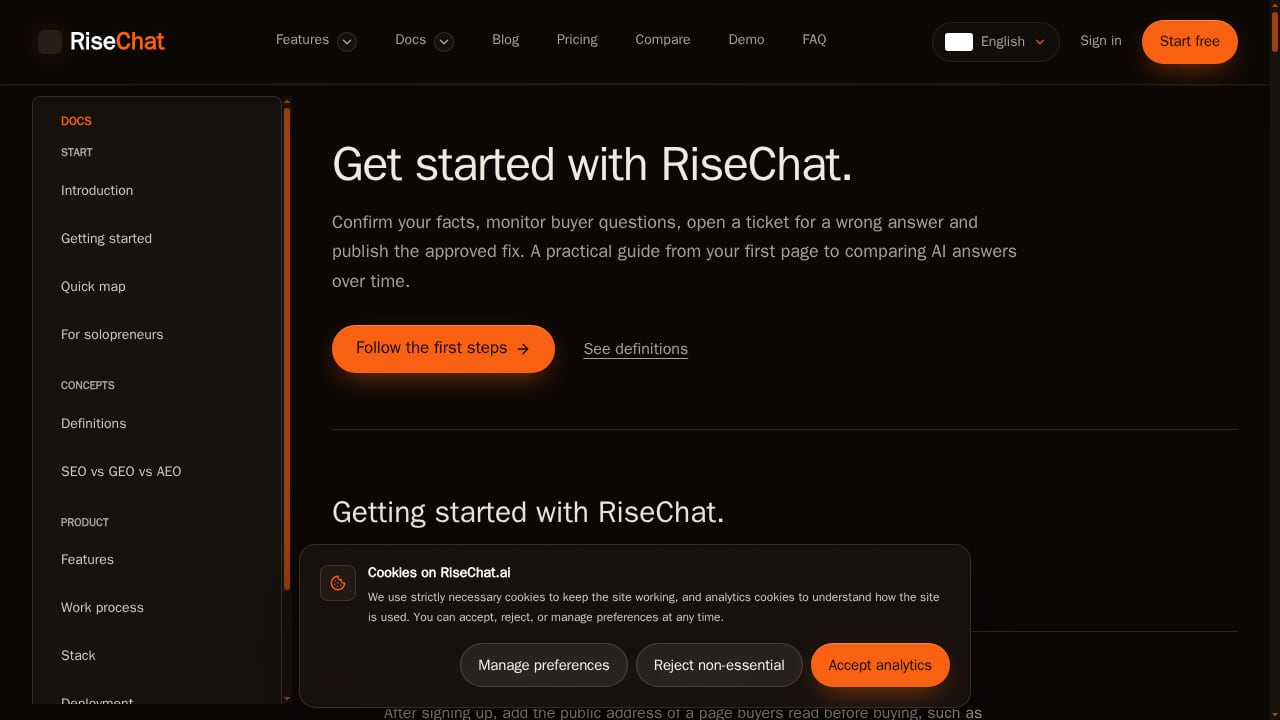
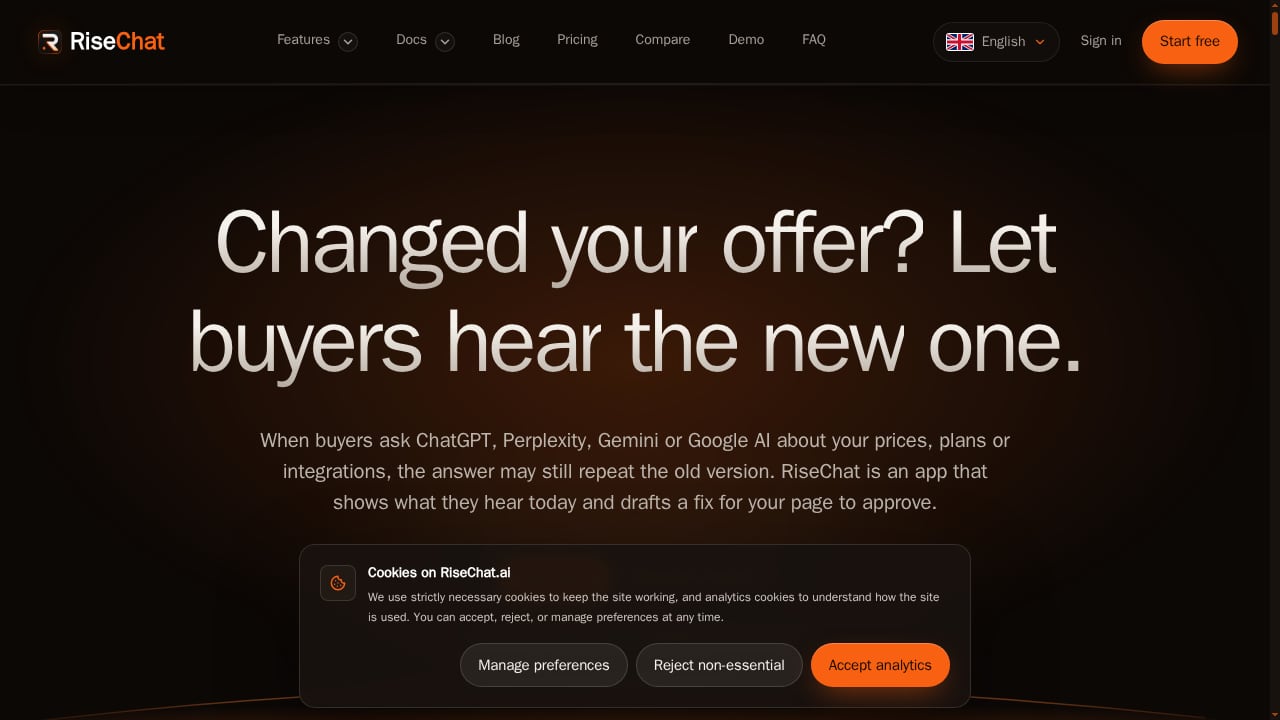
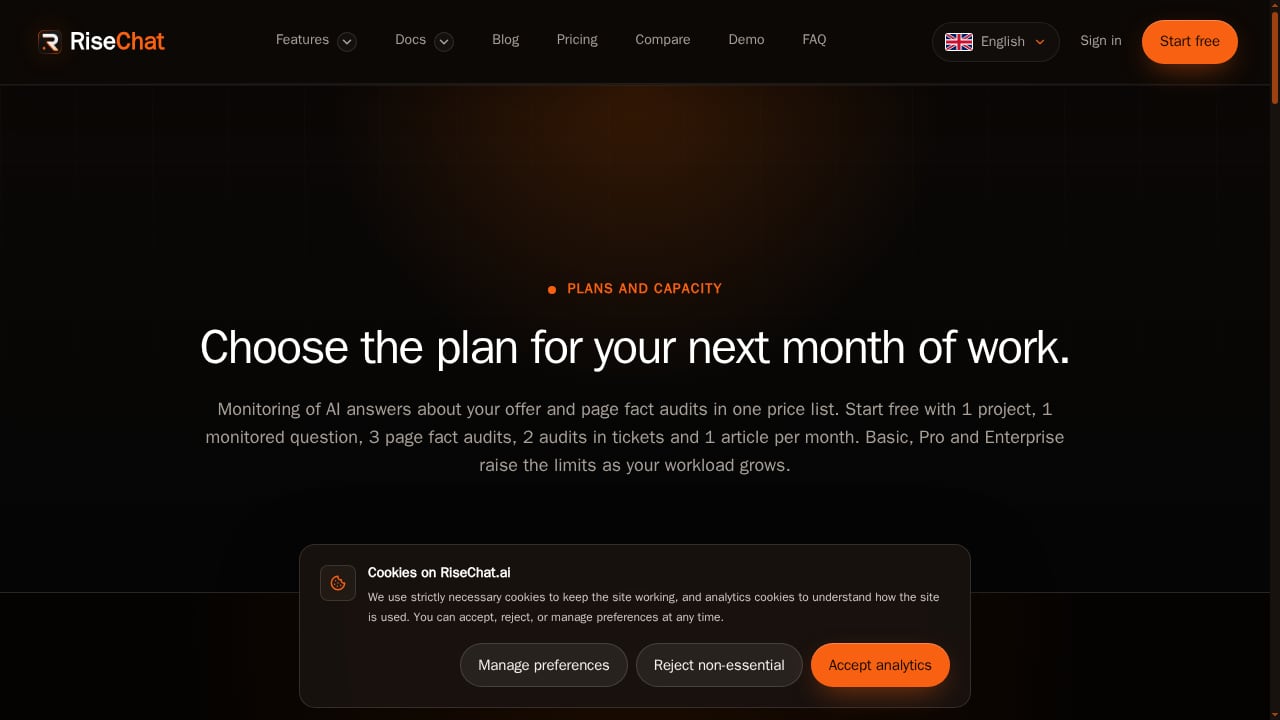
RiseChat is a SaaS application that helps businesses ensure AI assistants like ChatGPT, Perplexity, Gemini, and Google AI give accurate answers about their offers. It addresses a specific pain: outdated or incorrect information—old prices, missing integrations—appearing in AI-generated responses to buyer questions. The workflow is practical: confirm facts, monitor buyer questions across AI models, grade answers against confirmed facts, and draft page fixes for approval. It also generates articles and llms.txt files, and offers ticket-based audits.
Pricing includes a free tier and paid plans: Basic at $60/month, Pro at $185/month, and Enterprise. Limits apply to projects, monitored questions, audits, and articles. The product emphasizes an evidence-based approach, not automatic guarantees, and provides documentation and a blog covering GEO, AEO, and AI visibility topics.
Evidence: RiseChat's feature set and pricing are documented on its website. It is a strong fit for small businesses that need fact-accuracy monitoring and page-fix workflows rather than enterprise-scale prompt tracking. For teams that need broader multi-brand monitoring, a specialist GEO platform may be a better fit.
How to choose the right tool for your team
First viewport screenshot of risechat.ai.
The right choice depends on your team size, budget, and whether you need monitoring only or monitoring plus fixing.
- Solo founders and small businesses: Start with Otterly AI for low-cost tracking, or RiseChat if inaccurate AI answers about your products are the primary concern. HubSpot AEO is a good middle ground if you already use HubSpot.
- Lean marketing teams: Peec AI offers clean multi-engine data and sentiment at a mid-market price. For a deeper comparison of lean-team options, see our AskScope vs Semrush comparison for lean teams.
- SEO teams: Semrush or SE Ranking integrate AI visibility into existing workflows. Ahrefs Brand Radar is best if authority data matters.
- Agencies: Peec AI's agency plan and Scrunch's multi-platform coverage are strong, but for a workflow that connects diagnosis to action and retesting, consider AEO for agencies: scaling AI visibility without headcount.
- Enterprise: Profound and Scrunch offer the depth and engine coverage large teams need.
If you are evaluating specialist GEO platforms alongside these tools, our AskScope vs Lumar vs Superlines comparison breaks down differences in weekly monitoring and citation analysis. AskScope is a self-serve GEO platform for lean marketing teams, but it is not part of this AEO software ranking.
Related reading
- How to Use AskScope with Onclusive: GEO + PR Workflow - Learn how to combine AskScope's AI visibility monitoring with Onclusive's media intelligence to track, diagnose, and improve brand presence in AI answers.
- Answer Assurance Review: AI Answer Monitoring for Regulated Products - Evidence-based review of Answer Assurance: how it tests AI answers about regulated products, risk-rated findings, ideal users, setup, pricing signals, and limits.
Sources and further reading
- Best AEO Tools in 2026: I Ran 25 Buyer Prompts Through 10 of Them - By Ran Yosef , Founder of Arobis AI . All prices and engine coverage were checked on each vendor's pricing page on the day of publishing.
- 10 Best AI Visibility Tools for 2026 - Compare the 10 best AI visibility tools for 2026: engines covered, what each plan does beyond tracking, and monthly prices checked in November 2026.
- 10 Best AEO Software Tools for 2026 (Tested & Ranked) - The 10 best AEO software tools for improving AI visibility, tested and ranked. Find the right fit for your team and budget.
Frequently asked questions
What is the difference between AI visibility software and AEO software?
The terms overlap. AI visibility software typically focuses on monitoring how brands appear in AI-generated answers—mentions, citations, sentiment, and share of voice. AEO software often adds optimization features: audits, recommendations, content briefs, and page fixes. Many products now combine both.
Do I need a separate tool for each AI engine?
No. Most tools on this list cover multiple engines, but entry plans often limit which engines are included. Check whether ChatGPT, Google AI Overviews, Gemini, Perplexity, and Claude are covered on the plan you are considering. Some vendors charge extra for Claude or Gemini.
How many prompts should I track?
It depends on your buyer personas. A single persona might need 15–25 prompts covering comparison, pricing, and use-case questions. Most SaaS categories need three to five personas, so 50–100 prompts is a realistic starting point for a mid-market team. Entry plans with 15–25 prompts are best for testing.
Can these tools guarantee my brand will appear in AI answers?
No. These tools measure and help you improve visibility, but AI answers are probabilistic and change frequently. Tools that promise guaranteed placement should be treated with skepticism. Look for evidence-based workflows that help you fix source pages and track changes over time.
What should I do if AI answers contain outdated information about my brand?
Prioritize tools that grade answers against confirmed facts and help you draft page fixes. RiseChat, for example, is built around confirming facts, monitoring buyer questions, and drafting page fixes for approval. Scrunch also detects false claims. Once fixes are published, retest to confirm the AI answers update.
Conclusion
The AI visibility and AEO software market in 2026 offers strong options at every price point. Profound and Scrunch lead for enterprise depth, Semrush and Ahrefs are best for teams already invested in SEO suites, Peec AI and Otterly AI serve lean teams well, and RiseChat fills a specific gap for small businesses that need fact-accuracy monitoring and page-fix workflows. Choose based on your team size, the engines your buyers use, and whether you need monitoring alone or a path from diagnosis to fix.
For a broader view of how AI visibility fits into search reporting, see our Top 10 SEO rank tracking and search visibility platforms 2026.