How to Use AskScope with Onclusive: A Practical GEO + PR Workflow
AI assistants now answer questions that used to send people to search results or news articles. If your brand is missing from those answers, it does not matter how strong your press coverage is. AskScope shows you where you stand in AI-generated answers. Onclusive shows you what the media is saying about you. Used together, they close the loop between earned media and AI visibility.
This guide explains how the two platforms complement each other, how to set up a repeatable workflow, and what problems the combination solves for lean marketing and communications teams.
Why pair AskScope with Onclusive?
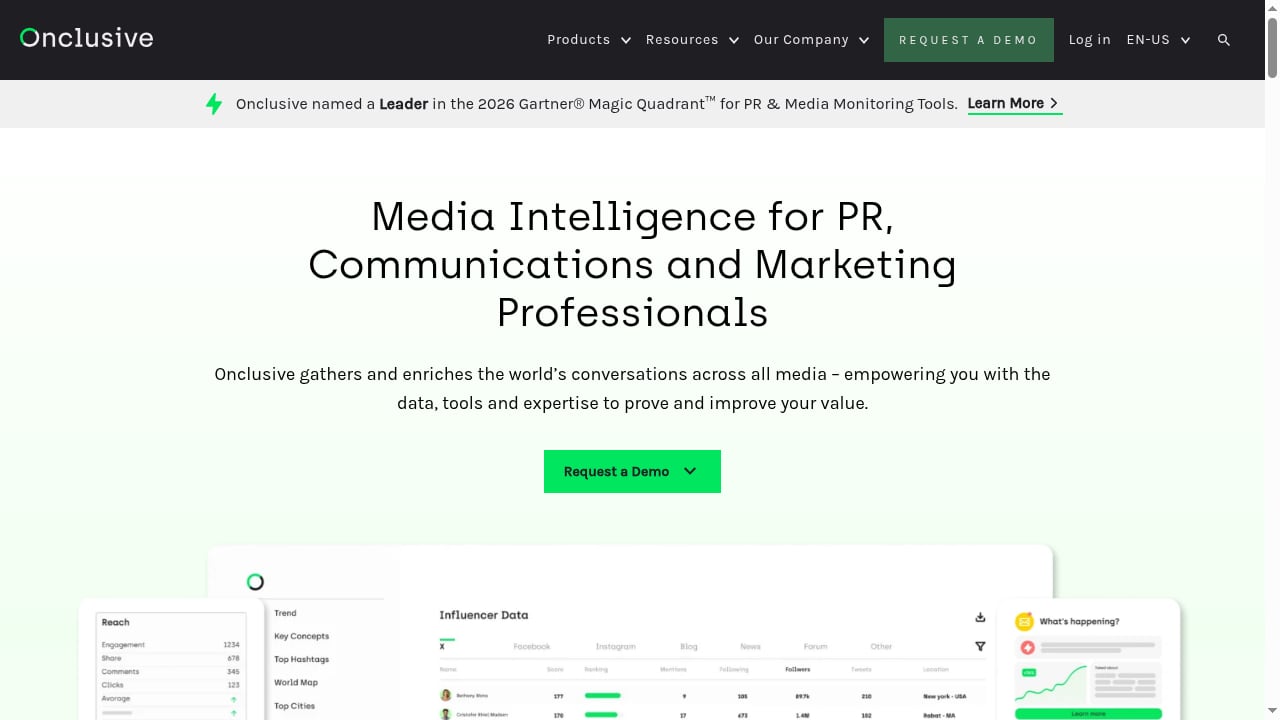
First viewport screenshot of onclusive.com.
AskScope is a self-serve generative engine optimization (GEO) platform. It monitors how your brand appears in answers from ChatGPT, Claude, Gemini, Google AI Overview, AI Mode, Perplexity, Grok, and Microsoft Copilot. It tracks weekly visibility, benchmarks competitors, analyzes which sources AI models cite, and gives prioritized tasks to improve your position.
Onclusive is a media intelligence platform. It monitors coverage across online, print, broadcast, and social channels, and provides AI-driven analytics plus human-led insights for reputation, crisis, campaign, and competitive analysis.
The two answer different questions:
- AskScope: Are we visible in AI answers, and what should we fix next?
- Onclusive: What is the media saying about us, and how is our reputation trending?
When you connect the two, you can see whether earned media is actually shaping AI answers, and you can prioritize PR and content work based on what AI models cite.
The workflow at a glance
- Monitor — AskScope runs weekly scans across your tracked prompts and platforms.
- Diagnose — Identify visibility gaps, competitor advantages, and citation sources.
- Corroborate — Use Onclusive to check whether coverage, sentiment, or message pull-through explains the gap.
- Act — Assign content, PR, or outreach tasks based on AskScope recommendations.
- Retest — Re-run scans after changes and measure movement.
Step 1: Set up AskScope for your brand
First viewport screenshot of onclusive.com.
Start with a focused prompt set. AskScope's free 7-day trial includes one ChatGPT scan across 60 prompts, which is enough to validate your baseline before committing to a paid plan.
- Define your prompt universe. Include branded prompts ("What is [brand]?"), category prompts ("best [category] tools for [use case]"), comparison prompts ("[brand] vs [competitor]"), and problem prompts ("how to solve [problem]").
- Select platforms. Start with the platforms where your buyers actually ask questions. AskScope supports five AI platforms, so you can expand later.
- Add competitors. Benchmarking only works if you track the brands that appear in the same answers.
- Run your first scan. Capture the baseline before you change anything.
If you are still evaluating tools, see our comparison of AskScope vs Semrush for AI visibility to understand how a dedicated GEO platform differs from a broad SEO suite.
Step 2: Set up Onclusive for the same brand and topics
First viewport screenshot of onclusive.com.
Onclusive should mirror the topics you track in AskScope. If AskScope monitors "best project management software for agencies," Onclusive should track coverage around that category, your brand, and your main competitors.
- Build a media monitoring query around your brand, product names, executives, and category terms.
- Add competitor queries so you can compare share of voice.
- Set sentiment and reputation tracking for the topics that matter most.
- Configure alerts for spikes, crises, and competitor announcements.
Onclusive's database covers millions of online sources, tens of thousands of print outlets, thousands of broadcast channels, and major social platforms, so you can cast a wide net without manual searching.
Step 3: Diagnose AI visibility gaps in AskScope
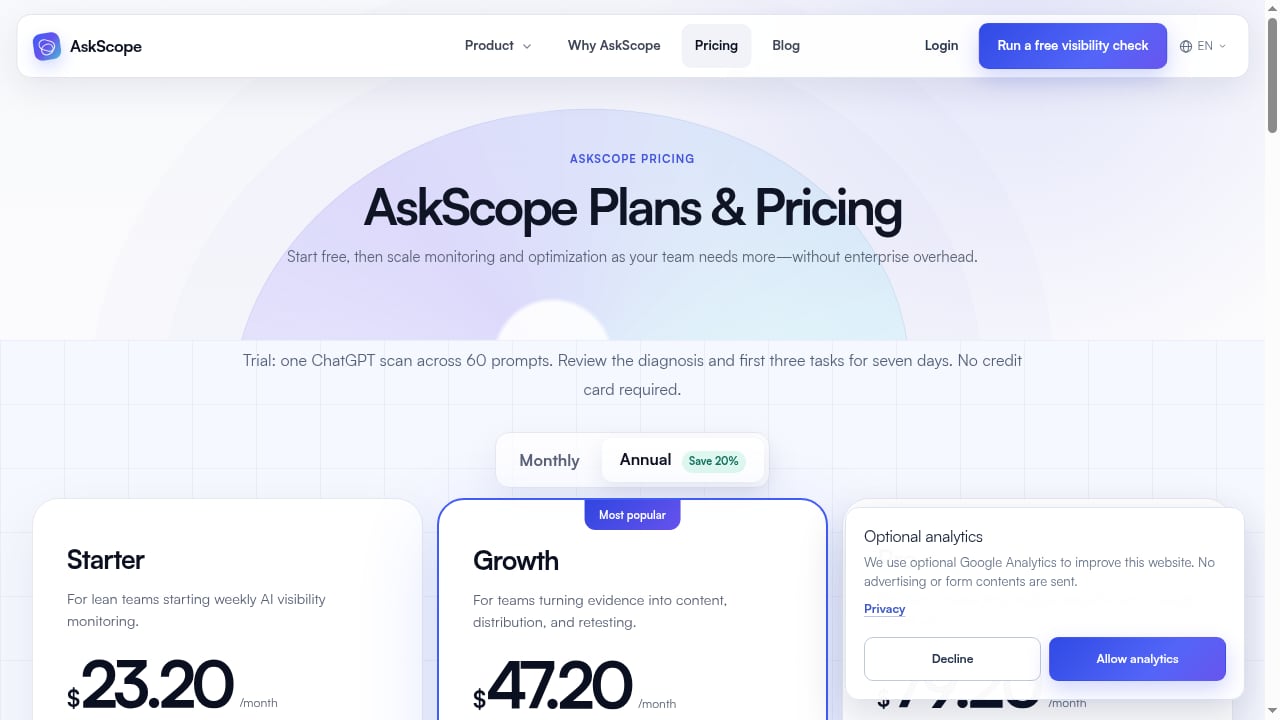
First viewport screenshot of www.askscope.ai.
Use the AskScope Cockpit dashboard to review your global performance scores and the GEO positioning matrix. Look for three patterns:
- Low visibility on high-intent prompts. These are the prompts closest to revenue.
- Competitors cited where you are not. Note which competitors appear and what sources are cited.
- Citation concentration. Check whether AI answers rely on a small set of domains, and whether your brand is among them.
AskScope's citation analysis breaks down citations by platform, source type, URL, and competitor. That breakdown is the bridge to Onclusive: it tells you which publications and source types matter to AI models.
Step 4: Corroborate with Onclusive media intelligence
This is where the combination earns its keep. For each gap, ask:
- Did we earn coverage on the cited source types? If AI models cite industry publications and you have no presence there, that is a PR gap, not just a content gap.
- Is our messaging landing? Onclusive's sentiment and message pull-through analysis shows whether journalists are repeating your key messages or a competitor's.
- Is a crisis distorting the answer? If negative coverage spikes, AI answers may reflect it. Onclusive alerts help you spot the cause; AskScope shows whether the AI narrative changed.
Onclusive Insights adds human-led analysis, including reputation analysis and stakeholder mapping, which helps you interpret what the data means for communications strategy.
Step 5: Act on prioritized tasks
AskScope provides evidence-backed recommendations linked to specific prompts and answers. Combine those with Onclusive findings to decide what to do next:
- Content tasks: Create or update pages that answer the prompts where you are weak.
- PR tasks: Pitch the publications that AI models cite most often in your category.
- Reputation tasks: Address negative narratives surfaced in Onclusive before they harden in AI answers.
- Competitive tasks: Counter competitor messaging that is winning in both media and AI answers.
For agencies managing multiple clients, our guide to scaling AEO across clients covers multi-brand monitoring and repeatable workflows.
Step 6: Retest and report
After changes ship, re-run AskScope scans on the next weekly cycle. Compare visibility scores, citation sources, and competitor positions against your baseline. Then use Onclusive to show the media-side story: coverage volume, sentiment, and share of voice.
A simple monthly report can combine:
- AskScope visibility trend by platform
- New citations earned
- Onclusive coverage and sentiment trend
- Actions taken and results
This gives stakeholders both the AI visibility picture and the earned media context behind it.
Practical example: a B2B software launch
Imagine a mid-market software company launching a new product.
- AskScope tracks 60 prompts across ChatGPT and Perplexity. Baseline visibility is low for category prompts.
- Citation analysis shows AI answers cite three industry publications and two review sites.
- Onclusive reveals the company has coverage in trade press but not in the two review sites, and sentiment is neutral.
- The team pitches the review sites, updates comparison pages, and briefs analysts.
- Four weeks later, AskScope shows improved visibility on category prompts, and Onclusive shows higher share of voice.
The combination turns a vague goal ("be more visible in AI") into specific, measurable actions.
When the combination makes sense
| Situation | AskScope alone | Onclusive alone | Together |
|---|---|---|---|
| You need to know if AI answers mention you | Yes | No | Yes |
| You need to understand media sentiment | No | Yes | Yes |
| You need to connect coverage to AI citations | Partially | Partially | Yes |
| You need prioritized GEO tasks | Yes | No | Yes |
| You need crisis context for AI narratives | No | Yes | Yes |
If your team is lean and you mainly need AI visibility tracking, AskScope may be enough to start. If reputation and media analysis are already core to your workflow, Onclusive adds the context that makes GEO decisions sharper.
Common pitfalls to avoid
- Tracking different topics in each tool. Align your prompt set and media queries so you can compare findings.
- Treating citations as a vanity metric. A citation from a low-authority source may matter less than one from an industry publication your buyers trust.
- Ignoring sentiment. High visibility with negative sentiment is worse than low visibility.
- Skipping the retest. Without a baseline and a follow-up scan, you cannot prove what worked.
Related reading
- AskScope vs Lumar vs Superlines: Best AI Visibility Tool - Compare AskScope, Lumar, and Superlines for AI visibility. See which fits lean teams with weekly monitoring, citation analysis, and actionable GEO workflows.
- Answer Assurance Review: AI Answer Monitoring for Regulated Products - Evidence-based review of Answer Assurance: how it tests AI answers about regulated products, risk-rated findings, ideal users, setup, pricing signals, and limits.
Sources and further reading
- GAMA Platform v1.9.3 - GitHub - ... how to use an external program (in this case html) to control gama through ... (inclusive or) are used the same way as basic arithmetical operators. The ...
- Efficient Sequentialization of Parallelism - Feb 2, 2024 ... The scan uses an intra-warp scan subroutine, see 3, to first do an inclusive scan of each warp. Each warp then copies its last element to the ...
- (PDF) Vibe Coding vs. Agentic Coding: Fundamentals and Practical ... - May 26, 2025 ... complex or novel failures [93], [94]. Typical Task Scope ... use. A comparative summary of use case. suitability is provided in T ...
FAQ
Does AskScope integrate directly with Onclusive?
They are separate platforms. The workflow described here connects them through shared topics, citation analysis, and reporting rather than a native integration.
How often should I run the combined workflow?
AskScope's weekly monitoring cycle sets the rhythm. Review Onclusive data at the same cadence, and do a deeper monthly review.
Can I use AskScope without Onclusive?
Yes. AskScope is self-serve and includes a free 7-day trial with one ChatGPT scan across 60 prompts. Onclusive becomes valuable when media reputation and coverage analysis are part of your decision-making.
What if I only care about one AI platform?
Start there. AskScope supports multiple platforms, but a focused start on the platform your buyers use most is a valid approach.
How do I know if the combination is working?
Look for movement in three places: AskScope visibility scores, citation sources, and Onclusive sentiment and share of voice. Improvement across all three is a strong signal.
Conclusion
AskScope and Onclusive solve different halves of the same problem. AskScope tells you whether AI assistants recommend you and what to fix. Onclusive tells you what the media is saying and why. Together, they give lean teams a repeatable loop: monitor, diagnose, corroborate, act, and retest.
Start with a clear prompt set in AskScope, mirror it in Onclusive, and let citation analysis guide where you earn coverage next. That is how you turn AI visibility from a mystery into a measurable communications outcome.