Top 10 SEO Rank Tracking and Search Visibility Platforms 2026
Search visibility in 2026 is no longer just a list of blue-link positions. Google AI Overviews, ChatGPT, Perplexity, and Gemini now answer questions before users click, so the best rank trackers must measure both classic SERP rankings and whether your brand appears inside AI-generated answers. This guide ranks ten platforms that genuinely belong to the SEO rank tracking and search visibility category, explains how each was evaluated, and helps you choose based on team size, budget, and reporting needs.
How We Evaluated These Platforms
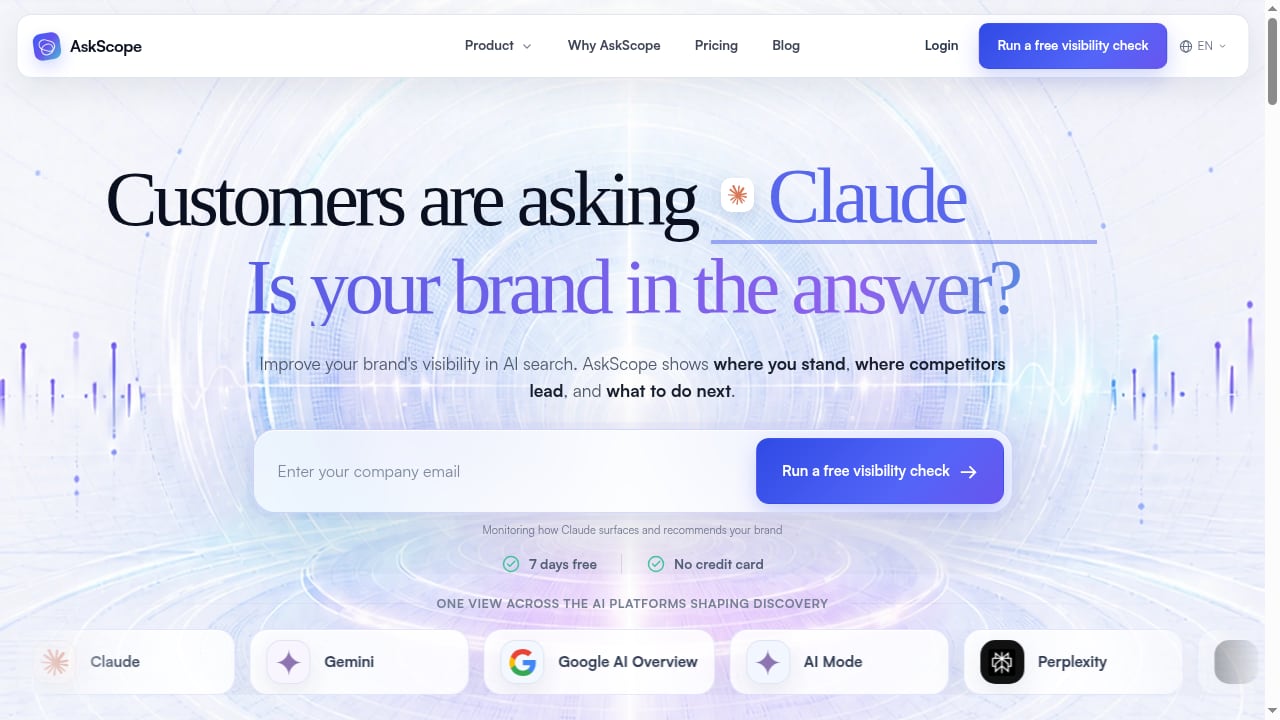
First viewport screenshot of www.askscope.ai.
We scored each product on six criteria, using vendor documentation, published pricing, and independent reviews from Conductor, Rankability, and HubSpot.
- SERP accuracy and freshness: How reliably the tool captures desktop, mobile, and local rankings.
- AI visibility coverage: Whether it tracks AI Overviews, AI Mode, ChatGPT, Perplexity, Gemini, and similar surfaces.
- Reporting and client readiness: White-label reports, scheduled exports, and stakeholder-friendly dashboards.
- Competitor and share-of-voice analysis: Ability to benchmark against rivals across keywords and AI answers.
- Workflow depth: Keyword research, forecasting, alerts, and integrations that turn data into action.
- Pricing transparency and value: Published plans, trial availability, and fit for agencies versus enterprises.
The Top 10 SEO Rank Tracking and Search Visibility Platforms
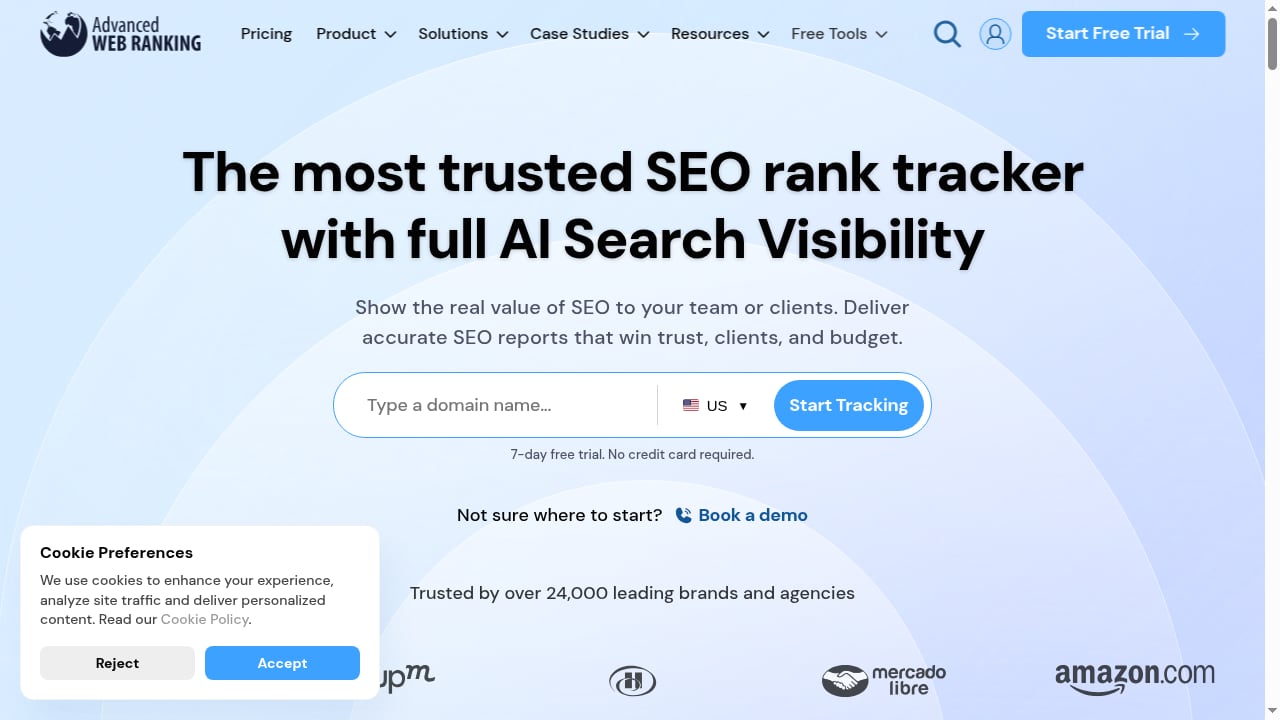
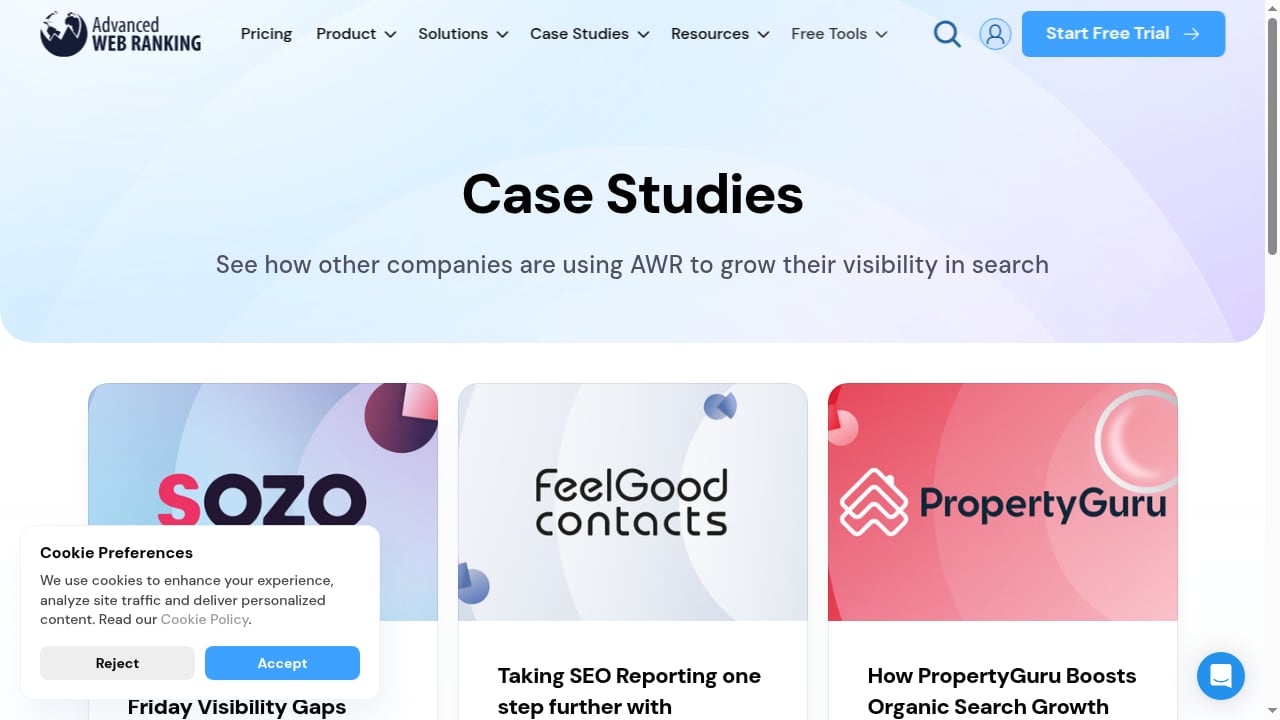
First viewport screenshot of www.advancedwebranking.com.
1. Advanced Web Ranking (AWR)
Best for: Agencies, enterprise SEO teams, and consultants that need proven SERP accuracy plus AI search visibility.
Advanced Web Ranking combines more than 20 years of SERP tracking with newer AI brand intelligence and AI visibility tracking. It covers rank tracking, SEO reporting, competitor analysis, SEO forecasting, and keyword research in one platform. The 7-day free trial requires no credit card, and a 30-day money-back guarantee lowers the risk for teams switching tools. Published case studies with agencies such as Search Influence and brands like PropertyGuru and FeelGood Contacts report outcomes including a 30% organic traffic increase and stronger local SEO performance. For teams that need to prove ROI to clients, AWR's reporting and forecasting features are a strong fit.
2. Semrush
Best for: Teams already using Semrush for keyword research and competitive analysis who want AI visibility added to an existing workflow.
Semrush remains one of the broadest SEO suites, and its AI visibility features extend traditional rank tracking into AI Overviews and ChatGPT-style answers. The trade-off is that AI data sits inside a large report library, so teams may need time to configure dashboards. Entry pricing starts around $139.95 per month according to Conductor's 2026 review. For a deeper cost breakdown, see our Semrush review 2026.
3. SE Ranking
Best for: Agencies that want hybrid SEO rank tracking with AI Overviews monitoring inside a familiar suite.
SE Ranking pairs traditional keyword tracking with AI Overviews and AI Mode monitoring. Its Essential plan starts around $65 per month, making it accessible for small agencies. The AI tracking depth is lighter than purpose-built generative search platforms, but the familiar interface reduces training time for teams already managing multiple client projects.
4. Rankability
Best for: Agencies that want a single visibility score across traditional search, local pack, AI answers, citations, and video.
Rankability's Search Performance Index (SPI) rolls multiple visibility signals into one number, which helps account managers explain performance to executives. Plans start at $97 per month and include unlimited client workspaces. The platform tracks ChatGPT, Gemini, Claude, Perplexity, Copilot, Grok, and DeepSeek alongside Google rankings, making it a strong choice for agencies standardizing AI reporting.
5. Profound
Best for: Enterprise teams focused on citation tracking and competitive benchmarking across AI engines.
Profound specializes in generative search analytics, with coverage across ChatGPT, Gemini, Perplexity, Google AI Overviews, Google AI Mode, and Copilot. Pricing is custom, which suits larger organizations with dedicated analytics resources. It is less focused on traditional keyword rank tracking, so it works best as a complement to a core SEO platform rather than a replacement.
6. Otterly.AI
Best for: Budget-conscious agencies and mid-market teams that need citation analysis.
Otterly.AI tracks brand mentions and citations across ChatGPT, Gemini, Perplexity, Google AI Overviews, Google AI Mode, and Copilot. Starting at $29 per month, it is one of the more affordable entry points for AI visibility monitoring. It does not replace a full rank tracker, but it is useful for teams adding AI citation checks to an existing SEO stack.
7. Keyword.com
Best for: Agencies that want straightforward LLM tracking alongside Google SERP rankings.
Keyword.com offers AI visibility tracking across nine engines, including ChatGPT, Perplexity, Gemini, Google AI Overviews, Google AI Mode, Claude, Copilot, Mistral, and DeepSeek. Its AI Visibility plan starts at $39 per month billed annually, and the platform supports multi-project organization for agency workflows. Setup is relatively simple, which helps teams that want fewer configuration steps.
8. Peec AI
Best for: Teams that need operational monitoring cadence for ongoing AI programs.
Peec AI focuses on tracking brand presence across ChatGPT, Google AI Overviews, Copilot, Perplexity, Gemini, and Claude. Pricing is custom, and the platform is built for teams running continuous AI visibility programs rather than one-off audits. It is a good fit for organizations that already have a content operations workflow and need regular measurement.
9. Rankscale
Best for: Teams that prioritize evidence trails and geographic coverage across many AI engines.
Rankscale tracks more than 17 AI engines with worldwide geographic coverage, starting at around €20 per month. The emphasis on reproducibility and evidence trails helps teams defend visibility changes in client meetings. It is a practical option for consultants who need broad engine coverage without enterprise pricing.
10. LLMrefs
Best for: Simple generative AI search analytics with geo-targeting across many countries.
LLMrefs offers generative AI search analytics with geo-targeting across 50+ countries and unlimited domains and seats on its All in One plan at $79 per month. It is less focused on traditional rank tracking, so it works best for teams that already have a core SEO rank tracker and want a dedicated AI visibility layer.
Comparison Table: Which Platform Fits Your Team?
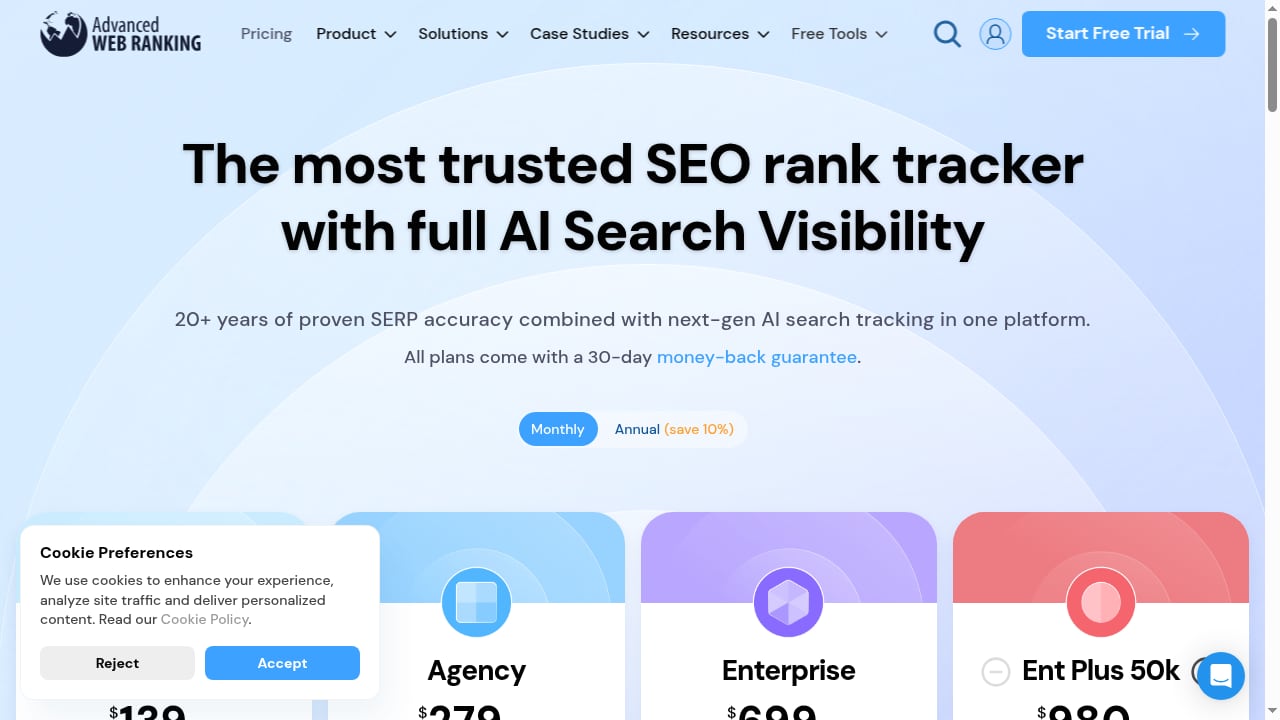
First viewport screenshot of www.advancedwebranking.com.
| Platform | Best for | Starting price | AI engine coverage | Traditional rank tracking |
|---|---|---|---|---|
| Advanced Web Ranking | Agencies and enterprises needing accuracy + AI visibility | Free trial; paid plans | AI brand intelligence and AI visibility tracking | Yes, with 20+ years of SERP data |
| Semrush | Existing Semrush users | ~$139.95/mo | Google AIO, ChatGPT | Yes |
| SE Ranking | Hybrid SEO + AI Overviews | ~$65/mo | AI Overviews, AI Mode | Yes |
| Rankability | Unified visibility score | $97/mo | ChatGPT, Gemini, Claude, Perplexity, Copilot, Grok, DeepSeek | Yes |
| Profound | Enterprise citation benchmarking | Custom | ChatGPT, Gemini, Perplexity, Google AIO, AI Mode, Copilot | Limited |
| Otterly.AI | Budget citation analysis | $29/mo | ChatGPT, Gemini, Perplexity, Google AIO, AI Mode, Copilot | No |
| Keyword.com | Simple LLM + SERP tracking | $39/mo (annual) | Nine engines including AIO and AI Mode | Yes |
| Peec AI | Ongoing AI monitoring | Custom | ChatGPT, Google AIO, Copilot, Perplexity, Gemini, Claude | No |
| Rankscale | Evidence trails and geo coverage | ~€20/mo | 17+ engines | Limited |
| LLMrefs | Geo-targeted AI analytics | $79/mo | Generative AI search analytics | No |
How to Choose the Right Rank Tracking Platform
First viewport screenshot of www.advancedwebranking.com.
Start with your reporting obligation. If clients expect traditional keyword rankings alongside AI citations, choose a platform like Advanced Web Ranking or Rankability that combines both. If your team already lives inside Semrush or SE Ranking, adding AI visibility to that suite may be more efficient than buying a separate tool.
Next, consider engine coverage. Agencies managing global clients should check whether the platform tracks AI answers in the markets they serve. Rankscale and LLMrefs offer broad geographic coverage, while Otterly.AI and Keyword.com are simpler starting points.
Finally, evaluate workflow. Rank tracking data is only useful if it leads to action. Platforms with forecasting, alerts, and client-ready reports reduce manual work. For teams that also need a dedicated generative engine optimization workflow, a complementary tool like AskScope can help monitor AI answers weekly and turn citation gaps into prioritized tasks. Our GEO blog for marketers explains how to build that repeatable process.
Related reading
- How to Use AskScope with Squarespace: GEO Workflow - Learn how to connect AskScope with Squarespace to monitor AI visibility, find citation gaps, and fix pages so your brand appears in AI answers.
- AskScope vs AI Search Visibility Platform vs Qvery - Compare AskScope, AI Search Visibility Platform, and Qvery for AI search visibility. See strengths, gaps, and which fits lean marketing teams.
- AskScope vs Rank Prompt: AI Visibility Platform Comparison - Compare AskScope and Rank Prompt for AI visibility tracking. See which GEO platform fits lean teams with weekly monitoring, citation analysis, and actionable workflows.
Frequently Asked Questions
What is the difference between SEO rank tracking and search visibility platforms?
SEO rank tracking platforms monitor keyword positions in traditional search results. Search visibility platforms broaden that scope to include SERP features, local packs, and AI-generated answers. Many 2026 tools combine both.
Do I still need traditional rank tracking if I track AI visibility?
Yes. Traditional rankings still drive significant traffic and provide a baseline for measuring AI impact. Most teams should track both rather than replacing one with the other.
Which platform is best for small agencies?
Otterly.AI and Keyword.com offer lower entry prices, while Advanced Web Ranking provides a free trial and a 30-day money-back guarantee for teams that want to test accuracy before committing.
How often should I check AI visibility?
Weekly monitoring is a practical cadence for most teams. AI answers change frequently, so monthly checks can miss shifts in citations and competitor mentions.
Can I use a GEO tool alongside a rank tracker?
Yes. A dedicated GEO platform like AskScope can complement a rank tracker by focusing on AI answer monitoring, citation analysis, and optimization tasks. See our Top 10 AI search visibility and brand monitoring tools 2026 for adjacent options.
Conclusion
The best SEO rank tracking and search visibility platform in 2026 depends on whether you need proven SERP accuracy, AI answer coverage, or both. Advanced Web Ranking leads this list for combining long-standing rank tracking with AI brand intelligence and client-ready reporting. Semrush and SE Ranking suit teams already invested in those ecosystems, while Rankability, Profound, and Otterly.AI offer specialized AI visibility depth. Evaluate your reporting obligations, engine coverage, and workflow needs before choosing, and consider a complementary GEO tool like AskScope if AI answer optimization becomes a core priority.