Topify AI Search Visibility Platform Review: What It Does and Who It Fits
Generative engine optimization (GEO) tools promise to show how your brand appears inside AI answers. Topify is one of the more visible entrants in that category, positioning itself as a platform to monitor mentions, citations, and competitors across ChatGPT, Gemini, Perplexity, and Google's AI Overviews. This review examines what Topify actually offers, where it fits, and what to verify before committing.
What Topify Is
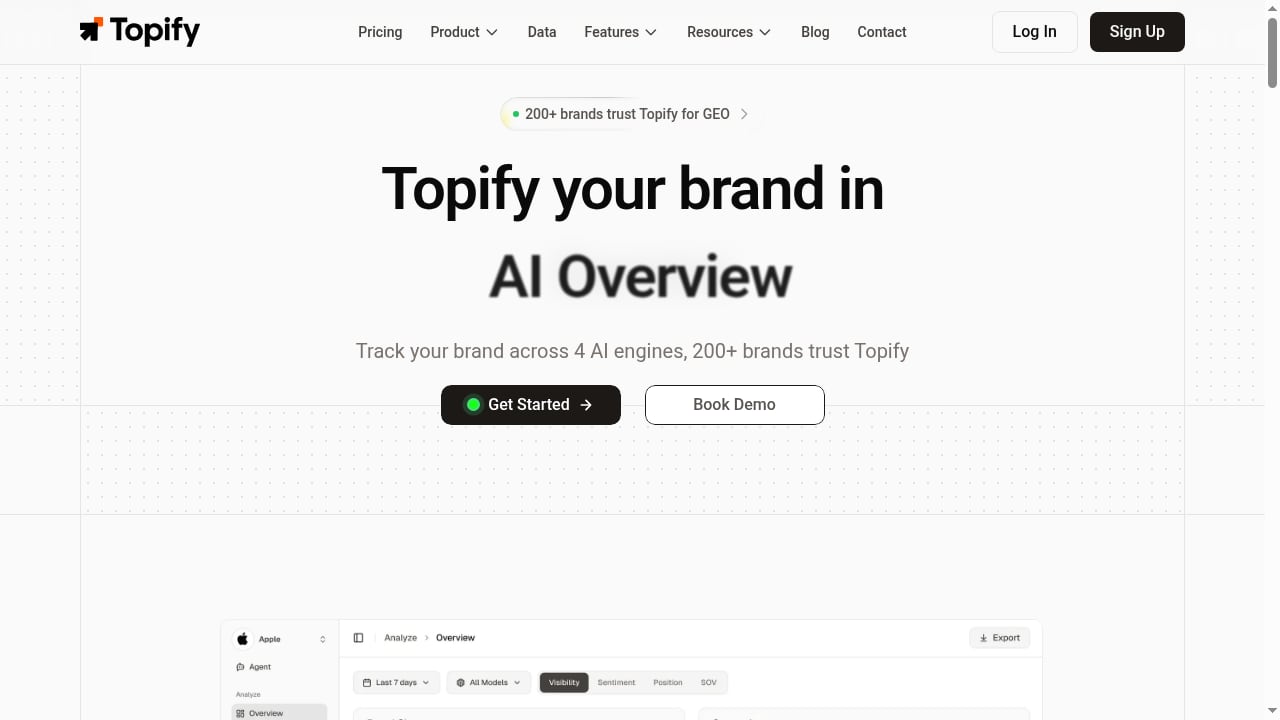
First viewport screenshot of topify.ai.
Topify is a software platform for tracking brand visibility in AI-generated answers. Rather than measuring traditional search rankings, it queries large language models with prompts and records whether your brand appears, what sources are cited, and how competitors show up in the same responses.
The product context describes four core capabilities:
- Mention monitoring across ChatGPT, Gemini, Perplexity, and AI Overviews
- Citation analysis to see which sources AI models reference
- Competitor tracking within the same prompt sets
- Prompt discovery to identify questions relevant to your category
This aligns with how external observers describe the tool. A Reddit discussion in r/DigitalMarketing notes that Topify "systematically checks your brand presence across ChatGPT, Gemini, Perplexity etc for different query variations" and calls it "the closest thing to actual visibility data you can get without being OpenAI." That framing is useful: no external tool has direct access to model internals, so every platform in this space works by repeatedly querying models and recording outputs.
Who Topify Is For
Topify fits teams that already understand traditional SEO but need a repeatable way to observe AI answer surfaces. Based on the product's stated focus and third-party commentary, the strongest fits are:
- Brand and content marketers who need to know whether their pages are being cited in AI answers
- SEO teams expanding into GEO and looking for a dedicated monitoring layer alongside existing rank trackers
- Agencies managing multiple brands that need prompt-level visibility reporting
- Competitive intelligence teams tracking share of voice in AI responses
It is less suited to teams looking for a pure technical SEO crawler or a JavaScript error diagnostic tool. As the company's own review page puts it, if you need to fix JavaScript errors, Topify is not the right product.
Core Use Cases
First viewport screenshot of topify.ai.
Monitoring brand mentions across engines
The primary workflow is straightforward: define prompts that reflect how buyers ask questions, run them across supported engines, and review where your brand appears. This is useful for spotting gaps, such as a competitor being recommended for a query where your brand is absent.
Analyzing citation sources
Topify surfaces which domains and pages AI models cite. This helps content teams understand whether their own pages are being referenced or whether third-party sources dominate. Citation analysis is more actionable than mention counts alone because it points to specific pages that may need updating or reinforcement.
Competitor benchmarking
By tracking the same prompts for multiple brands, Topify shows relative visibility. This is valuable for reporting to stakeholders who want to know not just whether the brand appears, but how often it appears compared to named competitors.
Prompt discovery
Identifying the questions worth tracking is often the hardest part of GEO. Topify's prompt discovery feature helps surface relevant queries, though the quality of suggestions should be tested against your own customer research.
Strengths
Focused on AI surfaces rather than retrofitted from traditional SEO. Topify was built for AI answer monitoring, not adapted from a rank tracker. That shows in its emphasis on citations and prompt-level analysis.
Multi-engine coverage. Tracking across ChatGPT, Gemini, Perplexity, and AI Overviews covers the major surfaces where buyers encounter AI-generated recommendations.
Actionable citation data. Knowing which sources are cited gives content teams a concrete starting point for improvement, rather than just a visibility score.
Competitive context. Side-by-side brand tracking makes the data easier to interpret and report.
Limitations and What to Verify
First viewport screenshot of topify.ai.
No tool has direct model access. Every external GEO platform, including Topify, infers visibility by querying models. Results can vary by time, location, and phrasing. Treat any single data point as a sample, not ground truth. The Reddit commenter makes this point directly: "Just don't expect the same level of data precision you get from traditional SEO tools."
Prompt design drives everything. If your tracked prompts do not match real buyer questions, the visibility data will be misleading. Budget time for prompt research and refinement.
Mention is not citation. A brand can appear in an answer without a link to its site. When evaluating Topify or any alternative, confirm whether reports distinguish between mentions and cited URLs, and whether they show exact pages or only domains.
Execution features need scrutiny. Topify's site lists content execution capabilities alongside monitoring. As an independent comparison on SEOGrove advises, do not assume the platform is limited to a basic mention counter, but also verify how much of the content workflow you actually need versus what you will do in your existing CMS.
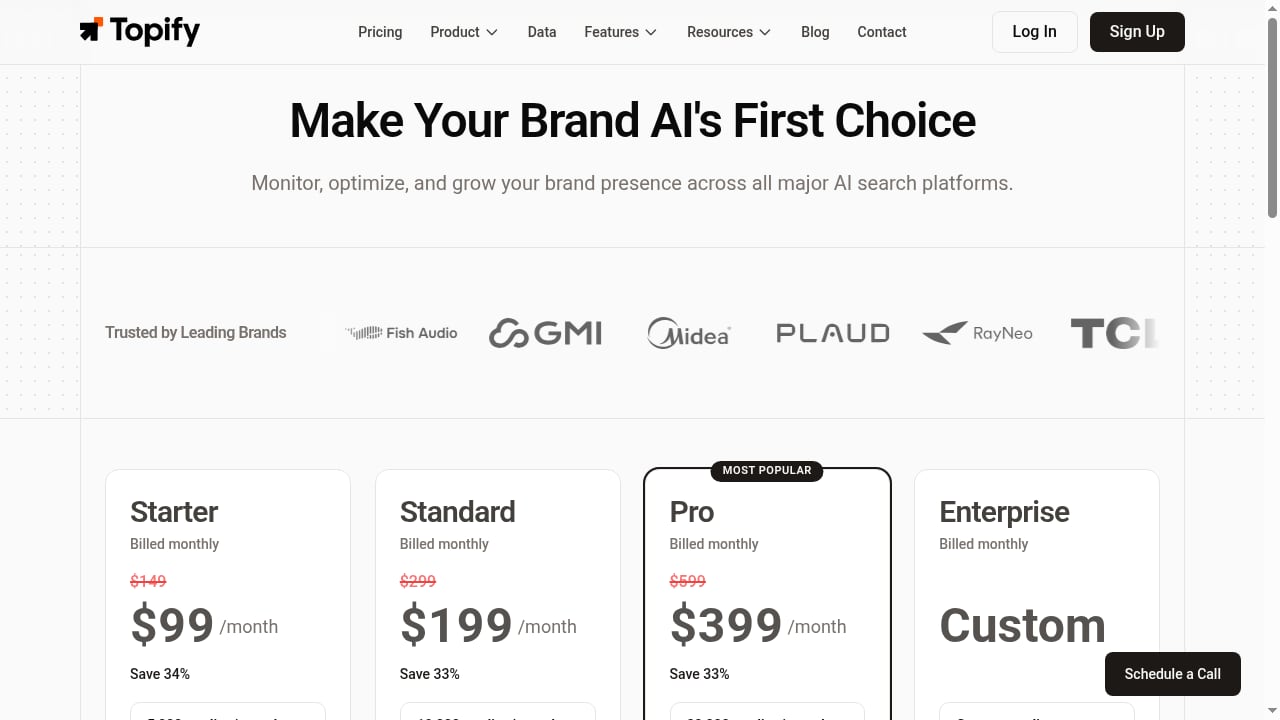
Pricing transparency. Topify offers a 30-day free trial according to its site. Published plan details should be checked directly, since AI visibility plans often vary by number of prompts, engines, projects, and history depth. For a broader view of how AI visibility tool pricing is structured, see this guide to AI customer journey platform pricing.
Setup and First Steps
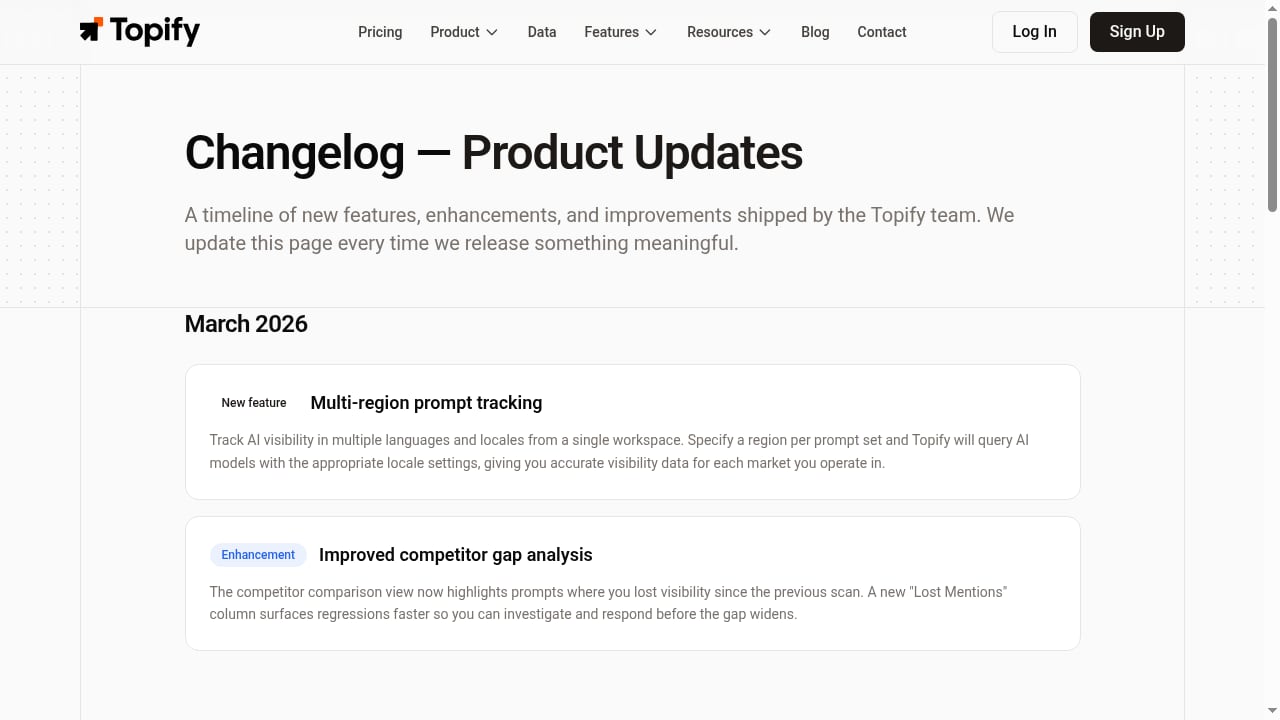
First viewport screenshot of topify.ai.
A practical onboarding sequence for Topify looks like this:
- Define a starter prompt set. Use 20–30 questions your buyers actually ask, drawn from sales calls, support tickets, and search data.
- Connect your brand and competitors. Add the brands you want to benchmark against.
- Run an initial baseline. Record results with engine, date, and location so you can compare later.
- Review citations. Identify which domains are cited for your priority prompts and whether your pages appear.
- Assign an owner. Decide who reviews findings and who updates content. A report without an action owner rarely changes outcomes.
For teams comparing tools, a structured evaluation helps. This ranking of AI visibility and answer engine optimization software scores products on prompt tracking, citation analysis, actionability, and value.
Topify vs Alternatives: Decision Criteria
Topify is not the only option, and the right choice depends on your workflow. Based on published positioning from SEOGrove's comparison and the Reddit discussion, here is how to think about the decision:
| Criterion | What to check |
|---|---|
| Engine coverage | Which models and surfaces are supported, and how often results refresh |
| Citation detail | Domain-level only, or exact page URLs |
| Prompt limits | How many prompts per project and whether historical data is included |
| Workflow fit | Does the tool connect findings to content updates, or is it monitoring only? |
| Reporting | Can you export or share reports with stakeholders? |
| Price per prompt | Compare total cost at your expected prompt volume |
If your team already runs Semrush for traditional SEO, a common pattern is to pair it with a dedicated AI visibility tool. The Reddit commenter describes exactly this setup: "Topify for AI search visibility + Semrush for traditional SEO." For a closer look at that pairing, see AskScope vs Semrush: AI visibility for lean teams.
If content execution is your priority, tools that connect monitoring to publishing may fit better. SEOGrove's comparison positions itself around content workflow, Ahrefs Brand Radar around research alongside an established SEO toolkit, and LLMrefs around keyword-based monitoring. Each has different strengths; the question is which matches your team's process.
Pricing Signals
Topify's site promotes a 30-day free trial, which is a reasonable way to test prompt coverage and citation detail before committing. Public pricing details should be verified directly with the vendor, as plans in this category typically scale by prompts, engines, projects, and data history. When comparing, calculate cost per tracked prompt rather than headline plan price, since prompt volume is the main driver of value.
Related reading
- How to Use AskScope with Onclusive: GEO + PR Workflow - Learn how to combine AskScope's AI visibility monitoring with Onclusive's media intelligence to track, diagnose, and improve brand presence in AI answers.
- AskScope vs Lumar vs Superlines: Best AI Visibility Tool - Compare AskScope, Lumar, and Superlines for AI visibility. See which fits lean teams with weekly monitoring, citation analysis, and actionable GEO workflows.
Sources and further reading
- Topify AI Review Search Visibility Platform - Topify is the Silicon Valley pioneer of GEO. We are the growth engine for brands in the AI era, ensuring your content dominates AI search and recommendations.
- The heart of the internet - Yeah semrush's AI tracking is pretty limited honestly. The core issue is that their approach was built for traditional search, massive crawler networks monitoring internet traffic. That works great for Google rankings but AI search is fundamentally different.
- Topify Alternatives for AI Visibility Tracking - Compare Topify alternatives including SEOGrove, Ahrefs Brand Radar and LLMrefs. Check citation sources, monitoring needs and the work behind each report.
FAQ
Does Topify track AI Overviews?
Yes. The product context lists Google's AI Overviews alongside ChatGPT, Gemini, and Perplexity as supported surfaces.
Can Topify show which pages are cited, not just domains?
Citation analysis is a stated feature, but the level of detail (domain vs. exact URL) should be confirmed during a trial, as this varies by plan and tool.
Is Topify a replacement for traditional SEO tools?
No. It monitors AI answer visibility, not classic rankings, backlinks, or technical crawl issues. Most teams pair it with an existing SEO platform.
How accurate is AI visibility data?
No external tool has direct access to model internals. Accuracy depends on prompt design, query frequency, and how results are sampled. Treat the data as directional and validate with repeated runs.
Does Topify offer a free trial?
Yes, the company advertises a 30-day free trial. Check current terms on the vendor's site.
Conclusion
Topify is a credible option for teams that need structured visibility into AI answers. Its focus on mentions, citations, and competitor benchmarking across major engines aligns with what GEO practitioners actually need. The main caveats are inherent to the category: results are sampled, prompt design determines usefulness, and citation detail should be verified before purchase.
For teams building a GEO stack, Topify is worth a trial alongside alternatives. Compare it on prompt limits, citation granularity, and workflow fit, then decide based on the questions you need to answer and who will act on the findings. For agencies scaling this work across clients, see AEO for agencies: scale AI visibility without headcount.