Answer Assurance Review: AI Answer Monitoring for Regulated Products
When a customer asks an AI assistant whether a drug interacts with a supplement, or a clinician asks a chatbot about a device's contraindications, the answer arrives without a label, a disclaimer, or a review trail. Answer Assurance exists to close that gap: it tests what AI tools say about regulated products and turns the results into risk-rated findings that QA, regulatory affairs, product, and support teams can act on. This review examines what the platform does well, where it falls short, who should consider it, and how to decide whether it belongs in your monitoring stack.
What Answer Assurance actually does
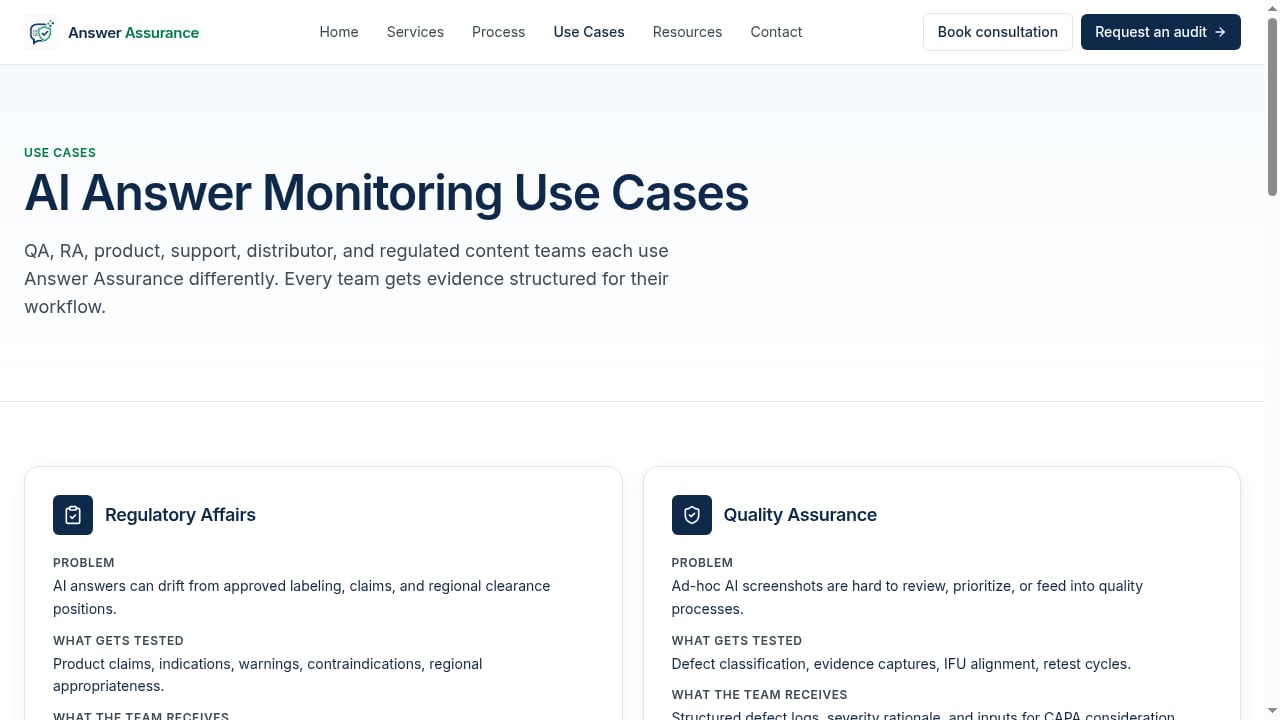
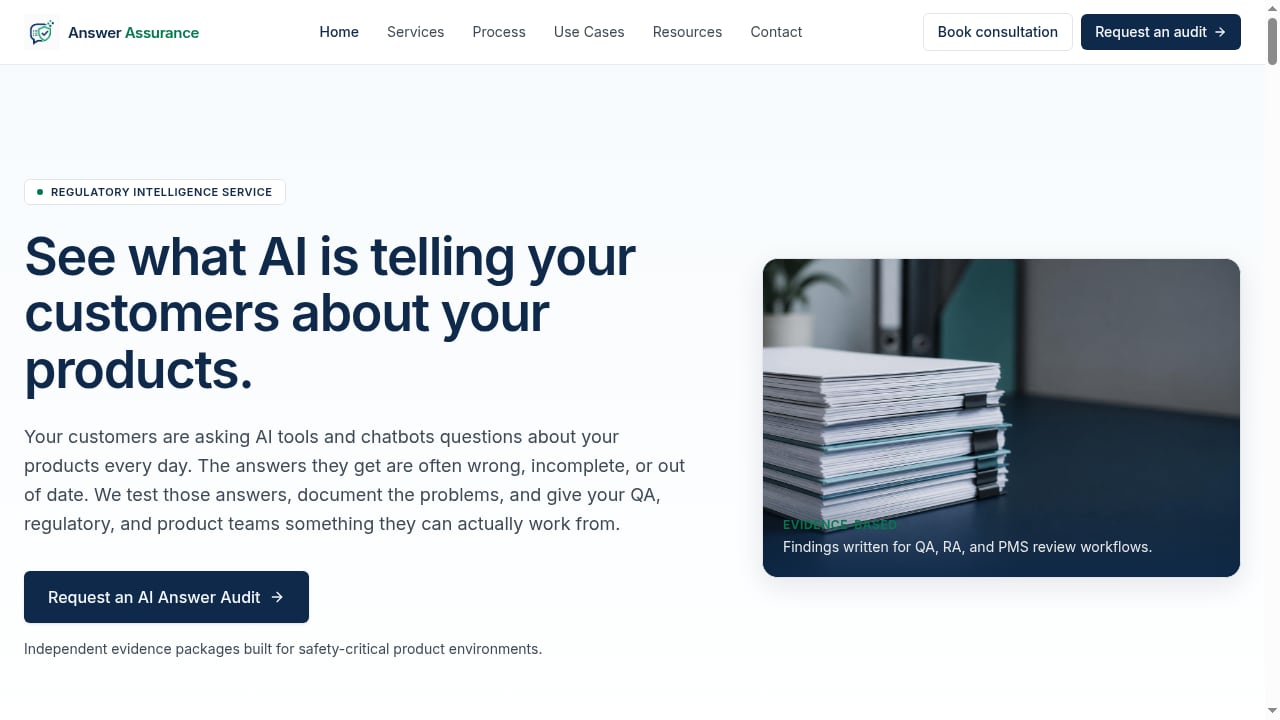
First viewport screenshot of answerassurance.com.
Answer Assurance is an AI answer monitoring and regulatory intelligence platform. Instead of tracking how your brand ranks in search results, it interrogates generative AI tools with prompts that real users might ask about your regulated products, then evaluates the responses against your approved claims, labeling, and policy standards.
The output is not a raw transcript dump. Findings are rated by risk, so a hallucinated dosage or an off-label claim surfaces above a minor tone inconsistency. That risk rating is the core design decision that separates Answer Assurance from general-purpose brand monitoring tools.
The monitoring loop
- Define the question set. You build prompts that mirror real customer, clinician, or patient questions about your products.
- Run against AI tools. The platform queries the AI systems you select and captures their answers.
- Score against your standards. Responses are compared with approved language, regulatory constraints, and internal policy.
- Rate and route by risk. Findings are classified so the right team — QA, RA, product, or support — sees the issues that matter to them.
- Track over time. Repeated runs reveal whether a wrong answer persists, drifts, or disappears after a content or model change.
Who Answer Assurance is built for
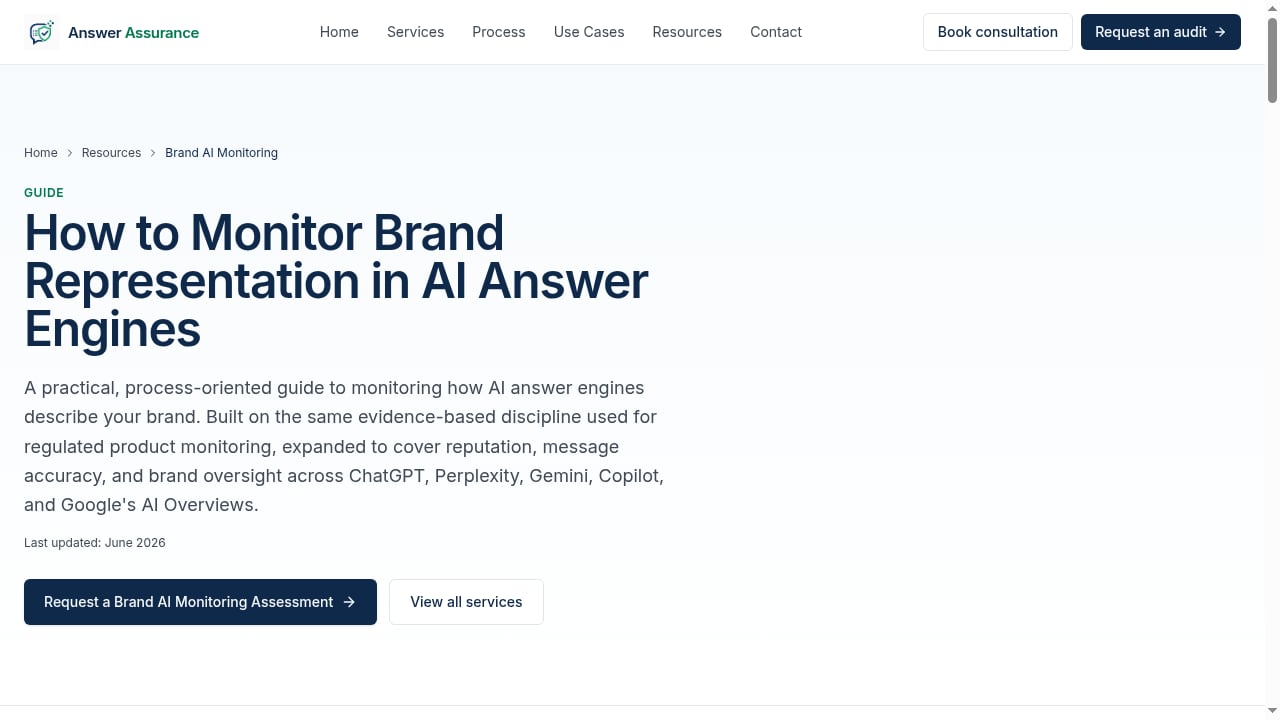
First viewport screenshot of answerassurance.com.
The product context points to four buyer groups, and each has a different reason to care.
- Regulatory affairs teams need evidence that AI-generated statements about their products stay within approved labeling and claims. Risk-rated findings give them a defensible record.
- QA teams treat AI answers as another output to validate. The platform extends quality assurance beyond internal systems to external AI tools the company does not control.
- Product teams want to know which product attributes are most often misdescribed by AI, because those gaps often trace back to unclear or missing public documentation.
- Support teams field the downstream consequences — customers arriving with wrong information they read in an AI answer — and need early warning before those conversations escalate.
It is a poor fit for teams that only want general brand sentiment tracking or social listening. The platform is purpose-built for regulated claims, not broad reputation monitoring.
Strengths
First viewport screenshot of answerassurance.com.
Risk-rated findings match how regulated teams prioritize
A flat list of AI mentions is not useful to a regulatory reviewer. Answer Assurance's risk rating does the triage work up front, which is the same principle behind effective AI agent quality monitoring: score every output against defined criteria, then route failures to the people who can fix them. For a deeper look at that evaluation discipline, see this guide to monitoring AI agent quality at scale with automated QA.
It monitors the answers, not just the mentions
Most AI visibility tools count citations and share of voice. Answer Assurance evaluates whether the substance of an answer is accurate and compliant. That is a meaningfully different question, and for regulated products it is the one that carries legal exposure. The liability question is not hypothetical; as this analysis of AI-generated customer response liability notes, a company cannot simply outsource blame to a model when a customer relies on a wrong answer.
Cross-functional by design
Because findings are rated and categorized, the same monitoring run can serve QA's validation needs, RA's compliance record, product's documentation gaps, and support's escalation prep. That shared evidence base reduces the duplicate work that happens when each team runs its own ad hoc AI checks.
Continuous rather than one-off
AI models change. A prompt that produced a compliant answer last quarter may produce a different one after a model update. Continuous monitoring catches regressions that a one-time audit would miss — the same reason production AI evaluation tools emphasize ongoing scoring rather than pre-launch testing alone, as outlined in this comparison of AI evaluation tools for production systems.
Limitations and honest caveats
- It is a monitoring layer, not a fix. Answer Assurance tells you what AI tools say. Correcting the underlying cause — thin public documentation, ambiguous labeling, outdated web content — is still your team's job.
- Prompt design quality drives everything. If your question set does not reflect what real users ask, the findings will be accurate but irrelevant. Expect an ongoing curation effort, not a set-and-forget configuration.
- Regulated review still needs humans. Risk-rated findings support expert judgment; they do not replace sign-off from qualified regulatory or medical reviewers.
- AI tool coverage is a moving target. The set of AI assistants people use shifts constantly, so coverage should be re-evaluated regularly rather than assumed.
- Pricing is not publicly transparent. Buyers should expect a scoped quote based on product portfolio size, number of AI tools monitored, and run frequency.
Pricing signals and what to expect
Answer Assurance does not publish a public price list, which is common for compliance-adjacent enterprise software. Based on the category, expect pricing to scale with three variables: the number of products or claims in scope, the number of AI tools queried per run, and monitoring frequency. A single-product pilot will cost far less than a portfolio-wide program running daily.
When you request a quote, ask specifically:
- Is pricing per product, per prompt, per AI tool, or per monitoring run?
- What is included in onboarding, and who builds the initial question set?
- Are historical findings retained, and for how long?
- Is there a limit on user seats for QA, RA, product, and support access?
For a broader view of how AI visibility platforms price and position themselves, this independent ranking of AI search visibility and brand monitoring tools is a useful benchmark.
Setup: what implementation looks like
Setup follows the monitoring loop described earlier, but the real work happens in two places.
First, the question set. Gather the questions your support team actually receives, the questions regulators or clinicians ask, and the questions that appear in public forums about your product category. Write them the way a real person would, not the way a compliance manual would.
Second, the standard. Define what a compliant answer looks like for each question — approved claims, required caveats, prohibited statements. This is where regulatory affairs earns its keep, and it is the step most likely to slow a rollout.
A realistic timeline for a focused pilot is a few weeks, dominated by question-set and standard definition rather than technical integration. Teams that treat setup as a content project, not an IT project, move faster.
How Answer Assurance compares to adjacent tools
First viewport screenshot of answerassurance.com.
| Need | Answer Assurance | General AI visibility platforms | AI evaluation tools |
|---|---|---|---|
| Monitor what AI says about regulated products | Core strength | Partial — focus on citations and share of voice | Not designed for external AI tools |
| Risk-rated, compliance-oriented findings | Core strength | Rare | Internal model scoring only |
| Brand and citation tracking across AI answers | Limited | Core strength | No |
| Testing your own AI agent or model | No | No | Core strength |
| Regulatory intelligence workflow | Core strength | No | No |
The distinction matters. If your concern is whether your own chatbot is behaving, you need an evaluation tool. If your concern is whether ChatGPT, Gemini, or Perplexity is misstating your regulated product to the public, Answer Assurance addresses that specific problem. For teams that also want to track broader AI visibility and citation patterns, a platform like AskScope complements rather than replaces it — see the GEO playbook for marketers for how citation monitoring fits alongside answer accuracy work.
Decision criteria: should you buy it?
Answer Assurance is likely a good fit if most of these are true:
- You sell products in a regulated category where incorrect AI answers create real harm or legal exposure.
- You have a named owner in regulatory affairs or QA who can define compliant answers.
- You can commit to ongoing prompt curation and periodic review of findings.
- You need an auditable record of what AI tools said and when.
It is likely a poor fit if:
- Your main goal is marketing visibility or share of voice in AI answers.
- You have no internal capacity to act on findings once they arrive.
- Your products are unregulated and the risk of an inaccurate AI answer is low.
A sensible path is a scoped pilot on your highest-risk product line, with a clear success metric: the number and severity of non-compliant AI answers identified, and whether your team can trace each one to a fix.
Related reading
- AEO for Agencies: Scale AI Visibility Without Headcount - Agencies: learn how to deliver AEO across clients with multi-brand monitoring, citation analysis, and repeatable GEO workflows using AskScope.
- Top 10 SEO Rank Tracking & Search Visibility Platforms 2026 - Independent 2026 ranking of the top 10 SEO rank tracking and search visibility platforms, scored on SERP accuracy, AI visibility, reporting, and value.
- How to Use AskScope with Squarespace: GEO Workflow - Learn how to connect AskScope with Squarespace to monitor AI visibility, find citation gaps, and fix pages so your brand appears in AI answers.
FAQ
Is Answer Assurance the same as AI visibility software? No. AI visibility tools measure whether and how often your brand appears in AI answers. Answer Assurance measures whether the content of those answers is accurate and compliant for regulated products.
Does it fix inaccurate AI answers automatically? No. It identifies and risk-rates them. Remediation usually involves improving public documentation, clarifying labeling, or updating the content AI systems draw from.
How often should monitoring run? Frequency should match risk. High-risk product claims warrant more frequent runs, especially after model updates or content changes. Many teams start weekly and tighten from there.
Can it replace manual regulatory review? No. It prioritizes findings so human reviewers spend time on the highest-risk issues, but qualified sign-off remains necessary.
What should I ask before buying? Ask about pricing structure, AI tool coverage, data retention, onboarding support for question-set design, and how findings are exported for audit purposes.
Conclusion
Answer Assurance addresses a real and under-served problem: regulated companies have little visibility into what generative AI tools tell the public about their products. Its risk-rated findings and cross-functional framing make it more useful to QA and regulatory teams than generic brand monitoring platforms, and its focus on answer substance rather than mention volume is the right instinct for a compliance use case. The trade-offs are real — setup depends on disciplined prompt and standard design, pricing requires a scoped conversation, and the platform surfaces problems rather than solving them. For organizations where an inaccurate AI answer carries genuine risk, that trade-off is worth evaluating through a focused pilot on your most sensitive product line.