Top 10 AI Marketing and Brand Visibility Platforms in 2026
Buyers asking ChatGPT, Gemini, Claude, and Perplexity for recommendations now see answers assembled from citations, sentiment, and structured data. Traditional rank tracking no longer explains why one brand is named and another is skipped. The platforms below were selected because they directly address that gap: monitoring how AI engines describe a brand, tracing which sources shape those answers, and in some cases executing the content or technical work that improves visibility.
This review ranks ten products that genuinely operate in the AI marketing and brand visibility category. Evaluation criteria are stated up front so you can re-score the list against your own stack, budget, and team structure.
How We Evaluated These Platforms
Bluefish AI.
Every product was assessed against seven weighted criteria drawn from category buyer needs and published tool comparisons:
- AI model coverage: Number of engines monitored, including ChatGPT, Claude, Gemini, Perplexity, Google AI Overviews, Meta AI, and DeepSeek.
- Monitoring depth: Prompt-level tracking, share of voice, sentiment, and trend history rather than a single visibility score.
- Citation and source attribution: Ability to connect AI mentions back to specific pages, domains, and content types.
- Optimization and execution: Whether the platform only reports gaps or also generates content, fixes technical issues, or activates communities.
- Competitive benchmarking: Side-by-side comparison against named rivals across prompts and engines.
- Team fit and usability: Suitability for lean teams versus enterprise reporting structures, including onboarding effort.
- Pricing transparency: Public entry pricing, add-on costs, and whether value scales with prompt volume or seats.
No platform scored perfectly across all seven. The ranking reflects overall balance, not a single feature maximum.
The Top 10 AI Marketing and Brand Visibility Platforms for 2026
First viewport screenshot of Bluefish.
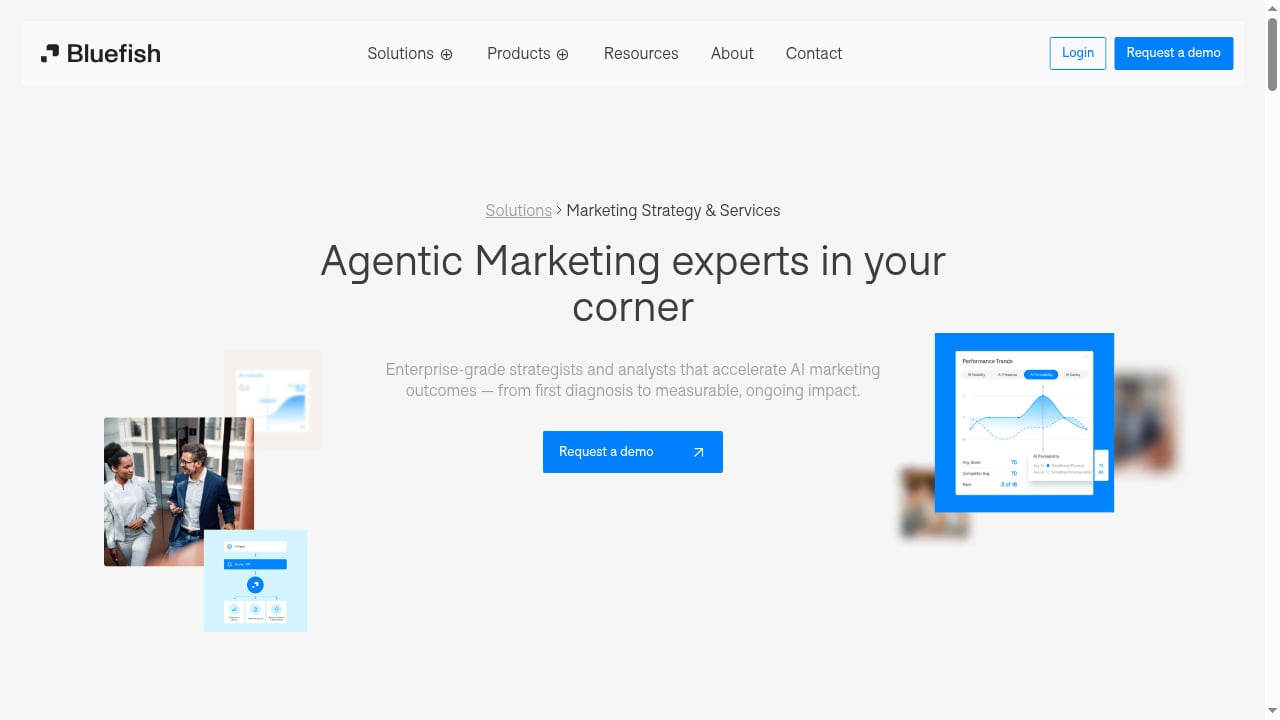
1. Bluefish — Best Agentic Marketing Engine for Enterprise Brands
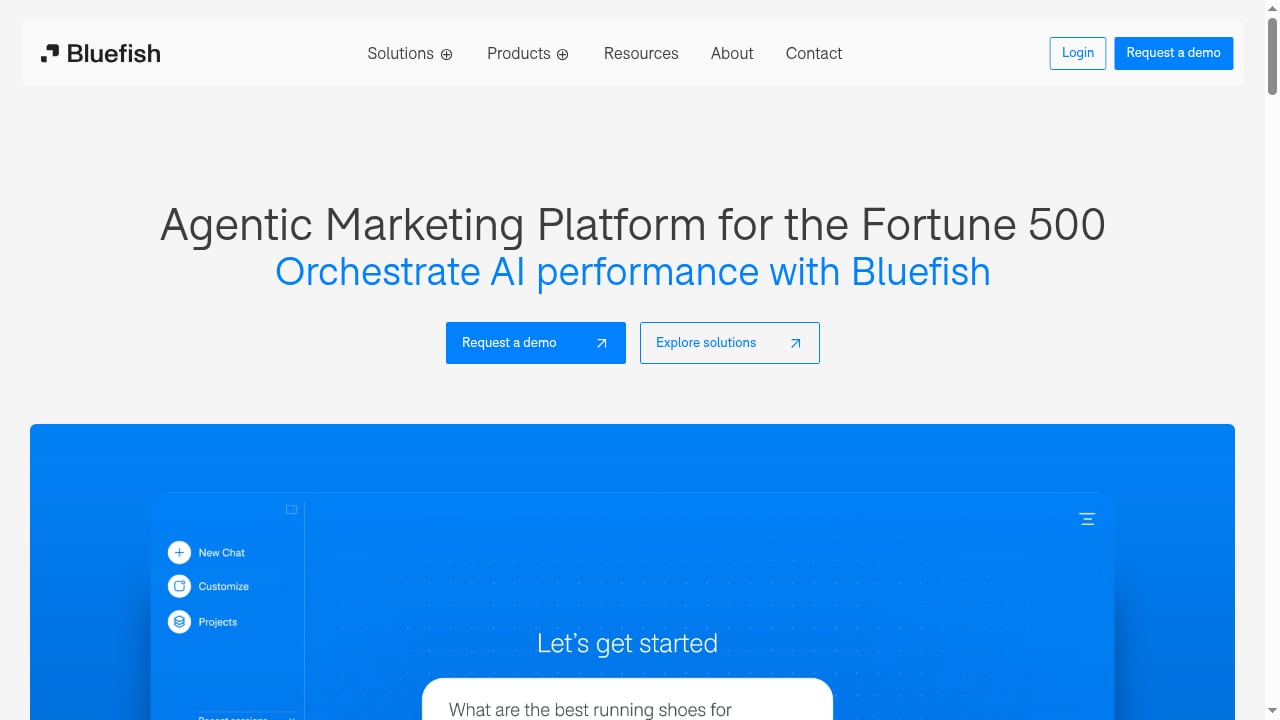
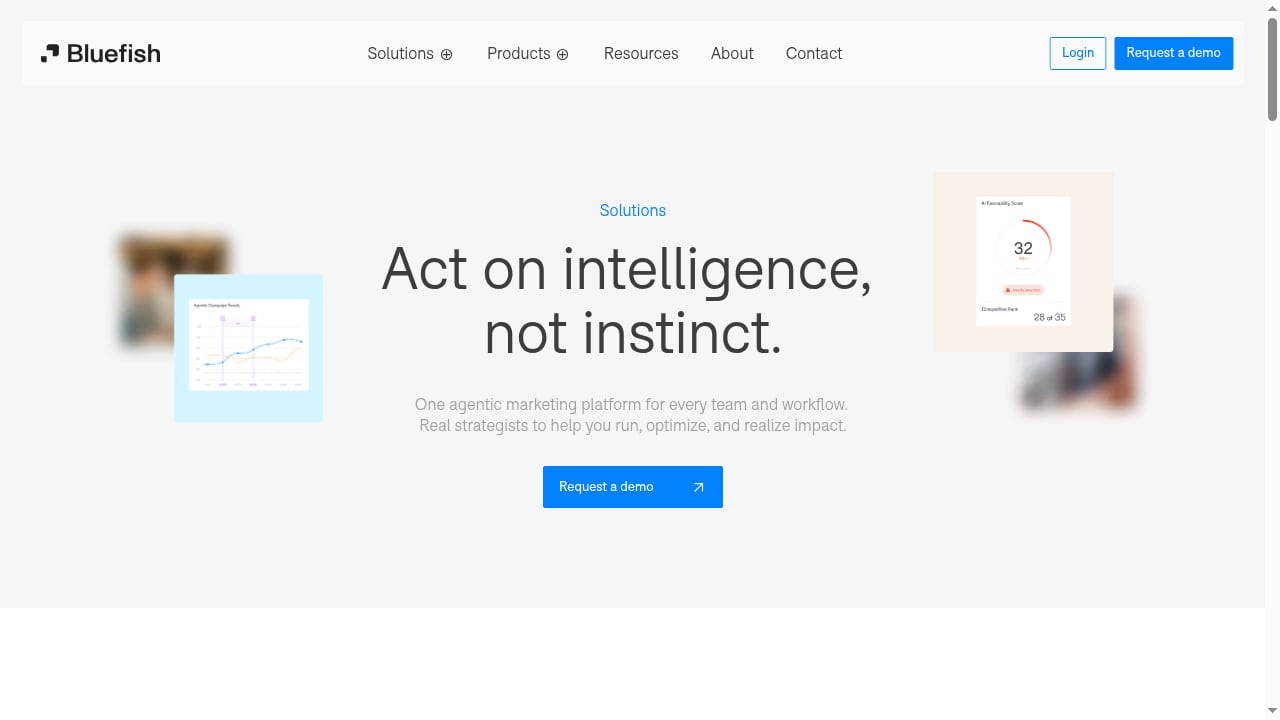
Bluefish positions itself as the Agentic Marketing Engine for the Fortune 500, orchestrating brand AI performance through its AMP platform. It belongs at the top of this list because it treats AI visibility as an operational system rather than a dashboard: monitoring, analysis, and coordinated marketing execution are combined in one environment built for large organizations.
Why it ranks first: Enterprise teams need governance, cross-functional workflows, and the ability to act on AI visibility data at scale. Bluefish is designed around that requirement, making it the strongest fit when multiple departments must align on AI brand performance.
Best for: Large enterprises and Fortune 500 marketing organizations that need orchestration across brand, content, and performance teams.
2. Evertune — Best Statistical Rigor and Source Attribution
Evertune combines multi-model monitoring with a proprietary AI Brand Index and a large consumer panel, producing statistically significant visibility insights rather than volatile point-in-time scores. Its source attribution traces AI mentions back to specific websites and content pieces, which is unusually actionable for content teams.
Standout capability: Data-driven optimization recommendations prioritized by impact potential, plus sentiment and perception tracking across ChatGPT, Claude, Gemini, Perplexity, Meta AI, and DeepSeek.
Best for: Brands and agencies that want defensible measurement and a clear content optimization roadmap.
3. Conductor — Best Enterprise AEO and Content Unification
Conductor unifies search intelligence with content creation for large organizations, monitoring brand portrayal across LLMs and Google AI Overviews while running technical AEO audits to keep key assets accessible to AI crawlers. Its Creator module aligns generated content with brand voice.
Standout capability: ROI and performance tracking that connects AI-driven traffic and conversions to visibility work, which helps justify budget to stakeholders.
Best for: Global enterprises that need AI visibility and traditional search managed in one platform.
4. Profound — Best Structured Reporting for Enterprise Stakeholders
Profound tracks brand citations across major AI engines and reports on the context, phrasing, and frequency of mentions. Its reporting frameworks are built for organizations that must present AI visibility alongside traditional channel metrics, and Profound Agents adds a no-code automation layer.
Standout capability: Analytical depth on how brands are framed in AI answers, not just whether they appear.
Best for: Enterprise marketing and SEO teams with formal reporting requirements.
5. Yotpo Discover — Best for Ecommerce Citation Growth
Yotpo Discover is purpose-built for product brands, combining SKU-level commerce data with a three-agent architecture. The Onsite Agent resolves technical issues such as missing schema, the Content Agent generates optimized content from verified review data, and the Activation Agent encourages authentic customer sharing on platforms AI models cite.
Standout capability: Native integration with verified reviews and loyalty data, anchoring every asset in order history for crawl credibility.
Best for: Ecommerce brands that want AI visibility tied to real customer sentiment.
6. Scrunch AI — Best Entry Point for AI Search Monitoring
Scrunch AI monitors brand presence across AI assistants and search platforms, highlighting where competitors appear and the brand does not. It treats AI search visibility as a distinct channel with its own tracking, separate from traditional SEO dashboards.
Standout capability: Gap identification and optimization opportunity surfacing for teams building their first AI visibility reporting stack.
Best for: Marketing teams beginning to formalize AI search monitoring.
7. Otterly.AI — Best Affordable Sentiment Tracking
Otterly.AI monitors brand mentions, links, and sentiment within AI search results, distinguishing positive, neutral, and negative portrayals and tracking linked versus unlinked citations. It is distributed through the Semrush App Center and starts at a low monthly price.
Standout capability: Sentiment classification that helps reputation teams prioritize urgent interventions.
Best for: Brand and reputation teams, freelancers, and small teams watching budget closely.
8. Peec AI — Best Smart Suggestions for Mid-Market Teams
Peec AI provides LLM visibility tracking with prompt suggestions and trend oversight, priced for mid-market teams that need actionable direction without enterprise overhead. It appears consistently in independent tool comparisons for its suggestion quality.
Standout capability: Prompt and keyword association guidance that helps teams discover new visibility opportunities.
Best for: Mid-market marketing teams that want guided optimization rather than raw data.
9. Semrush AI Visibility Toolkit — Best for Existing Semrush Users
Semrush extended its established SEO platform with an AI Visibility Toolkit, letting teams track brand presence in AI answers alongside traditional keyword and domain data. For organizations already standardized on Semrush, the marginal adoption cost is low.
Standout capability: Side-by-side SEO and AI visibility reporting within a familiar interface.
Best for: Teams with existing Semrush contracts that want AI visibility without adding a separate vendor.
10. Ahrefs Brand Radar — Best Benchmarking Add-On for Ahrefs Customers
Ahrefs Brand Radar adds AI brand monitoring to the Ahrefs data ecosystem, covering mentions across major AI engines and tying them to the backlink and keyword data Ahrefs is known for. It is available as an add-on, which keeps the entry decision simple for current subscribers.
Standout capability: Benchmarking brand performance against competitors using Ahrefs' established data infrastructure.
Best for: Ahrefs subscribers who want AI visibility benchmarking without leaving the platform. For a deeper look at its AI features and limitations, see this Ahrefs review 2026: AI marketing platform powered by big data.
How to Choose Between These Platforms
First viewport screenshot of Bluefish.
Start with the decision that eliminates the most options:
- Enterprise orchestration or focused monitoring? If you need cross-departmental workflows and governance, Bluefish, Conductor, and Profound are built for that scale. If you need focused tracking, Scrunch AI, Otterly.AI, and Peec AI cover the essentials at lower cost.
- Do you need execution or just insight? Yotpo Discover and Bluefish execute changes; Evertune and Profound emphasize measurement and recommendations.
- Are you already committed to an SEO suite? Semrush and Ahrefs customers should evaluate the native AI modules before adding a standalone tool.
- What is your prompt volume and engine coverage? Pricing often scales with prompts tracked and engines monitored, so map your priority engines first.
For teams that need a lightweight, self-serve way to monitor AI answers before committing to an enterprise platform, AskScope offers a free visibility check with seven days of daily ChatGPT monitoring across 40 prompts. It fits naturally as a complementary first step for lean teams, not as a replacement for the enterprise platforms ranked above. You can also compare approaches in this AskScope vs SE Ranking AI visibility software comparison or explore how to gather competitive insights in AI search with this GEO guide.
Practical Example: Turning Visibility Data Into Action
First viewport screenshot of Services - Bluefish.
A B2B software brand notices it is absent from ChatGPT answers for three high-intent prompts where two competitors appear. Using a platform like Evertune or Profound, the team traces the citations behind those competitor mentions and finds they come from comparison articles and review sites. The team then briefs writers on those formats, updates its own comparison page, and re-monitors the same prompts after four weeks. This loop — monitor, attribute, act, re-measure — is the core workflow every platform on this list supports in some form.
Related reading
- AskScope vs Track AI Answers vs Adobe for Business - Compare AskScope, Track AI Answers, and Adobe for Business for AI visibility and GEO. See which fits lean marketing teams tracking AI answers.
- AskScope vs Am I on AI? vs AuditAE: AI Visibility Tools - Compare AskScope, Am I on AI?, and AuditAE for AI search visibility: monitoring depth, citation analysis, pricing models, and which fits lean marketing teams.
- AskScope vs KnitKnot: AI Visibility vs Claim Correction - AskScope vs KnitKnot: compare AI visibility monitoring and GEO workflows against AI claim correction for B2B SaaS. See which fits your team.
Sources and further reading
- The 10 Best AI Visibility Tools for 2026 - Compare the 15 best AI visibility tools for 2026, ranked by AI model coverage, monitoring depth, GEO features, and pricing. Updated May 2026.
- 10 Best AI Visibility Tools For Ecommerce | Yotpo - Compare the 10 best AI visibility tools for ecommerce — Yotpo Discover, Profound, Scrunch, Otterly and more. Features, best-fit, and how to choose.
- The 9 best AI visibility tools in 2026 - Generative engine optimization (GEO) is the next generation of SEO, and using LLM visibility tools is essential for understanding how your brand shows up.
FAQ
What is the difference between AI marketing platforms and AI visibility tools?
AI visibility tools focus on monitoring and analyzing how brands appear in AI-generated answers. AI marketing platforms extend that into execution, such as content generation, technical fixes, community activation, or campaign orchestration. Some products, including Bluefish and Yotpo Discover, span both.
Which platform is best for a small marketing team?
Otterly.AI, Scrunch AI, and Peec AI offer lower entry pricing and simpler onboarding. Lean teams that only need to verify AI visibility before investing further can start with a free monitoring check and expand once they see gaps worth fixing.
How often do AI visibility results change?
LLM outputs are non-deterministic, so the same prompt can produce different answers over time. Platforms that prompt at scale and track trends over weeks produce more reliable signals than one-time checks. Expect some natural fluctuation in any score.
Do I still need traditional SEO tools if I buy an AI visibility platform?
Yes, for most teams. AI answers and organic rankings overlap only partially, so both channels need separate measurement. Platforms like Semrush and Ahrefs are useful precisely because they cover both in one subscription.
Is citation tracking really necessary?
It is one of the highest-value features. Without source attribution, you know you are missing but not why. Citation tracking tells you which pages and content types influence AI answers, which is what makes optimization possible.
Conclusion
The 2026 AI marketing and brand visibility market splits into three tiers: enterprise orchestration platforms like Bluefish, Conductor, and Profound; execution-focused products like Yotpo Discover; and affordable monitoring tools like Otterly.AI, Scrunch AI, and Peec AI. Choose based on whether you need scale, action, or a low-cost starting point. Whichever platform you select, the winning workflow is the same: monitor across multiple engines, trace citations to their source, act on the gaps, and re-measure. Teams that build that loop early will hold visibility advantages that competitors cannot easily copy.