AskScope vs Track AI Answers vs Adobe for Business
AI assistants now answer questions about your brand before a prospect ever reaches your site. That shift has created a new buying decision: which tool actually shows you what AI systems say about you, and which one helps you change it? AskScope, Track AI Answers, and Adobe for Business all touch this problem, but they solve it at very different scopes and price points. This comparison breaks down what each does well so you can match the tool to your team's size, budget, and workflow.
Quick comparison at a glance
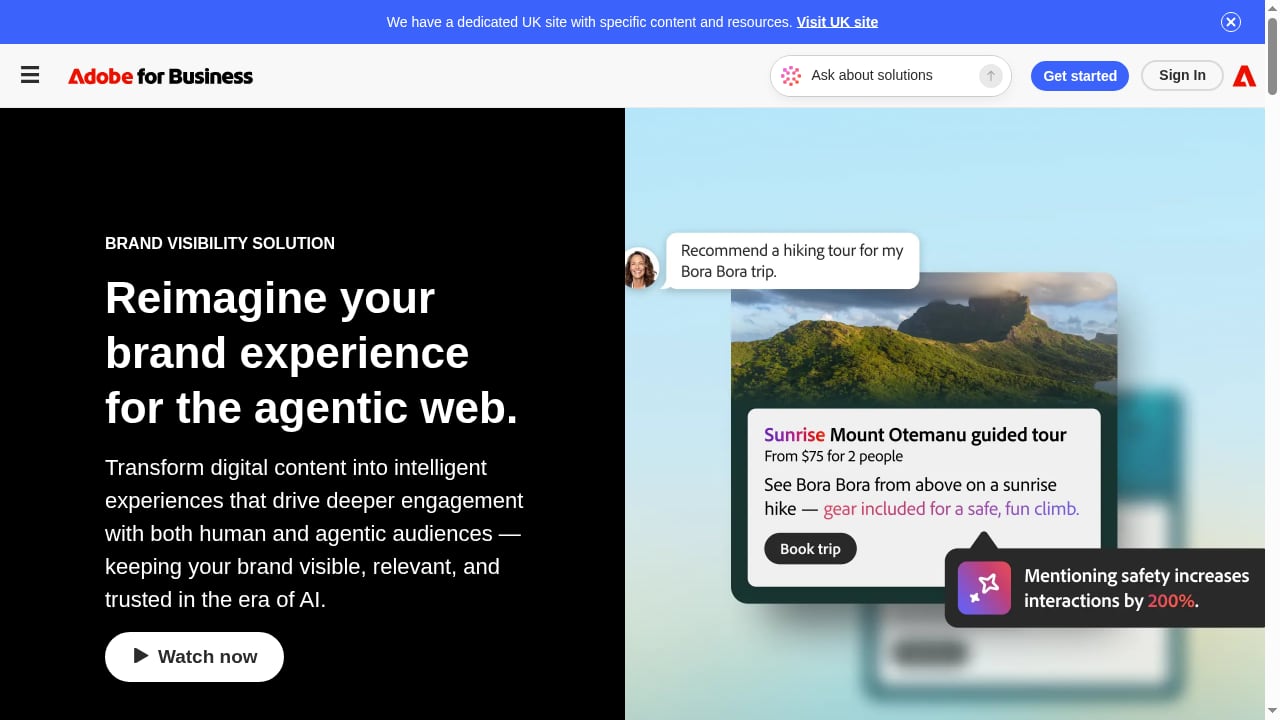
First viewport screenshot of Brand Visibility Solutions | Adobe for Business.
| Criterion | AskScope | Track AI Answers | Adobe for Business |
|---|---|---|---|
| Primary job | Monitor, analyze, and improve brand visibility in AI answers | Track what AI chatbots and LLMs know about a person or brand | Orchestrate enterprise digital experiences, including AI-era brand visibility |
| Best fit | Lean marketing teams | Individuals and small teams checking AI reputation | Large enterprises with creative, marketing, and IT teams |
| Core workflow | Continuous Monitor → Analyze → Act loop | Cross-model tracking of brand/person knowledge | Content supply chain, personalization, analytics, commerce, e-signatures |
| Entry cost | Free visibility check, then plans that scale | Low-friction tracking tool | Enterprise licensing |
| Citation tracing | Yes — traces sources shaping AI answers | Limited to what each model reports | Part of broader content and analytics stack |
| Actionable GEO tasks | Prioritized recommendations and tasks | Not the core focus | Delivered through enterprise content workflows |
What AskScope does
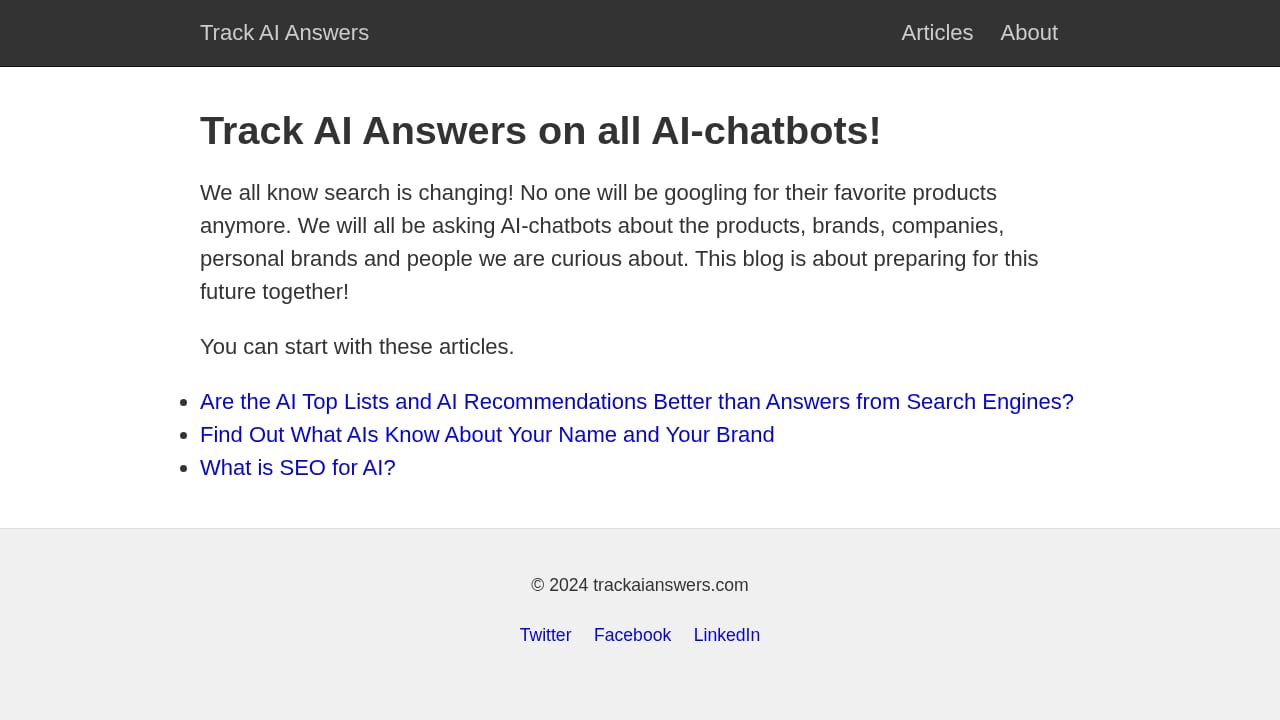
First viewport screenshot of SEO for AI - Dolor Sit.
AskScope is a self-serve GEO (Generative Engine Optimization) platform built for lean marketing teams. It monitors how your brand appears across AI-generated answers, benchmarks you against competitors, and traces the citations that shape those answers. Every score ties back to actual AI responses rather than an abstract index, so you can see the evidence behind a visibility number.
The workflow runs as a loop: monitor prompts, analyze where you and competitors stand, then act on prioritized recommendations and tasks. Content creation and distribution features support the "act" stage, so the platform is designed to move you from insight to change rather than stopping at a dashboard. A free visibility check includes seven days of daily ChatGPT monitoring across 40 prompts, and paid plans scale with team needs.
If you want to see how this stacks up against other monitoring-first tools, the AskScope vs Am I on AI? vs AuditAE comparison covers monitoring depth and pricing models, and the competitive insights in AI search guide walks through turning benchmarks into GEO actions.
What Track AI Answers does well
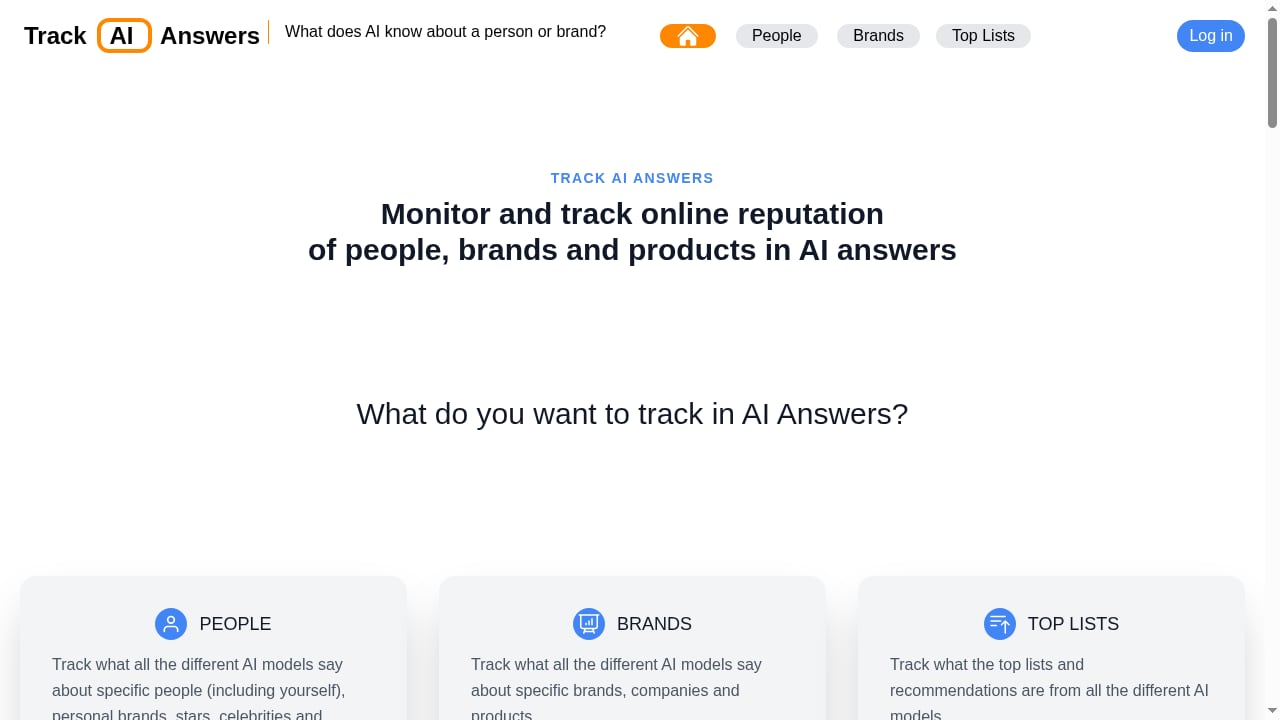
First viewport screenshot of Track AI Answers - Track What AI Knows About A Person or Brand!.
Track AI Answers - Track What AI Knows About A Person or Brand! focuses on a narrow, useful question: what do the different AI chatbots and large language models actually know about a given person or brand? It aggregates that view across multiple models in one place, which makes it a practical starting point for reputation checks.
Its strengths are clarity and accessibility. If you are an individual, a consultant, or a small team that wants a fast read on how AI systems describe you, a single-site tracker removes the need to query each assistant manually. It is a sensible first step before investing in a full optimization workflow, and it is easy to justify when the goal is awareness rather than a managed program.
Where it is lighter is the action layer. Tracking what models know is not the same as systematically improving it, and it does not center on prioritized GEO tasks or citation-driven content changes. Teams that need to close the gap between observation and improvement will eventually want a workflow tool alongside it.
What Adobe for Business does well
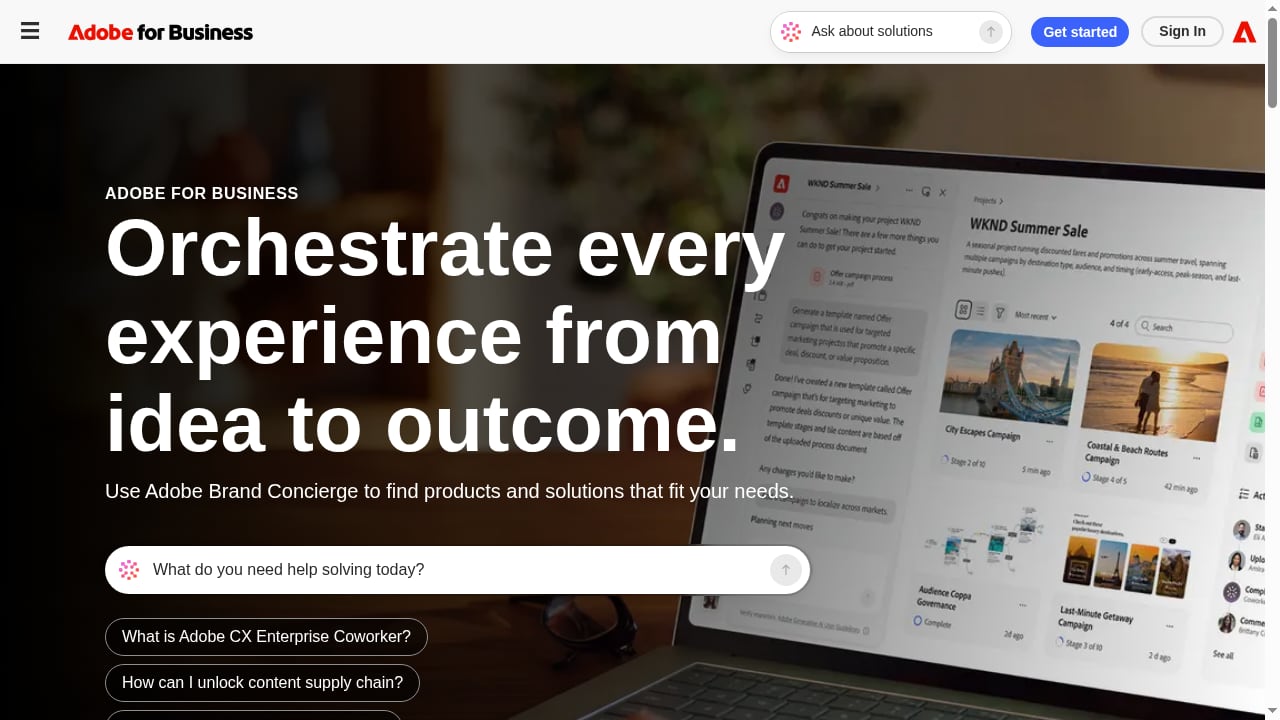
First viewport screenshot of Adobe for Business | Enterprise Digital Marketing Solutions.
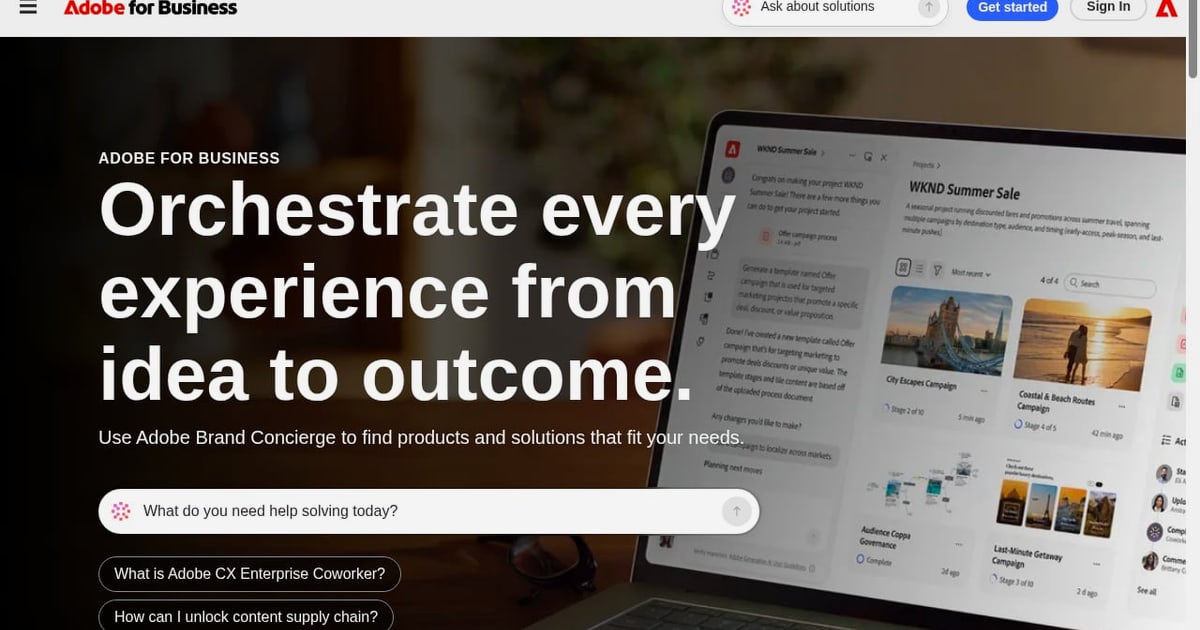
Adobe for Business is an enterprise digital experience suite that orchestrates every experience from idea to outcome. It combines an AI-powered content supply chain, customer engagement, brand visibility across AI search and the agentic web, analytics, commerce, and e-signature tools such as Acrobat Sign. Adobe GenStudio modernizes content supply chains, and content insights measure asset-level performance.
The platform's scale is its advantage. It supports real-time personalization, omnichannel journey orchestration, and scalable content production with brand governance — capabilities that matter when you are coordinating dozens of markets, brands, and creative teams. Adobe's own framing reflects the stakes: 25% of customers already use AI as their primary research source, 80% of organizations expect real-time hyper-personalization to define the next era of customer experience, and $18T in purchases will be transacted or influenced by machine customers.
That breadth is also the trade-off. Adobe for Business is built for large enterprises with dedicated marketing, creative, and IT resources. A lean team looking for a focused AI visibility answer will find far more platform than it needs, and the implementation and licensing overhead reflects that.
Where AskScope has a supported advantage
On criteria that matter to lean marketing teams, AskScope's positioning is specific and defensible:
- Self-serve onboarding. AskScope is designed to be adopted without an enterprise implementation project, which matters when no one owns a platform rollout.
- Evidence-linked scoring. Visibility scores are grounded in actual AI answers, so recommendations can be traced back to what a model said.
- Citation analysis. Tracing the sources that shape AI answers gives teams a concrete list of pages and domains to influence.
- Action orientation. Prioritized recommendations and tasks connect monitoring to content and distribution work, closing the loop that pure trackers leave open.
- Free starting point. Seven days of daily ChatGPT monitoring across 40 prompts lets a team validate the data before committing budget.
If your team is weighing monitoring tools more broadly, the top 10 AI reputation monitoring and analytics software roundup and the Perplexity visibility tool pricing overview are useful next reads on evaluation criteria and cost drivers.
How to choose
Choose Track AI Answers if you need a quick, low-commitment read on what multiple AI models know about a person or brand and you are not yet running a structured optimization program. It answers the awareness question well.
Choose Adobe for Business if you are a large enterprise that needs content supply chain modernization, personalization at scale, commerce, and governance in one suite, and AI search visibility is one component of a much larger experience strategy.
Choose AskScope if you are a lean marketing team that needs to monitor AI answers, understand why competitors appear instead of you, and act on specific GEO tasks — with evidence behind every metric and a free way to start.
These are not strictly competing products. Track AI Answers and Adobe for Business sit at opposite ends of the market: one is a lightweight tracker, the other an enterprise suite. AskScope occupies the middle ground, which is exactly where most marketing teams without dedicated platform resources end up looking.
Related reading
- AskScope vs SE Ranking: AI Visibility Software Compared - Compare AskScope and SE Ranking for AI visibility monitoring, GEO workflows, pricing, and team fit. See which tool gets results for lean marketing teams.
- AskScope vs KnitKnot: AI Visibility vs Claim Correction - AskScope vs KnitKnot: compare AI visibility monitoring and GEO workflows against AI claim correction for B2B SaaS. See which fits your team.
- Ahrefs Review 2026: AI Marketing Platform Powered by Big Data - Evidence-based Ahrefs review: AI features, backlink and keyword data, pricing signals, setup, ideal users, and limitations for 2026.
Sources and further reading
- Airtable | Everyone's app platform - Airtable is a low-code platform for building collaborative apps. Customize your workflow, collaborate, and achieve ambitious outcomes. Get started for free.
- Career Readiness Guide - George Mason University - How do you know if your choice is a good fit? The process involves both knowing yourself and exploring academic programs and careers. Some people first choose a ...
- Project Designer Interview Questions & Answers - Prepare for your Project Designer interview with common questions and expert sample answers.
FAQ
Is AskScope a replacement for Track AI Answers?
Not exactly. Track AI Answers is a tracking tool for what models know; AskScope adds analysis, citation tracing, and prioritized GEO actions on top of monitoring. Teams that only need awareness can start with a tracker; teams that need to improve visibility will get more from AskScope.
Can Adobe for Business handle AI visibility for a small team?
It can, but it is built for enterprise scale. Small teams typically pay for capabilities they will not use, and the implementation overhead is significant compared with a self-serve GEO platform.
Which tool tracks citations behind AI answers?
AskScope includes citation analysis that traces the sources shaping AI answers. Track AI Answers focuses on what models report about a brand, and Adobe addresses visibility within a broader content and analytics suite.
Is there a free way to check AI visibility?
Yes. AskScope offers a free visibility check with seven days of daily ChatGPT monitoring across 40 prompts, which is enough to see baseline visibility before choosing a plan.
Do I need all three tools?
Most teams do not. A lean marketing team can run AskScope alone, a solo user may only need Track AI Answers, and an enterprise already invested in Adobe's ecosystem will evaluate AI visibility inside that stack.
Conclusion
Track AI Answers and Adobe for Business are credible at what they were built for: lightweight cross-model tracking and enterprise experience orchestration, respectively. AskScope targets the gap between them — teams that need evidence-based AI visibility monitoring plus a practical path to improving it. Start with the free visibility check, confirm the data reflects your real AI answers, and then decide how much workflow you need.