Ahrefs Review 2026: AI Marketing Platform Powered by Big Data
Ahrefs has spent more than a decade building one of the largest backlink and keyword databases in the industry. In 2026, it positions itself as an AI marketing platform powered by big data, extending beyond classic SEO into AI search visibility, content optimization, and competitive intelligence. This review examines what Ahrefs actually does well, where it falls short, and whether it fits your team.
What Ahrefs Is and Who It Is For
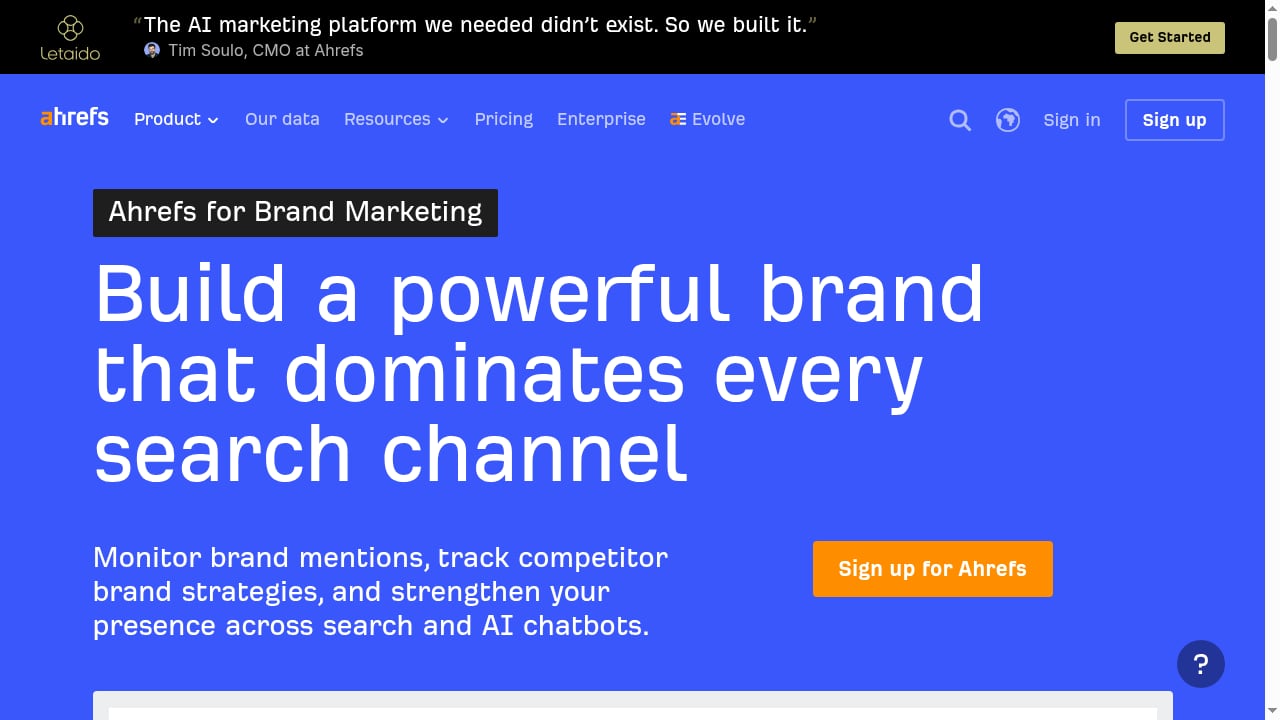
First viewport screenshot of AI Marketing Platform for Brand & PR Specialists | Ahrefs.
Ahrefs is an all-in-one marketing intelligence platform. Its core strength is data: backlinks, organic keywords, paid search data, and content performance across billions of indexed pages. The platform is used by SEO professionals, content marketers, PPC teams, digital PR specialists, and agencies managing multiple client sites.
According to Gartner Peer Insights, Ahrefs is designed for search engine optimization and digital marketing professionals to analyze and monitor website performance. The same source notes that the platform supports backlink analysis, keyword research, competitor exploration, and site auditing.
Ideal users include:
- SEO specialists and consultants who need reliable backlink and keyword data
- Content marketers researching topics, gaps, and competitor performance
- Agencies managing large-scale campaigns across many domains
- PPC advertisers validating keyword demand and competitor ad copy
- Digital PR teams identifying link-building and outreach opportunities
If you only publish occasional blog posts and do not track rankings or backlinks, Ahrefs is likely more tool than you need.
Core Features That Matter
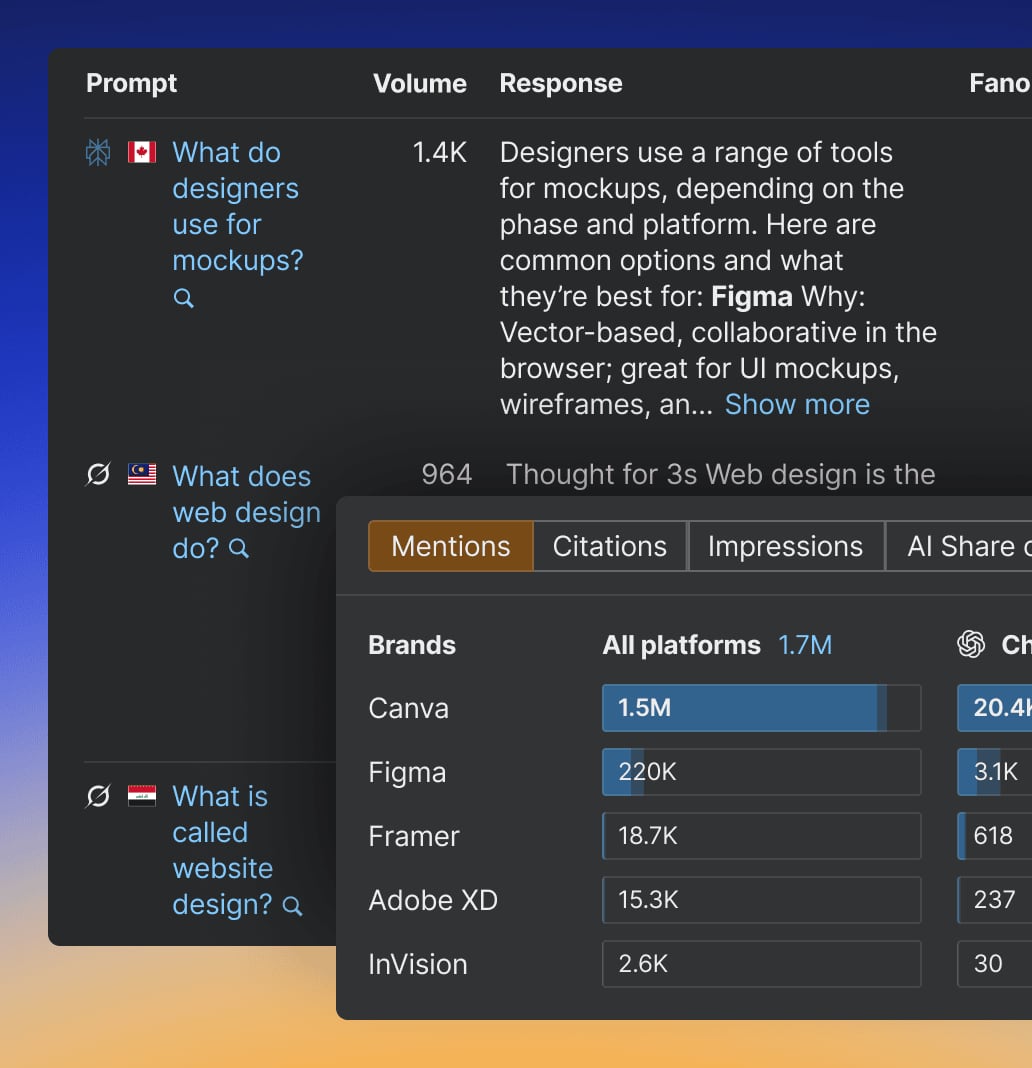
Brand Radar showing AI visibility across prompts and platforms.
Site Explorer
Site Explorer provides an in-depth view of any website's organic traffic, backlink profile, and top-performing pages. The Overview 2.0 interface adds visualizations that make it easier to spot trends without exporting raw data. For competitive research, this is often the first stop: enter a competitor's domain and see which pages earn traffic and which domains link to them.
Keywords Explorer
Keywords Explorer delivers search volume, keyword difficulty, click potential, and traffic potential. The AI keyword suggestions feature generates related terms based on machine learning rather than simple string matching. This is useful when you need to expand a topic cluster quickly, though you should still validate suggestions against your own audience data.
Site Audit
Site Audit crawls your website and flags technical issues: broken links, redirect chains, thin content, slow pages, and indexation problems. You can customize issue filters and schedule recurring crawls. In practice, this is one of the most actionable parts of the platform because it produces a prioritized fix list rather than a raw error dump.
Rank Tracker
Rank Tracker monitors keyword positions across multiple search engines and locations. You can track your own site and competitors side by side, and the tool records ranking history and SERP feature presence. For teams reporting to clients, the scheduled reports reduce manual work.
Content Explorer
Content Explorer indexes billions of pages and surfaces metrics on social shares, backlinks, and organic traffic potential. It is built for content ideation and link prospecting. You can filter by topic, language, and minimum referring domains to find pages that already attract links.
AI-Powered Features
Ahrefs has integrated AI across several workflows, including content grading, search intent analysis, and technical SEO recommendations. These features are designed to save time, but they are assistive rather than autonomous. You still need a human to interpret recommendations and decide what aligns with your brand.
AI Search and the Big Data Advantage
First viewport screenshot of Ahrefs—AI Marketing Platform Powered by Big Data.
Ahrefs' claim to being an AI marketing platform rests on its data infrastructure. The company maintains large, regularly updated databases of keywords, backlinks, and rankings. That scale matters because AI-driven recommendations are only as good as the underlying data.
That said, AI search visibility is a newer battleground. Tools that monitor how brands appear in ChatGPT, Perplexity, and Gemini answers are a different category from classic backlink and keyword analytics. Ahrefs is expanding into AI and content optimization, but if AI answer monitoring is your primary need, compare dedicated platforms. Our guide to AI search visibility and AEO/GEO analytics platforms covers that category in detail.
Pricing Signals
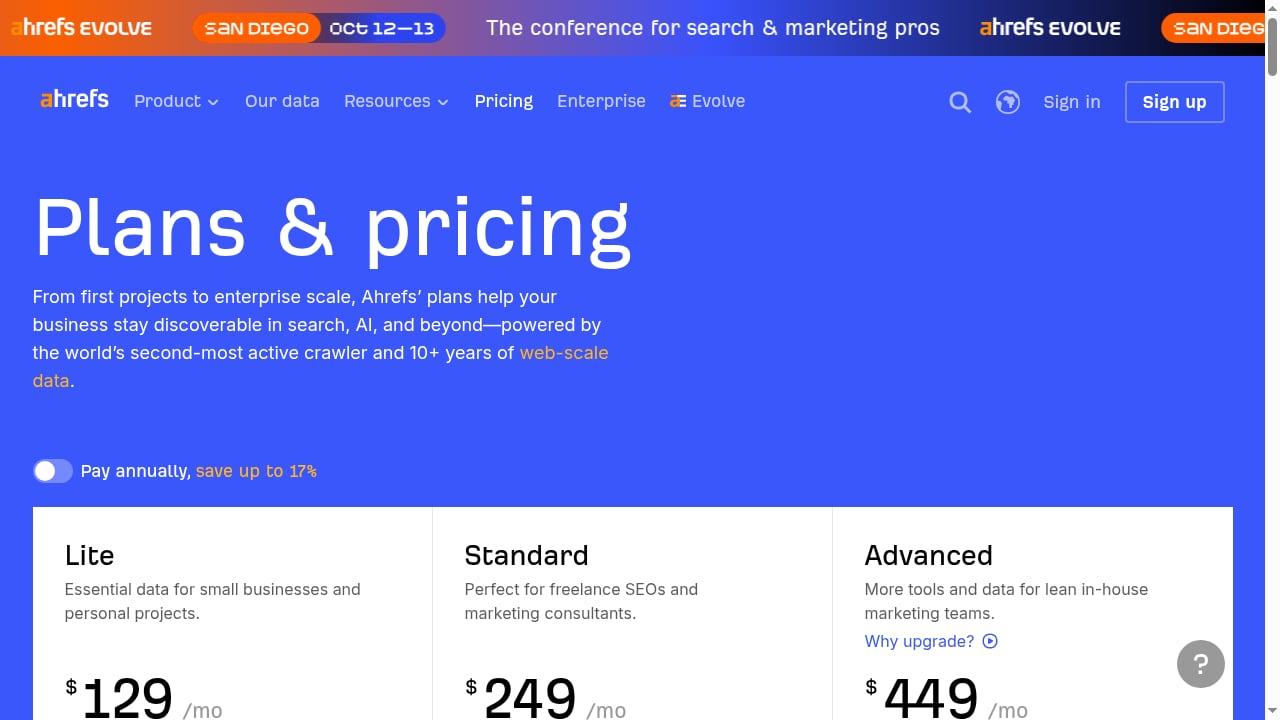
First viewport screenshot of Plans & Pricing - Ahrefs.
Ahrefs uses tiered subscriptions with monthly and annual billing. Based on published pricing signals for 2026:
- Lite – around $129/month or $1,290/year, one user, limited credits
- Standard – around $249/month or $2,490/year, unlimited credits, additional users available
- Advanced – around $449/month or $4,490/year, larger team support
- Enterprise – custom pricing, typically annual, for large organizations
Annual billing generally provides a discount equivalent to two months free. Additional user seats are available on most plans for an extra monthly fee.
Two pricing caveats appear repeatedly in user feedback. First, costs have risen over time, and some long-term users report that the value proposition has shifted. Second, AI and content features may be gated behind higher tiers or add-ons. Before committing, map your actual usage: how many projects, how many tracked keywords, and how many team members need access.
For a broader comparison of what visibility tooling costs, see our breakdown of Perplexity visibility tool pricing, which explains the cost drivers that apply across this category.
Setup and Onboarding
Setup is generally straightforward. Most users start by adding a project, connecting a domain, and running a Site Audit. From there, you configure Rank Tracker with your target keywords and begin exploring competitors in Site Explorer.
The learning curve is the main friction point. Ahrefs packs many features into its interface, and new users can feel overwhelmed by the number of reports and metrics. Reviews on G2 consistently praise the accuracy of backlink data and keyword research, but also note that the depth of features takes time to master.
A practical onboarding sequence:
- Add your domain and run a full Site Audit.
- Fix high-priority technical issues first.
- Set up Rank Tracker with 20–50 core keywords.
- Use Site Explorer to analyze two or three direct competitors.
- Build a content gap list in Keywords Explorer.
- Schedule recurring reports for stakeholders.
This sequence gets you to actionable output within the first week rather than spending a month exploring menus.
Strengths and Limitations
Strengths
- Data quality – Backlink and keyword data are widely regarded as accurate and up to date.
- Breadth – One subscription covers backlinks, keywords, audits, rank tracking, and content research.
- Competitive analysis – Site Explorer makes it easy to reverse-engineer competitor strategies.
- Reporting – Scheduled reports and dashboards reduce manual reporting work.
- Education – Ahrefs produces extensive tutorials, webinars, and documentation.
Limitations
- Price – Entry costs are high for freelancers and small businesses.
- Complexity – The feature depth creates a steep learning curve.
- AI search monitoring – Dedicated AI answer tracking is not the platform's core strength compared with specialized GEO tools.
- Credit limits – Lower tiers cap usage, which can constrain heavy research.
- Add-on costs – Some newer AI and content features may require higher plans.
A Gartner Peer Insights reviewer summarized the trade-off well: the platform provides detailed competitor tracking and expanding AI capabilities, but additional features come at extra cost. Another reviewer described the reporting and competitive analysis as easy to set up and repeat, which reflects the platform's strength in recurring workflows.
Ahrefs vs Alternatives: Decision Criteria
| Criterion | Ahrefs | Typical alternatives |
|---|---|---|
| Backlink data depth | Industry-leading | Varies; some match, some lag |
| Keyword research | Strong, with AI suggestions | Comparable in top-tier tools |
| AI answer monitoring | Emerging | Stronger in dedicated GEO platforms |
| Pricing entry point | High | Some lower-cost options exist |
| Learning curve | Steep | Mixed |
| Agency scalability | Strong | Strong in enterprise tools |
Choose Ahrefs if backlink intelligence, keyword research, and technical audits are central to your workflow. Look elsewhere if your primary need is monitoring brand mentions in AI-generated answers, or if budget is the deciding factor. For teams balancing both needs, a combined stack may make sense. Our comparison of AskScope, GetMint, and AuditAE shows how dedicated AI visibility tools approach the problem differently.
Related reading
- Am I on AI? Review: AI Visibility Check for Business - Hands-on review of Am I on AI? - Check Your Business's AI Visibility: how it tracks ChatGPT mentions, benchmarks rivals, pricing signals, and limits.
- Perplexity Visibility Tool Pricing: What to Expect in 2026 - Compare Perplexity visibility tool pricing in 2026: what drives cost, typical price ranges, and how AskScope's GEO plans fit lean marketing teams.
- Competitive Insights in AI Search: A GEO Guide - Learn how to gather competitive insights in AI search, benchmark rivals in ChatGPT and Perplexity, and turn findings into GEO actions.
Sources and further reading
- Powerful SEO Toolkit to Boost Rankings and Organic Traffic - Ahrefs Review: Discover the all-in-one SEO toolset for growing search traffic. With backlink analysis, keyword research, rank tracking, site audits, and more.
FAQ
Is Ahrefs worth the price in 2026?
It depends on usage. If you actively use backlink analysis, keyword research, and site audits across multiple projects, the data quality justifies the cost. If you only need occasional keyword lookups, a lower-tier or alternative tool may be more efficient.
Does Ahrefs monitor AI search results?
Ahrefs has expanded into AI and content optimization, but dedicated AI answer monitoring across ChatGPT, Perplexity, and Gemini is a separate category. Evaluate specialized GEO platforms if that is your priority.
How long does it take to learn Ahrefs?
Most users become productive within a few weeks. Full mastery of advanced reports and workflows can take several months, especially for agencies managing complex campaigns.
Can Ahrefs replace multiple tools?
For many SEO teams, yes. It covers backlinks, keywords, audits, rank tracking, and content research. However, it does not replace dedicated AI visibility monitoring, social listening, or analytics platforms.
Is there a free trial?
Ahrefs offers limited free tools and a paid trial structure. Check the official site for current terms, as offerings change.
Conclusion
Ahrefs remains one of the most capable marketing intelligence platforms available, and its big-data foundation is a genuine differentiator. The backlink and keyword databases are deep, the audit and rank tracking tools are practical, and the AI features are useful additions rather than marketing fluff.
The main questions are cost and fit. If your work depends on reliable search data and competitive analysis, Ahrefs earns its place in your stack. If you need AI answer monitoring or a lighter, cheaper tool, look at dedicated alternatives first. For a wider view of the market, see our roundup of AI reputation monitoring and analytics software.