Semrush Review: Your Unfair Advantage for Growing Brand Visibility
Semrush markets itself as "the leading platform to grow and measure brand visibility across AI search, SEO, PPC, social, and more." That is a broad claim. This review tests it against what the platform actually does, what it costs, and where it falls short — so you can decide whether it is the right tool for your team in 2026.
What Semrush actually is
Semrush is an all-in-one marketing suite. Its core is SEO: keyword research, rank tracking, site audits, backlink analysis, and competitor research. Around that core it has added advertising, social, local, content, and — most relevant here — AI search visibility tracking.
Its scale is real. Semrush reports databases of roughly 29 billion keywords, 43 trillion backlinks, 808 million domain profiles, 142 geo databases, and 317 million+ LLM prompts. For teams that need deep competitive data, that breadth is the product.
Who should buy Semrush
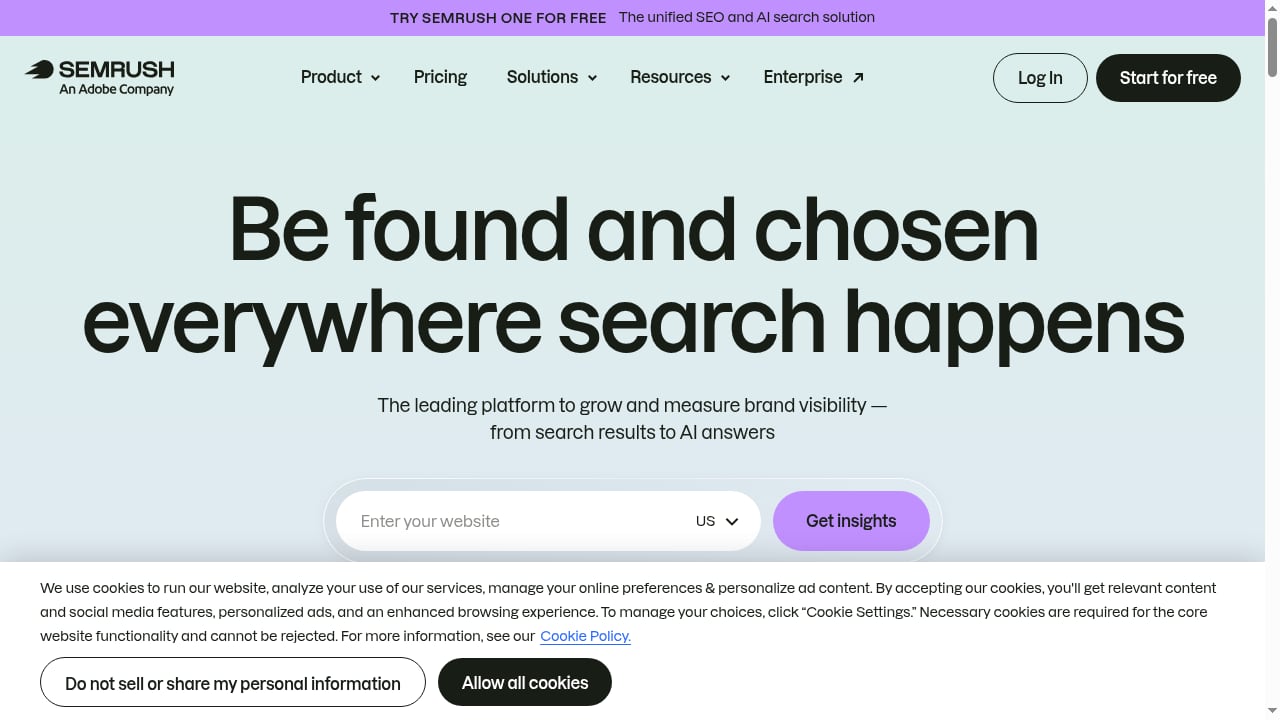
First viewport screenshot of Semrush: Your Unfair Advantage for Growing Brand Visibility.
Semrush fits best when search visibility is a recurring, measurable workstream rather than an occasional check-in.
- In-house SEO and content teams publishing regularly and tracking dozens or hundreds of keywords.
- Agencies and freelancers managing SEO for multiple clients, where the cost is spread across accounts.
- Brands investing in AI search visibility that want prompt tracking and brand perception data alongside classic SEO metrics.
- Multi-location or scaling businesses with a dedicated marketer who will use enough of the suite to justify it.
It fits poorly for a single-location service business that checks rankings once a month. A premium suite you open rarely is an expensive dashboard, not an advantage.
Strengths: where Semrush earns its price
1. Depth across SEO and competitive research
Keyword and backlink databases remain among the largest in the industry. You can research a topic, audit the page, see who outranks you, and inspect their backlinks without switching tools. That consolidation saves real time for teams doing this daily.
2. AI visibility integrated with SEO data
Semrush's AI visibility toolkit tracks how brands appear in AI-generated answers and pairs that with SEO performance in one interface. Prompt research works much like keyword research: it surfaces AI volume, topic difficulty, intent, and competing brand mentions. The Brand Performance report compares share of voice and sentiment against competitors, which is genuinely useful for spotting narrative gaps.
3. A gentler learning curve for existing users
If your team already lives in Semrush, the AI features feel familiar. Less retraining, one login, consolidated reporting.
Limitations: what the marketing page won't tell you
First viewport screenshot of Sign up.
Pricing scales in ways that are easy to underestimate
Semrush's classic plans have started around $139.95/month for Pro, with Guru and Business tiers well above that. The standalone AI visibility toolkit has been priced around $99/month, but that entry tier has been limited to one domain and a small number of custom prompts. Extra domains, teammates, and prompt capacity are add-ons. Semrush One, bundling SEO and AI features, has started around $199/month.
For a solo operator, the entry price can look reasonable. For an agency managing several clients, per-domain and per-seat costs compound quickly. Before committing, model your realistic usage — domains, seats, prompts — not the headline price.
AI insights are not always immediately actionable
Brand perception and strategic opportunity reports are insightful, but turning them into next steps still requires judgment. Teams expecting one-click fixes will be disappointed; teams with a content workflow will get value.
Coverage and depth vary by market
AI visibility tracking depends on which models, languages, and regions are covered. Global brands should verify coverage for their priority markets before relying on the data.
How Semrush compares with alternatives
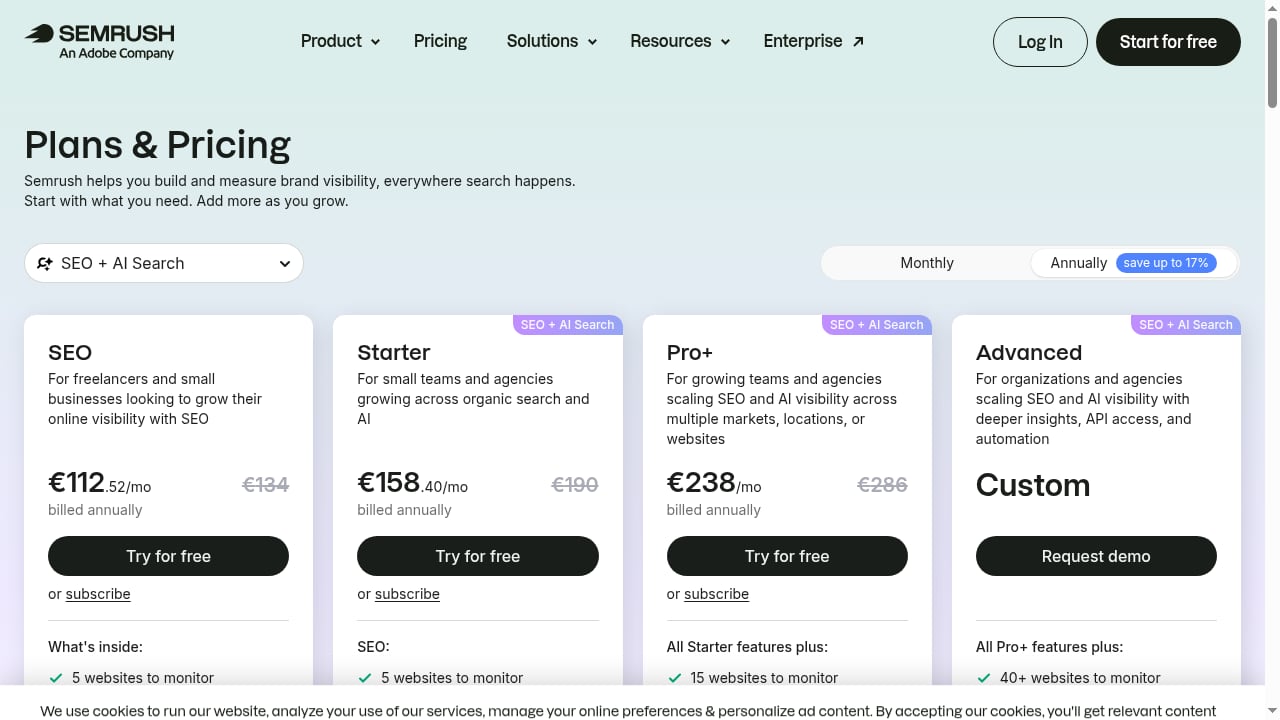
First viewport screenshot of SEO & AI Search Plans and Pricing | Semrush.
| Need | Semrush | Lighter or specialized tools |
|---|---|---|
| Full-stack SEO + AI visibility in one login | Strong fit | Usually requires two tools |
| Budget under ~$100/month | Limited | Better fit |
| Agency multi-client reporting | Strong, but costs scale | Varies; check per-domain pricing |
| Deep AI citation and GEO workflows | Good, improving | Specialized GEO platforms may go deeper |
| Local service business, occasional checks | Overkill | Free Google tools plus a light tool |
If AI search visibility is your primary goal rather than a secondary feature, compare dedicated platforms. Our GEO blog for marketers walks through a repeatable workflow, and the top 10 AI search visibility and brand monitoring tools for 2026 ranks options on model coverage, citation depth, and pricing. Lean teams weighing self-serve options can also read AskScope vs Bluefish for a pricing and workflow comparison.
Setup: what the first two weeks look like
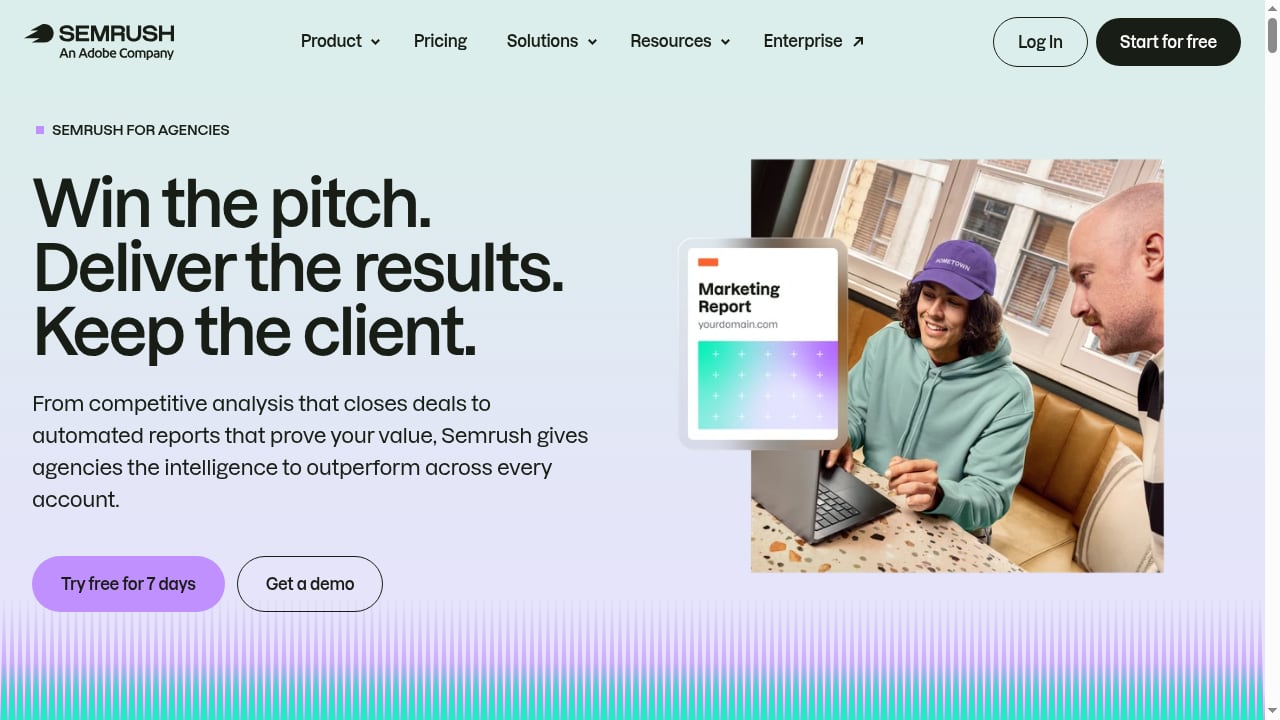
First viewport screenshot of Semrush for agencies | Win pitches. Prove ROI. Scale clients..
- Connect your properties. Add your domain, verify Google Search Console and Analytics, and set up a project.
- Build a keyword baseline. Import your priority keywords and let rank tracking run for a few days before drawing conclusions.
- Run a site audit. Fix crawl and technical issues first; content work on a broken site wastes effort.
- Configure AI visibility tracking. Define a focused prompt set around your brand, category, and competitor comparisons. Start narrow — 20 to 50 prompts — and expand once you see which ones matter.
- Set up competitor tracking. Add three to five direct competitors so share-of-voice and backlink comparisons are meaningful.
- Schedule reporting. Weekly for active campaigns, monthly for executive summaries.
Expect a real learning curve. Budget several hours in week one and a few hours weekly thereafter; teams that skip this step rarely use the suite well.
Decision criteria: should you buy Semrush?
Ask yourself these questions before paying:
- Do we publish consistently? If yes, keyword and content tools earn their keep.
- Is link building part of our strategy? If yes, the backlink index is a genuine asset.
- Do we manage SEO for multiple clients or domains? If yes, model per-domain costs carefully.
- Is AI search visibility a priority channel? If yes, evaluate whether Semrush's AI toolkit is deep enough for your markets, or whether a specialized platform fits better.
- Will at least one person use it weekly? If no, start with free tools and revisit later.
A simple rule: buy Semrush when a specific bottleneck — research depth, competitive intelligence, or consolidated AI and SEO reporting — is slowing you down. Don't buy it because a consultant recommended it.
Related reading
- AskScope vs Siftly vs Brand Armor AI: AI Visibility Tools - Compare AskScope, Siftly, and Brand Armor AI for tracking brand mentions across AI engines. See strengths, gaps, and which GEO platform fits lean teams.
Sources and further reading
- Is Semrush Worth It for a Small Business? An Honest Look - Is Semrush worth it for a small business? An honest look at its price, features, and who actually needs it — plus cheaper alternatives that fit a local budget.
- Semrush AI Visibility Toolkit review: what it gets right (and wrong) - Is Semrush’s AI visibility toolkit worth the investment for you? Here’s a full breakdown of its features and why Profound is the better option for most teams.
- Semrush: Your Unfair Advantage for Growing Brand Visibility - Semrush is the leading platform to grow and measure brand visibility across AI search, SEO, PPC, social, and more.
FAQ
How much does Semrush cost in 2026?
Classic plans have started around $139.95/month, with higher tiers for agencies and larger teams. The standalone AI visibility toolkit has been priced around $99/month with limits on domains and prompts, and Semrush One around $199/month. Annual billing typically reduces the monthly rate. Always confirm current pricing on Semrush's site, since tiers change.
Is Semrush worth it for a small business?
Usually only if you publish content seriously, build backlinks, or manage SEO for others. A single-location business checking rankings occasionally will get more value from free Google tools plus one affordable specialist tool.
Does Semrush track AI search visibility like ChatGPT and Google AI Overviews?
Yes. Its AI visibility toolkit tracks brand mentions and citations in AI answers, with prompt research and brand performance reporting. Coverage of models, languages, and regions should be verified for your priority markets.
Is Semrush better than Ahrefs?
Neither is universally better. Semrush is broader, bundling SEO with advertising, social, and AI visibility features. Ahrefs is often favored for backlink and keyword depth. Choose based on which workflow you need most.
Can I use Semrush's AI visibility toolkit without the SEO suite?
Yes, it is sold as a standalone add-on, but its value is strongest when combined with SEO data. Standalone users may find the entry tier limiting once they add domains or teammates.
Conclusion
Semrush is a genuinely powerful platform, and its expansion into AI search visibility makes it more relevant than a pure SEO suite. The "unfair advantage" claim holds for teams with a real search strategy and the discipline to use the data weekly. For everyone else, the honest advice is to start with free tools, define the bottleneck, and buy only when Semrush solves it. If AI visibility is your priority, read our guide to AI search monitoring across ChatGPT, Perplexity, and Google AI Overviews before you commit.