
Top 10 AI Search Visibility & Brand Monitoring Tools for 2026
AI assistants now answer buying questions directly, often without sending a click to your site. That shift has created a new software category: tools that query large language models on your behalf, track whether your brand appears in the answers, and show which sources the models cite. This ranking covers ten platforms that genuinely belong to that category, scored on transparent criteria and supported by published product information as of 2026.
How we evaluated these tools
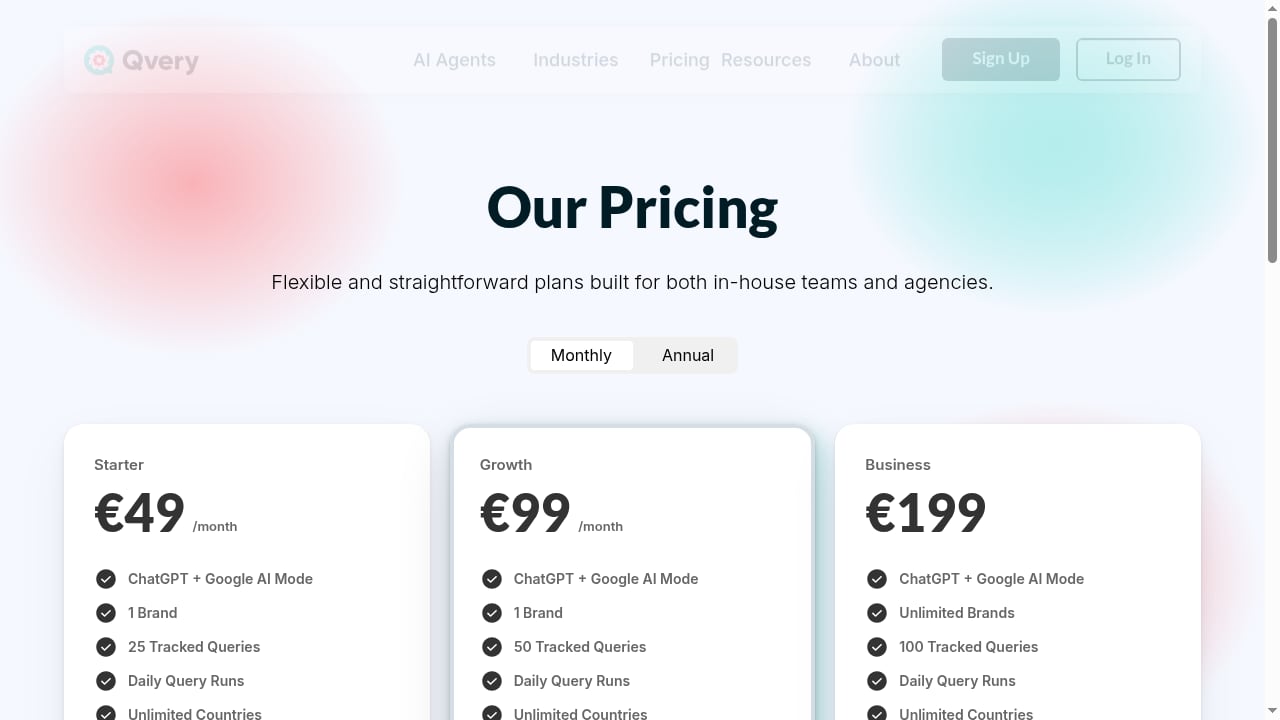
First viewport screenshot of Qvery: Pricing.
Every platform below was assessed against the same seven criteria, using vendor documentation, public pricing pages, and category research. No vendor paid for placement.
- Model coverage: How many engines are monitored (ChatGPT, Google AI Mode/AI Overviews, Perplexity, Gemini, Claude, Grok, DeepSeek, Meta AI).
- Prompt-level tracking: Whether you can define your own buying questions and see mention rates per prompt.
- Citation and source depth: Whether the tool shows the URLs and pages that AI answers draw from.
- Sentiment and perception: Whether it captures how your brand is described, not just whether it appears.
- Competitive benchmarking: Share-of-voice comparisons against named competitors.
- Workflow and actionability: Alerts, recommendations, content or schema fixes, integrations.
- Pricing transparency: Published entry plans, prompt allowances, and scaling costs.
One practical note before the list: tools in this category answer different questions. Some explain why a mention is missing; others only report a score. As IndustryLens puts it, choose a tool that helps explain a missing mention over one that gives you another number to report.
The top 10 AI search visibility and brand monitoring tools
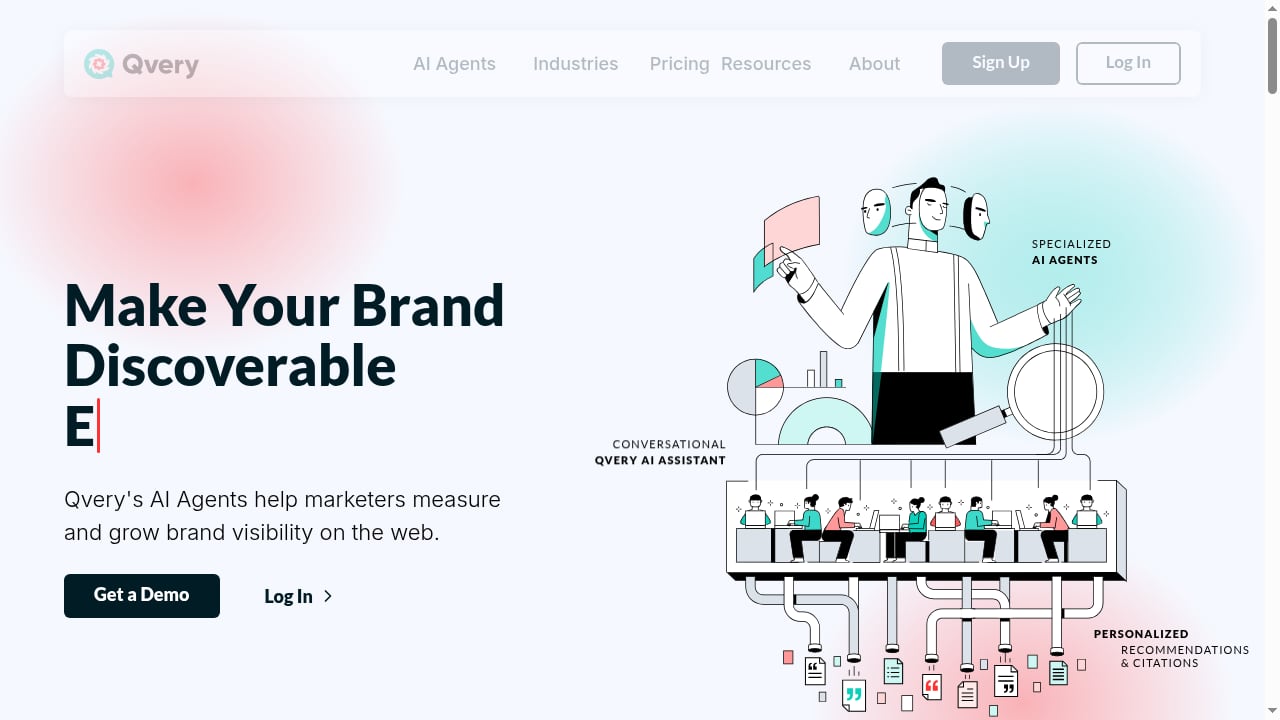
First viewport screenshot of Qvery: Measure & Grow Your Brand Visibility In AI Search Engines.
1. Profound — best for enterprise AEO execution
Profound positions itself as an AI marketing platform rather than a pure tracker. Its Answer Engine Insights module includes Citation Analytics, while Prompt Volumes and Agent Analytics extend the data into planning. In 2026 the company shipped dynamic bot rendering, a Microsoft 365 integration, FactCheck for inaccurate AI mentions, and Citation Decay tracking, and integrated Moz SEO data into its Pages view.
Best for: Large teams that want monitoring plus remediation. Watch out: Pricing is sales-led after the free trial; the $99 Starter tier was removed from the public pricing page in October 2026.
2. Peec AI — best for transparent entry-level prompt tracking
Peec AI publishes unusually specific plan limits: the Starter plan covers 50 prompts, 3 models, and 1 project, with additional models sold as add-ons. The company has also invested in original research on how brand-name semantics affect AI perception.
Best for: Teams that want predictable entry pricing and are willing to expand model coverage as needed. Watch out: Count your buying questions first — 50 prompts fills up quickly across multiple markets.
3. Ahrefs Brand Radar — best for SEO teams extending existing data
Brand Radar combines a pre-collected AI Visibility Index with Custom Prompts for questions you choose. In 2026 Ahrefs added entity extraction to AI response tracking, plus social mention tracking and bot analytics. Standalone pricing starts at $199/mo, with prompt packages from roughly $50/mo.
Best for: Teams already in the Ahrefs ecosystem that want AI visibility next to backlink and keyword data. Watch out: Niche questions may not appear in the pre-collected index, so budget for custom tracking.
4. Semrush AI Toolkit — best for all-in-one search and AI monitoring
Semrush bundles AI visibility into its core paid plans; the Starter SEO + AI Search tier tracks 50 prompts at $199/mo. The free tier was discontinued in August 2026 following the Adobe acquisition, so adoption is now paid-first.
Best for: Teams that want one vendor for classic SEO and AI search. Watch out: Prompt allowances are modest at entry level, and the product is evolving quickly post-acquisition.
5. Scrunch AI — best for page-level diagnostics
Scrunch AI's Core plan covers 125 prompts at $250/mo. Its 2026 Site Diagnostics feature audits pages for AI-search readiness and prioritizes fixes, and a SitecoreAI integration pushes corrections into the CMS where content is managed.
Best for: Content-heavy sites that need to know which pages AI engines actually read. Watch out: Entry pricing is above the category median.
6. Otterly.ai — best for affordable sentiment and position reporting
Otterly.ai starts at $29/mo for 15 prompts, making it one of the cheapest ways to begin. Its rebuilt brand reports emphasize sentiment and position rather than raw mention counts, and a Getfluence partnership extends its reach into AI search distribution.
Best for: Small teams running a first pilot. Watch out: 15 prompts is a narrow starting scope; costs rise as you expand.
7. Evertune — best for statistically rigorous brand perception data
Evertune combines model intelligence with a large consumer panel to produce its AI Brand Index, tracking context, sentiment, and competitive positioning across ChatGPT, Claude, Gemini, Perplexity, Meta AI, and DeepSeek. Source attribution traces mentions back to specific domains and pages. The Pro plan is listed at $800/mo for 100,000 prompts.
Best for: Enterprises that need defensible, large-sample perception data. Watch out: The price point excludes most small teams.
8. AthenaHQ — best for predictive citation monitoring
AthenaHQ's Starter plan is $295/mo with a free tier available. In 2026 it introduced a predictive citation engine and a ChatGPT integration for real-time monitoring, alongside automated remediation features.
Best for: Teams that want early warnings before visibility shifts fully materialize. Watch out: Predictive signals are only as good as the underlying prompt set you configure.
9. Rankscale — best for the lowest-cost entry point
Rankscale's Essentials plan is $20/mo on annual billing, with Pro at $99/mo as the cheapest monthly option. It covers the core monitoring loop across major engines without the content-creation layer.
Best for: Solo marketers and tiny teams validating whether AI visibility tracking is worth budget. Watch out: Limited workflow features; expect to export data into your own reporting.
10. Goodie AI — best for quarterly enterprise programs
Goodie AI's Core plan is $399/mo, billed quarterly or annually. It targets organizations that want structured, longer-cycle visibility programs rather than month-to-month experimentation.
Best for: Mid-market and enterprise teams with formal reporting cadences. Watch out: Annual or quarterly billing reduces flexibility if your prompt strategy changes.
Quick comparison: entry pricing and prompt allowances
| Tool | Entry price | Entry prompt allowance | Models at entry |
|---|---|---|---|
| Rankscale | $20/mo (annual) | Not published | Major engines |
| Otterly.ai | $29/mo | 15 prompts | Core engines |
| Peec AI | €85/mo | 50 prompts | 3 models |
| Ahrefs Brand Radar | $199/mo | Custom prompt packages | Major engines |
| Semrush AI Toolkit | $199/mo | 50 prompts | Major engines |
| Scrunch AI | $250/mo | 125 prompts | Core engines |
| AthenaHQ | $295/mo | Not published | Major engines |
| Goodie AI | $399/mo | Not published | Core engines |
| Evertune | $800/mo | 100,000 prompts | 6+ models |
| Profound | On request | Enterprise scope | Major engines |
Prices and allowances reflect published vendor pages as of 2026 and change frequently — verify before purchase. For a deeper dive into one option, see this Superlines review covering its €79/mo plan and engine coverage.
How to choose: match the tool to your workflow
First viewport screenshot of Qvery Customers: Companies That Trust Us.
If you are a lean marketing team: Start with a low-cost tracker such as Otterly.ai or Rankscale to establish a baseline prompt set. If you need a self-serve loop that moves from monitoring to prioritized actions, a platform like AskScope is worth evaluating alongside these tools — it focuses on citation analysis and GEO task recommendations for small teams, and its AI search monitoring workflow shows how prompt sets and citations fit together.
If you already run a mature SEO stack: Ahrefs Brand Radar or Semrush AI Toolkit avoids adding another dashboard, but check whether your niche questions are covered by pre-collected indexes or require custom tracking.
If you need enterprise-grade perception data: Evertune and Profound offer the deepest attribution and remediation, at correspondingly higher cost and sales-led onboarding.
If you are comparing specific vendors: Head-to-head breakdowns such as AskScope vs Bluefish clarify where a self-serve GEO platform diverges from an enterprise agentic marketing engine.
Common pitfalls when buying AI visibility software

Qvery: Measure & Grow Your Brand Visibility In AI Search Engines product interface.
- Monitoring without action. A score that never changes your content or schema is a reporting cost, not a growth lever.
- Single-model tracking. ChatGPT alone misses Google AI Mode, Perplexity, and Gemini, where many buying questions now resolve.
- Ignoring prompt allowances. Entry plans with 15–50 prompts can be exhausted by one product line in two languages.
- Skipping citation review. The source URLs behind an answer tell you far more than the mention count alone.
- Assuming attribution is solved. No platform yet closes the loop from AI citation to deterministic revenue.
Related reading
- AskScope vs Siftly vs Brand Armor AI: AI Visibility Tools - Compare AskScope, Siftly, and Brand Armor AI for tracking brand mentions across AI engines. See strengths, gaps, and which GEO platform fits lean teams.
- AskScope vs Bluefish: AI Visibility for Lean Teams - AskScope vs Bluefish: a self-serve GEO platform for lean teams compared with an enterprise agentic marketing engine. Pricing, workflows, and fit.
- SISTRIX Toolbox Review 2026: Features, Pricing, Pros & Cons - Evidence-based SISTRIX Toolbox review: Visibility Index, pricing from €99/module, EU strengths, backlink limits, setup, and who should choose it.
Sources and further reading
- The 10 Best AI Visibility Tools for 2026 - Compare the 15 best AI visibility tools for 2026, ranked by AI model coverage, monitoring depth, GEO features, and pricing. Updated May 2026.
- 7 Best AI Brand Monitoring Tools for 2026 - AI search engines don't index content; they extract it. For a brand manager, that shift creates a painful blind spot: your reputation is being shaped inside private AI conversations like ChatGPT and Google AI Overviews, yet traditional social listening and
FAQ
What is the difference between AI search visibility software and traditional brand monitoring? Traditional brand monitoring watches news, blogs, and social channels. AI search visibility tools programmatically query LLMs with defined prompts and record whether your brand is mentioned, how it is described, and which sources are cited.
How many prompts do I need? Start with your ten most valuable buying questions per market, then multiply by languages and regions. A 50-prompt plan supports roughly one product line in one language.
Do these tools replace SEO software? No. AI answers still draw heavily on web content and structured data. Most teams run both, which is why integrations with SEO platforms matter.
Can I track AI visibility for free? Several vendors offer free tiers or trials, and some GEO platforms provide free visibility checks with limited daily monitoring. Free access is usually enough to validate the concept, not to run an ongoing program.
Which models should I monitor? At minimum ChatGPT, Google AI Mode or AI Overviews, and Perplexity. Add Gemini, Claude, Grok, and DeepSeek if your audience is technical or global.
Conclusion
The 2026 market splits into three tiers: low-cost trackers (Rankscale, Otterly.ai), mid-market platforms with workflow features (Peec AI, Ahrefs Brand Radar, Semrush AI Toolkit, Scrunch AI, AthenaHQ, Goodie AI), and enterprise perception systems (Evertune, Profound). The right choice depends less on feature counts and more on whether the tool can explain a missing mention and tell you what to fix. Pick one, define a realistic prompt set, and review citations monthly — that loop matters more than any single dashboard.