AskScope vs Bluefish: Which AI Visibility Platform Fits Your Team?
AI search has become a primary discovery channel, and the tools that track your brand's presence in AI answers are not interchangeable. AskScope and Bluefish sit at opposite ends of the market: one is a self-serve GEO platform built for lean marketing teams, the other is an enterprise agentic marketing engine aimed at Fortune 500 organizations. This comparison breaks down their positioning, workflows, and practical fit so you can choose based on how your team actually operates.
What AskScope Is Built For
AskScope is a self-serve GEO (Generative Engine Optimization) platform designed for lean marketing teams. It addresses the shift from traditional search engines to AI-powered answers by showing where a brand stands in AI-generated responses, where competitors lead, and what actions to take next.
The platform runs on a continuous loop: Monitor, Analyze, Act. Core capabilities include:
- AI visibility monitoring across prompts
- Competitor analysis
- Citation analysis to trace the sources shaping AI answers
- Prioritized recommendations and tasks
- Content creation and distribution for GEO
AskScope emphasizes connecting every metric to evidence, ensuring scores are based on actual AI answers rather than estimates. It offers a free visibility check with seven days of daily ChatGPT monitoring across 40 prompts, and pricing plans that start free and scale with team needs. The product is positioned as a practical, actionable solution for lean marketing teams, reducing operational burden and enabling faster GEO improvements.
For a deeper look at how AskScope handles multi-engine tracking, see the guide on AI search monitoring for ChatGPT, Perplexity, and Google AIO.
What Bluefish Is Built For
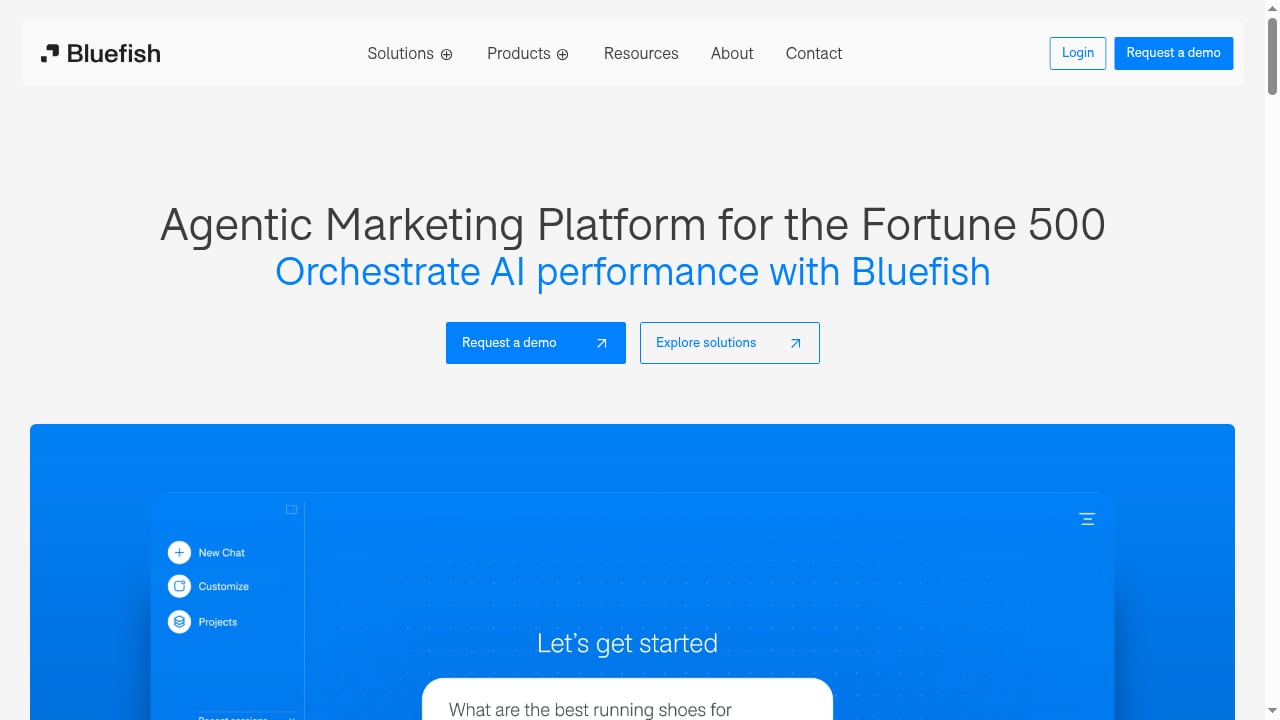
First viewport screenshot of Bluefish.
Bluefish describes itself as "The Agentic Marketing Engine for the Fortune 500" and invites organizations to "Orchestrate your brand's AI performance with the Bluefish AMP." That positioning is explicit: Bluefish targets large enterprises with complex brand governance, procurement processes, and multi-team coordination needs.
According to third-party comparisons, Bluefish is an enterprise platform that treats AI representation as a governance problem for large brands. A 2026 alternatives review notes that Bluefish is "an enterprise AI-agent visibility and brand-management platform aimed at large organizations" and that its core motion is enterprise governance and SSO, with sales-led pricing rather than self-serve signup.
In other words, Bluefish is built for organizations that need bundled governance workflows, procurement compatibility, and managed onboarding. If your team fits that profile, Bluefish is designed for you. If you are a lean marketing team that needs to move quickly without a sales cycle, the fit is different.
Key Differences at a Glance
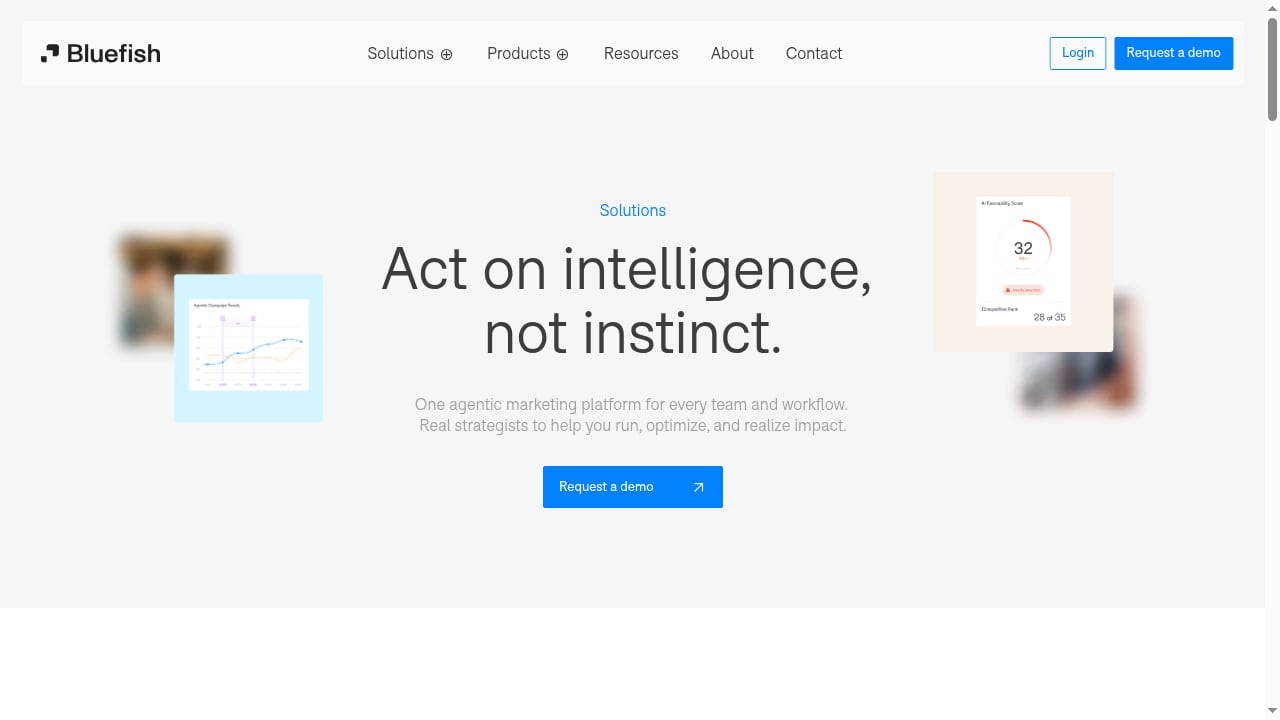
First viewport screenshot of Bluefish.
| Dimension | AskScope | Bluefish |
|---|---|---|
| Target buyer | Lean marketing teams, SMBs, startups, agencies | Fortune 500 enterprises |
| Signup model | Self-serve, free visibility check | Enterprise, sales-led |
| Core workflow | Monitor, Analyze, Act loop | Agentic marketing engine (AMP) |
| Pricing | Starts free, scales with team needs | Enterprise pricing (contact sales) |
| Governance focus | Practical GEO execution | Enterprise governance and brand safety |
| Evidence | Metrics tied to actual AI answers | Not specified in public sources |
Where AskScope Wins for Lean Teams
Speed to First Insight
AskScope's free visibility check gives you seven days of daily ChatGPT monitoring across 40 prompts. That means you can see what AI says about your brand before committing to a contract. For lean teams, this removes the biggest barrier to entry: proving the channel matters without a procurement cycle.
Actionable GEO Workflow
The Monitor, Analyze, Act loop is designed to close the gap between insight and execution. Instead of leaving you with a dashboard and a to-do list you build yourself, AskScope provides prioritized recommendations and tasks, plus content creation and distribution for GEO. This matters because monitoring alone does not improve visibility; publishing and iterating do.
Evidence-Based Scoring
AskScope connects every metric to evidence, ensuring scores are based on actual AI answers. This is a meaningful differentiator in a market where many tools report visibility without showing the underlying response. If you need to justify GEO investment to stakeholders, evidence-backed scores are easier to defend.
Transparent, Scalable Pricing
AskScope starts free and scales with team needs. For a lean team testing AI visibility for the first time, that is a lower-risk starting point than an enterprise contract. You can validate the channel, build a baseline, and expand as you see results.
Where Bluefish May Be the Better Fit
Bluefish AI.
Bluefish is not a weak product; it is a different product. Its enterprise focus means it is built for organizations that need:
- Governance workflows around AI representation
- SSO and procurement compatibility
- Managed onboarding and white-glove rollout
- Brand-safety programs at scale
A 2026 comparison notes that "if you are a large brand that needs bundled governance and white-glove rollout, Bluefish is built for that buyer." If your organization has multiple product lines, regions, and compliance requirements, those capabilities may justify the enterprise motion.
The trade-off is speed and accessibility. Enterprise platforms typically require a sales call, an annual contract, and onboarding time. For a lean team trying to answer "do we even have an AI visibility problem?" that sequence can be backwards.
How to Choose: A Decision Framework
Use these questions to decide which platform fits your situation:
How quickly do you need to start? If you want to see AI answers about your brand this week, AskScope's free visibility check is the faster path. If you are planning a multi-quarter governance initiative, Bluefish's enterprise motion may align.
Who owns the work? If a small marketing team will run GEO day to day, AskScope's self-serve workflow and prioritized tasks reduce operational burden. If a dedicated brand governance function will own it, Bluefish's enterprise features may be more relevant.
What does your procurement process look like? If you can sign up for a tool without a sales call, AskScope removes friction. If your organization requires vendor review and SSO, Bluefish is built for that environment.
What is your budget model? AskScope starts free and scales with team needs. Bluefish is enterprise pricing, which typically means annual commitment.
What evidence do you need? AskScope ties metrics to actual AI answers. If your stakeholders need to see the underlying response, that matters.
For a broader view of how these platforms compare with others in the category, see the Top 10 AI search visibility and AEO/GEO tracking platforms for 2026.
Practical Example: A Lean Team's First 30 Days
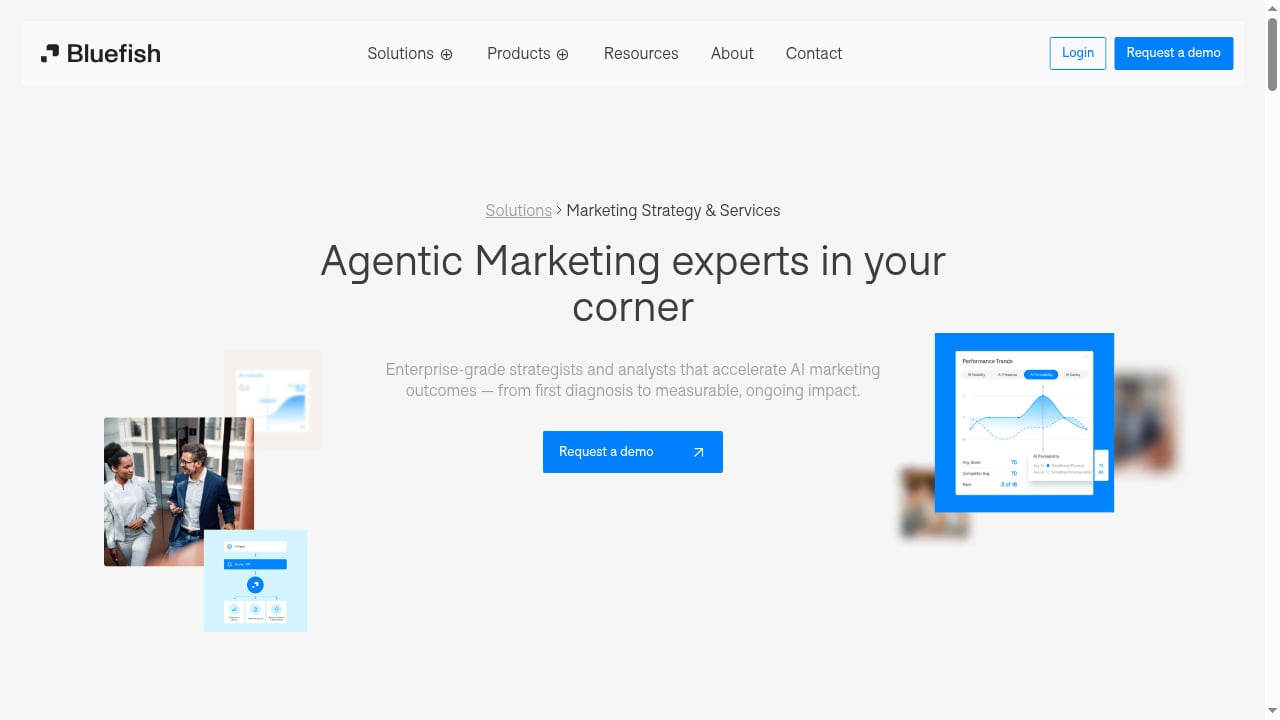
First viewport screenshot of Services - Bluefish.
Imagine a 10-person B2B SaaS marketing team. They suspect AI assistants are recommending competitors but have no data. Here is how AskScope's workflow would look:
- Week 1: Run the free visibility check. Get seven days of daily ChatGPT monitoring across 40 prompts. Identify which prompts mention the brand and which surface competitors.
- Week 2: Analyze citation gaps. See which sources feed AI answers and where competitors are cited instead.
- Week 3: Act on prioritized recommendations. Create or update content to fill the gaps identified in citation analysis.
- Week 4: Re-run monitoring. Compare visibility scores and adjust the content plan.
This loop is designed to be repeatable without a dedicated analyst. For a team without enterprise resources, that is the core value proposition.
Related reading
- SISTRIX Toolbox Review 2026: Features, Pricing, Pros & Cons - Evidence-based SISTRIX Toolbox review: Visibility Index, pricing from €99/module, EU strengths, backlink limits, setup, and who should choose it.
- AskScope vs PallasAI vs Rank Prompt: AI Visibility Tools - Compare AskScope, PallasAI, and Rank Prompt for AI visibility and GEO. See which platform fits lean teams monitoring AI answers and citations.
Sources and further reading
- AskScope — AI search visibility for small businesses - See when AI recommends you, ignores you, or gets you wrong. AskScope is a low-price AI search visibility monitor — run a free scan to see what AI says about your business, and what to fix.
- Top 5 Bluefish AI Alternatives Worth Using in 2026 -
Problem: Bluefish AI sits in a category that is moving faster than most buying committees can track. A year ago, it was enough to ask whethe
- 7 Best Bluefish Alternatives in 2026 (Tested) | Livesov - Looking for a Bluefish alternative? Livesov is a self-serve AI visibility tracker for all 5 LLMs from $9/mo, with no sales call. See how it compares.
FAQ
Is AskScope a Bluefish alternative?
AskScope is a self-serve GEO platform for lean marketing teams, while Bluefish is an enterprise agentic marketing engine for Fortune 500 organizations. They serve different buyers. If you need self-serve AI visibility monitoring with evidence-based scoring, AskScope is positioned for that. If you need enterprise governance and managed onboarding, Bluefish is built for that.
Does AskScope offer a free trial?
AskScope offers a free visibility check with seven days of daily ChatGPT monitoring across 40 prompts. Pricing plans start free and scale with team needs.
What is Bluefish's pricing?
Bluefish is an enterprise platform with sales-led pricing. Public sources describe it as enterprise pricing with a contact-sales motion. You should verify current terms directly with Bluefish.
Can AskScope track competitors in AI answers?
Yes. AskScope includes competitor analysis and citation analysis to trace the sources shaping AI answers. This helps you see where competitors lead and what actions to take next.
Which platform is better for a small marketing team?
For a small marketing team that needs to start quickly without a sales call, AskScope's self-serve model and free visibility check are designed for that scenario. Bluefish's enterprise motion is better suited to large organizations with governance and procurement requirements.
Conclusion
AskScope and Bluefish are not direct substitutes; they are built for different stages and structures. AskScope is a self-serve GEO platform that helps lean marketing teams monitor, analyze, and improve AI visibility with evidence-based scoring and a practical action loop. Bluefish is an enterprise agentic marketing engine for Fortune 500 organizations that need governance, SSO, and managed rollout.
If your priority is speed, transparency, and a workflow you can run without a procurement cycle, AskScope is the more practical starting point. If your priority is enterprise governance at scale, Bluefish is designed for that buyer. The right choice depends on how your team works, not on which platform has more features on a checklist.
For a side-by-side look at how AskScope compares with other AI visibility tools, see the AskScope vs Finseo comparison.