GrowByData Review: Search & AI Visibility Intelligence for Enterprise Brands
Most AI visibility tools answer one question: did ChatGPT mention us? GrowByData's Search & AI Visibility Intelligence answers a wider one: how does our brand appear across Google organic results, Shopping ads, SERP features, and AI-generated answers, on the same keyword set, in the same dashboard? This review examines what the platform does well, where it falls short, and which enterprise teams should shortlist it.
What GrowByData Search & AI Visibility Intelligence actually does
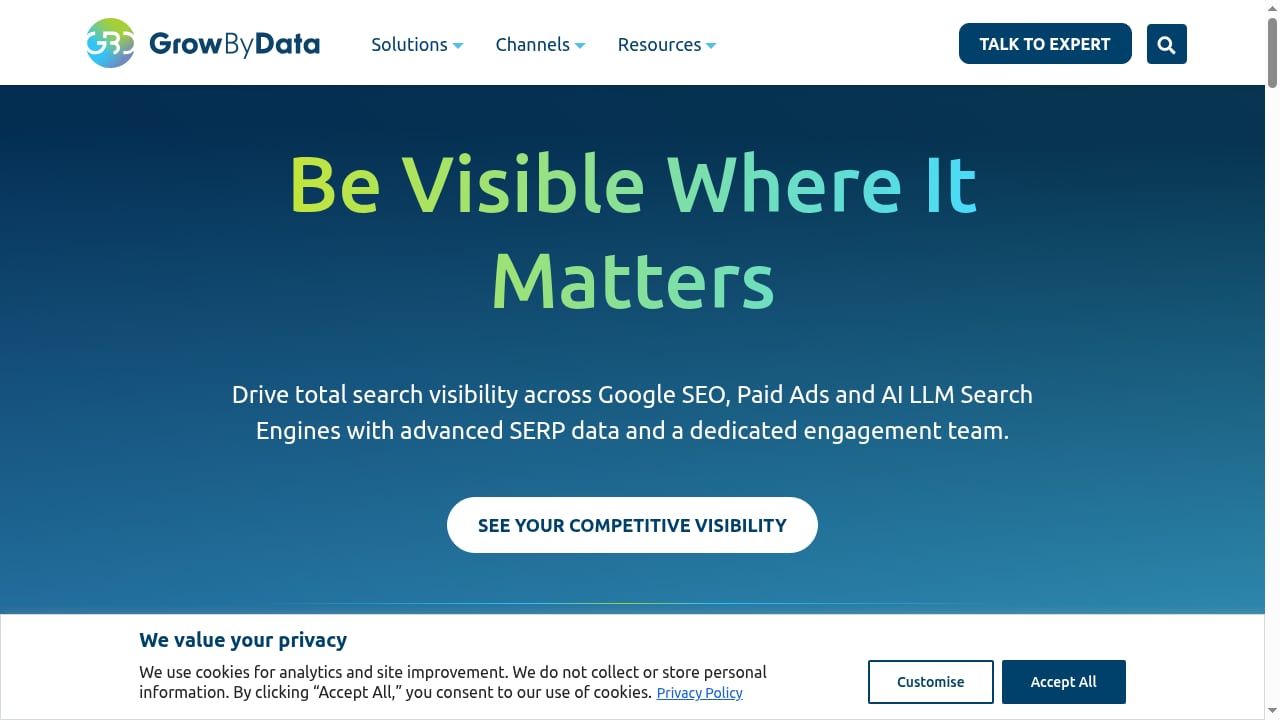
First viewport screenshot of Search & AI Visibility Intelligence for Enterprise Brands | GrowByData.
The product tracks competitor and brand visibility across four surfaces:
- Google organic search — rankings, SERP features, and keyword-level position changes.
- Google Shopping Ads — competitive paid visibility on product queries.
- AI search surfaces — Google AI Mode and AI Overviews, plus ChatGPT and Perplexity.
- Keyword and market scoping — tracking is configured around your keyword set and markets, not a shared prompt library.
The core differentiator is unification. Instead of buying an SEO rank tracker, a Shopping intelligence tool, and an AI visibility monitor, enterprise teams get one keyword framework spanning all three. That matters when a buying question can surface a competitor in an AI answer, an organic result, and a Shopping ad simultaneously.
Who it is built for

First viewport screenshot of Case Studies - GrowByData - Client Value -.
The product context is explicit: enterprise brands and agencies. In practice, that means teams with:
- Multi-market or multi-brand portfolios that need consistent tracking definitions across business units.
- Paid and organic teams sharing a keyword list — Shopping ad visibility and organic rankings on one dashboard reduces the classic disagreement about which channel "owns" a query.
- Agency reporting obligations — client-facing visibility reporting benefits from a single data source rather than three stitched exports.
- Procurement and security review — enterprise deployment typically involves SSO, role-based access, and vendor security documentation.
If you are a solo consultant tracking twenty prompts in ChatGPT, this platform is heavier than you need. A lighter tool will do. For a comparison of those options, see our roundup of AI visibility monitoring and GEO software.
Strengths
1. One keyword set across Search, Shopping, and AI
This is the strongest argument for the platform. Most competitors specialize: Profound and Scrunch AI focus on cross-LLM citation tracking, BrightEdge leans organic, and Shopping intelligence often lives in separate retail tools. GrowByData's positioning is the intersection — the same keyword scope feeding organic, paid, and AI views.
2. Scoped deployment, not a shared prompt library
Many AI visibility tools track a vendor-defined prompt set. GrowByData scopes deployment to your team's keywords. For enterprise brands with specific product terminology, regional phrasing, and branded query patterns, that produces more decision-relevant data than a generic prompt index.
3. Enterprise deployment orientation
Public materials describe dedicated, scoped deployment and security documentation available on request. That is a meaningful signal for teams whose procurement process requires a security questionnaire response and a standard agreement before a pilot.
4. Google AI surface coverage
Tracking Google AI Mode and AI Overviews alongside traditional rankings reflects where enterprise search visibility is actually shifting. Google's AI surfaces inherit from the same index as organic results, so seeing both in one place helps teams connect content changes to AI citation outcomes.
Limitations and trade-offs
Cross-LLM depth is not the headline
If your entire job is tracking citations across nine or ten AI engines, dedicated specialists go deeper. GrowByData covers Google AI surfaces, ChatGPT, and Perplexity — a practical set, but not the broadest engine list on the market. Teams whose AI visibility program is engine-maximalist should evaluate specialists first.
Pricing is not published
Enterprise pricing is quote-based. That is normal in this category — Profound, Conductor, and BrightEdge all gate pricing behind sales — but it means you cannot model cost from a pricing page. Budget for a demo and a scoping conversation.
Shopping coverage is Google-specific
Google Shopping Ads competitive data is a genuine differentiator, but teams needing Amazon retail intelligence or other marketplaces will still need separate tooling. Treat the Shopping capability as Google-ecosystem coverage, not total retail visibility.
Verification is on you
As with any enterprise vendor, confirm current security certifications, SSO/SAML support, data retention policies, and SLA terms directly. "Enterprise plan available" on a marketing page does not guarantee a SOC 2 report or identity-provider provisioning.
Pricing signals
First viewport screenshot of Granular Pricing insights and analytics for Pricing Managers.
GrowByData does not publish list pricing. Based on the enterprise positioning and comparable vendors in this category, expect:
- Quote-based annual contracts typical of enterprise search platforms.
- Scoping driven by keyword volume, markets, and tracked surfaces rather than seat count alone.
- A sales-led evaluation process including a demo and, for larger organizations, a security review.
For context, entry-level AI visibility tools start around $20–$30 per month, mid-market options land between $199 and $400, and enterprise platforms are custom-quoted. GrowByData sits firmly in the enterprise tier. If budget transparency is a hard requirement, ask for a written scope and pricing breakdown early in the process.
Setup and onboarding
Expect a configuration-heavy onboarding rather than a self-serve signup:
- Keyword and market scoping — you define the keyword set and markets that matter, which becomes the tracking backbone.
- Surface configuration — organic, Shopping, and AI surfaces are enabled against that keyword set.
- Access provisioning — enterprise deployments typically involve SSO and role-based permissions.
- Reporting alignment — dashboards or exports configured for internal stakeholders or agency clients.
The upside of scoped deployment is relevance. The cost is that onboarding takes longer than a plug-and-play tool, and the quality of your initial keyword architecture determines how useful the data is later.
How it compares to alternatives
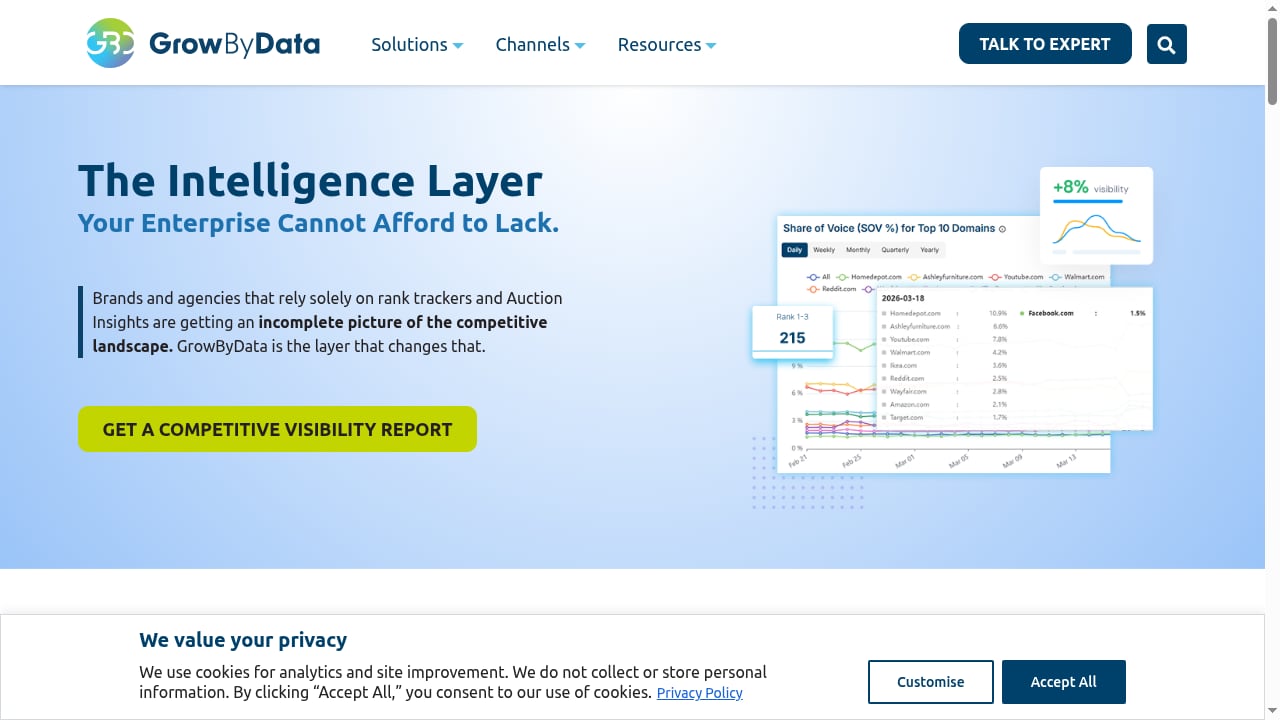
First viewport screenshot of Competitive Intelligence for eCommerce & Search Marketing.
| Need | GrowByData | Dedicated AI visibility specialists | Incumbent enterprise SEO suites |
|---|---|---|---|
| Google organic + SERP features | Yes | Partial | Yes |
| Google Shopping Ads competitive data | Yes | Rarely | Sometimes |
| Google AI Mode / AI Overviews | Yes | Varies | Growing |
| Cross-LLM engine breadth | Moderate | Broadest | Limited |
| Scoped to your keywords | Yes | Mixed | Yes |
| Published pricing | No | Sometimes | Rarely |
The decision rule is straightforward. If your visibility problem spans paid, organic, and AI on Google, GrowByData's unified model removes integration work. If your problem is narrowly "which LLMs cite us and why," a specialist is the better fit. For a framework on choosing between these categories, see AI search optimization tools: what to track.
Decision criteria: should you shortlist it?
Shortlist GrowByData if:
- You manage enterprise-scale keyword sets across multiple markets or brands.
- You want Google Shopping competitive visibility in the same view as organic and AI results.
- Your procurement process requires vendor security documentation and dedicated support.
- You prefer scoped tracking over a shared prompt library.
Look elsewhere if:
- You need the widest possible cross-LLM engine coverage.
- You require self-serve signup and published pricing.
- Your AI visibility program is standalone and does not touch Google Search or Shopping.
A practical evaluation step: bring three real buying questions to the demo, ask to see the answer and the cited sources for each, and confirm what happens when your keyword volume exceeds the initial scope. That single exercise reveals more than a feature checklist.
Related reading
- AI Search for Consultants: Win Client Recommendations - Consultants: learn how to track and improve your visibility in ChatGPT, Perplexity, and Google AI answers, with tools, metrics, and a 30-day plan.
- Citation Rate in AI Search: Benchmarks & How to Improve It - Learn what a good citation rate looks like across ChatGPT, Perplexity, and Google AI Mode, how to measure it, and how to improve AI citations.
Sources and further reading
- 15 Best AI Visibility Platforms for Enterprise (2026) - 15 AI visibility platforms scored on enterprise security, deployment and support, not just engine coverage and price.
- AI Search Visibility - Analytics & Optimization Platform Reviews 2026 - Filter reviews by the users' company size, role or industry to find out how AI Search Visibility - Analytics & Optimization Platform works for a business ...
- AI Search Visibility Tools 2026: 18 Compared & Priced - Compare 18 AI search visibility tools (Profound, Peec AI, Otterly, Scrunch and more) on pricing ($20-$800/mo), features and GEO coverage. Updated weekly.
FAQ
What is GrowByData Search & AI Visibility Intelligence?
It is an enterprise visibility platform that tracks brand and competitor presence across Google organic search, Google Shopping Ads, SERP features, and AI search surfaces including Google AI Mode, AI Overviews, ChatGPT, and Perplexity — scoped to your keyword set and markets.
How much does GrowByData cost?
Pricing is not published. It is quote-based and scoped to keyword volume, markets, and tracked surfaces. Expect an enterprise contract structure with a sales-led evaluation.
Does it replace a dedicated AI visibility tool?
Not entirely. It covers major AI surfaces alongside Search and Shopping data. If your primary need is deep cross-LLM citation analytics across many engines, a specialist tool is complementary or preferable.
Is it suitable for agencies?
The product context includes agencies. Multi-client reporting benefits from unified Search, Shopping, and AI data, though agencies should confirm multi-account management and white-label reporting during evaluation.
What should I verify before signing?
Ask for current security certification documentation, SSO/SAML support details, data retention and residency policies, SLA terms, and a written scope covering keyword volume and tracked markets.
Conclusion
GrowByData's Search & AI Visibility Intelligence occupies a specific and defensible position: unified Google Search, Shopping, and AI visibility on one scoped keyword set, built for enterprise deployment. It is not the broadest cross-LLM tracker, and its quote-based pricing demands a real evaluation process. But for enterprise brands and agencies whose visibility question spans paid, organic, and AI answers on Google, the unified model is a genuine advantage over stitching three tools together. Shortlist it, run the three-buying-questions test, and verify the enterprise requirements your procurement team cares about before committing.