AI Search Optimization Tools: What to Track in 2026
AI search optimization tools are software that helps you measure and improve how your brand appears in AI-generated answers — ChatGPT, Perplexity, Google AI Overviews, and similar surfaces. That definition is doing a lot of work, because the category has split into at least four different jobs: visibility monitoring, content optimization, technical auditing, and reporting. Buying one tool for all four is how teams end up paying for features nobody uses.
This guide breaks the category down by job, shows what to evaluate before you buy, and gives a practical way to decide which type of tool your team actually needs first.
What "AI search optimization" actually covers

What citation gaps reveal about your competitors' AI visibility editorial illustration.
Traditional SEO tools optimize for a ranked list of links. AI search optimization tools optimize for a synthesized answer that may cite zero, one, or several sources — and that answer changes depending on how the prompt is phrased.
That difference creates four distinct workstreams:
- Visibility monitoring — tracking whether and where your brand is mentioned in AI answers, and how that changes over time.
- Citation analysis — identifying which third-party sources the AI model is drawing from, so you can influence them.
- Content optimization — improving pages so they are more likely to be retrieved and quoted.
- Technical and data hygiene — fixing the structured data, entity consistency, and crawlability issues that make retrieval harder.
Most tools are strong in one or two of these. Very few are strong in all four, and the ones that claim to be usually mean "we have a dashboard for each."
The four tool categories, compared
First viewport screenshot of Customers are asking AI. Is your brand in the answer?.
1. AI visibility and GEO monitoring platforms
These tools run a defined set of prompts against one or more AI models on a schedule and record the results. The output is typically a mention rate, a position or prominence score, and a list of competitors that appeared instead of you.
The useful signal here is change over time. A single snapshot tells you almost nothing — AI answers are non-deterministic, so one run is noise. What matters is whether your mention rate across 40 prompts is trending up or down after you publish something.
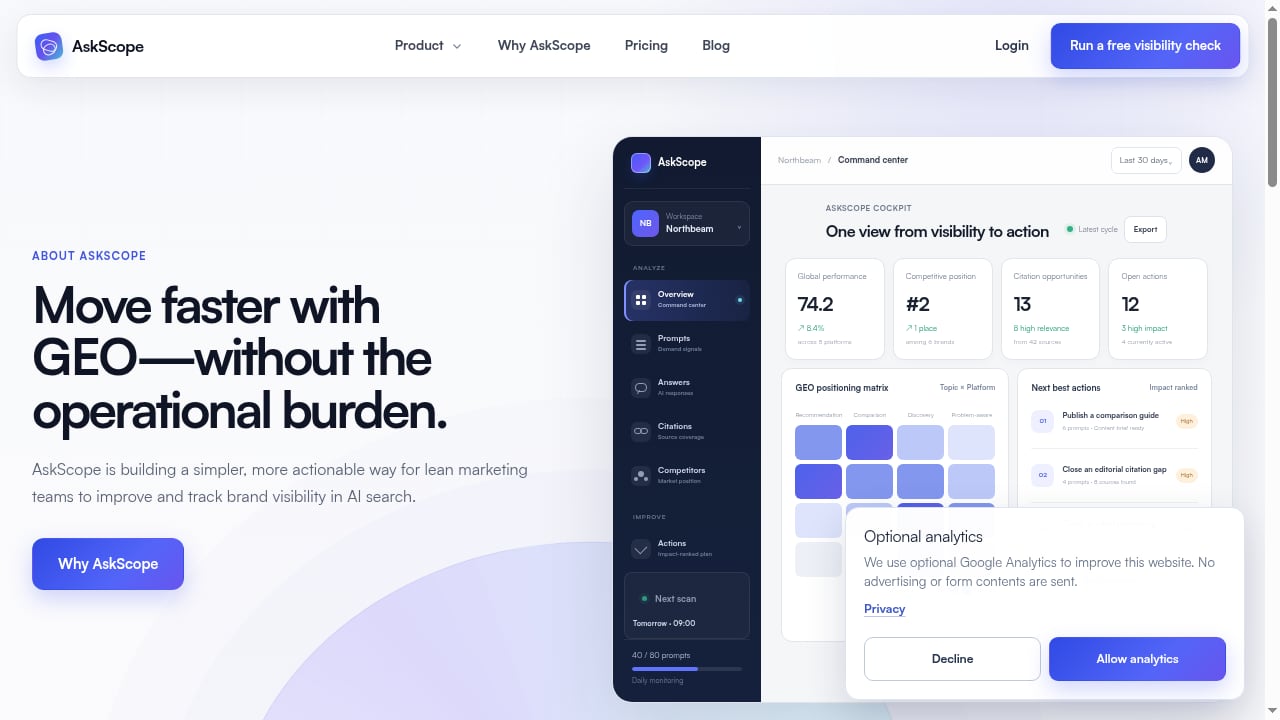
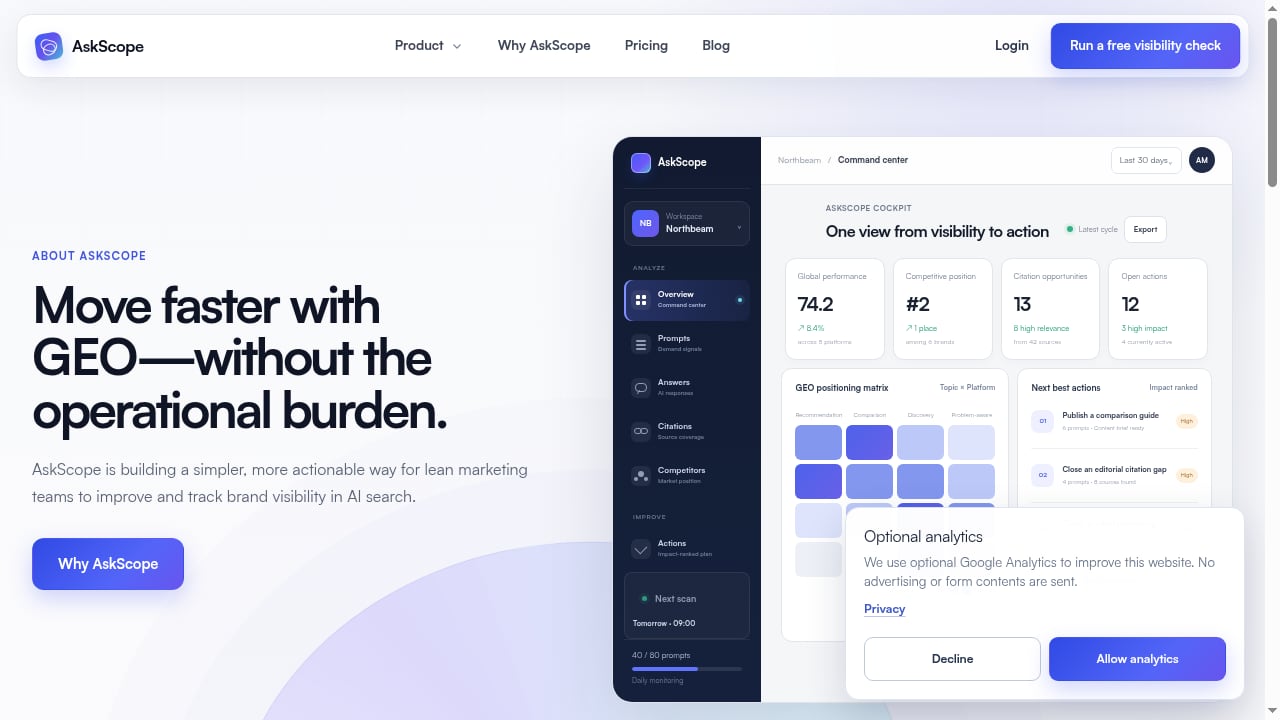
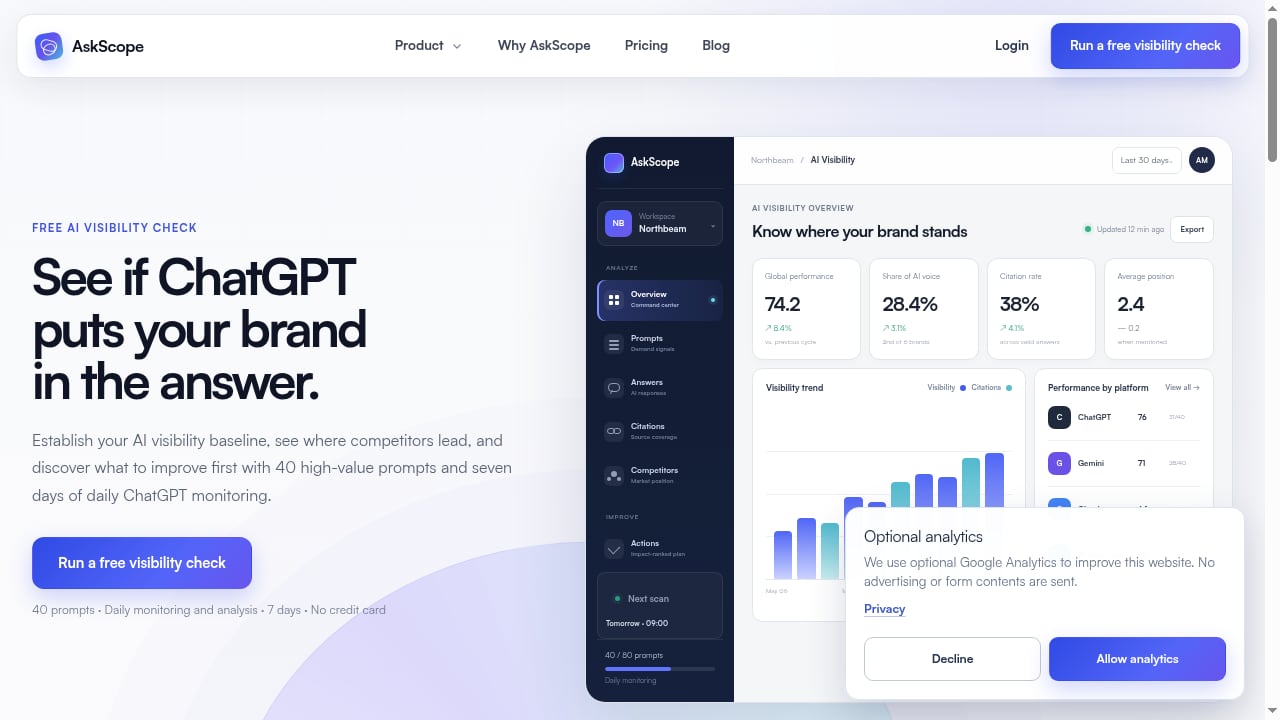
AskScope fits this category. It is a self-serve platform for monitoring and improving brand visibility in AI search, aimed at lean marketing teams rather than enterprise SEO departments. It tracks mentions, positions, and changes over time, analyzes which competitors AI recommends instead, and traces the citations shaping answers. The workflow goes past reporting: prioritized recommendations and tasks, plus content creation and distribution tools so you can act on an insight and then retest. There is a free visibility check and a seven-day free trial with daily ChatGPT monitoring across 40 prompts.
If you want a concrete example of pairing this kind of monitoring with an entity-data platform, the AskScope and Yext workflow walks through monitoring AI answers, fixing Knowledge Graph data, and retesting GEO content.
2. Content optimization platforms
These are the descendants of on-page SEO editors. They analyze a draft against competing pages and suggest structural and semantic improvements. Increasingly they also surface whether your brand is mentioned in AI answers, though usually as a secondary feature rather than the core product.
Clearscope is the reference point here for human-written content optimization. If your primary problem is "our writers need better briefs," this category solves it. If your primary problem is "we don't know whether ChatGPT recommends us," it does not. The AskScope vs Clearscope comparison covers where the two approaches diverge and which fits a lean team.
3. Technical SEO suites with AI modules
Large platforms have bolted AI visibility tracking onto existing SEO suites. The advantage is one login and one invoice. The trade-off is depth: prompt coverage, competitor benchmarking, and citation tracing are often shallower than in dedicated GEO tools, because the AI module is a retention feature rather than the product's reason to exist.
4. Reporting and data layers
A smaller category, but relevant for agencies: tools that pull AI visibility data into client-facing reports or into a warehouse. Worth considering only after you have a monitoring source producing data worth reporting on.
What to evaluate before you buy
First viewport screenshot of Customers are asking AI. Is your brand in the answer?.
Source 1's testing framework for AI SEO tools is a reasonable starting point — accuracy, pricing, integrations, ease of use, reliability. For AI search specifically, three criteria deserve more weight than they get in generic roundups.
Prompt coverage and transparency. How many prompts are tracked, and can you see them? A tool that reports "visibility score: 62" without showing the prompts behind it is not auditable. You need to know which questions were asked, on which model, on which date.
Model coverage. ChatGPT, Perplexity, Gemini, and Google AI Overviews behave differently and cite different sources. A tool that only tracks one model gives you a partial picture — but a tool that tracks five badly is worse than one that tracks one well. Start with the model your audience actually uses.
Actionability. This is the real dividing line. Monitoring without a next step produces a dashboard that gets opened twice. Ask whether the tool tells you what to change, or only what happened. The most useful platforms connect every metric to evidence and then to a task.
A secondary consideration: pricing model. Per-seat pricing punishes agencies onboarding clients; per-prompt pricing punishes teams that want broad coverage. Predictable costs matter more in this category than in traditional SEO, because prompt sets tend to grow.
A practical selection framework
First viewport screenshot of Customers are asking AI. Is your brand in the answer?.
Rather than comparing feature lists, work backwards from the question you cannot currently answer.
If the question is "Does AI recommend us at all?" — start with a free visibility check or a low-cost monitoring tool. You need a baseline before anything else. Do not buy a content optimization platform to answer this.
If the question is "Which competitors does AI recommend instead, and why?" — you need competitor benchmarking and citation analysis. This is where dedicated GEO platforms separate from SEO suites. The guide to monitoring competitor AI presence covers how to structure that tracking across ChatGPT, Perplexity, and Gemini.
If the question is "We know we're invisible — what do we publish?" — you need a tool with content workflows attached to the monitoring data, or a separate content platform plus a process for retesting. This is the stage where most teams stall, because monitoring tools and content tools rarely talk to each other.
If the question is "How do we report this to clients or leadership?" — solve monitoring first. Reporting layers on top of a data source, not instead of one.
One more decision point: build versus buy. Some teams run their own prompt tracking with scripts and a spreadsheet. That works until you need historical trend lines, competitor comparison, and citation tracing across models — at which point the maintenance cost exceeds a subscription. For a broader look at where agentic marketing platforms are heading in this space, see the enterprise agentic marketing platforms guide.
Common mistakes when adopting these tools
Treating AI visibility as a one-time audit. AI answers shift with model updates, new competitors, and seasonal query patterns. A quarterly snapshot is not monitoring.
Optimizing for the tool's score instead of the outcome. A rising visibility score that does not correlate with branded search, demo requests, or referral traffic from AI surfaces is a vanity metric. Connect the number to something downstream.
Ignoring citations. If AI answers consistently cite the same three third-party sources in your category, those sources are your real competitive set — not the brands you usually benchmark against. Citation analysis is often more actionable than mention tracking, because it points at specific pages you can influence.
Assuming AI visibility replaces SEO. It does not. Retrieval still depends on crawlable, well-structured, authoritative content. AI search optimization is an additional layer, not a replacement for the fundamentals.
Related reading
- AudFlo Review: AI Visibility Audit for Indie Founders - AudFlo review: how the AI visibility audit scores your site, what the $19/mo Pro plan adds, setup, limits, and who should use it.
Sources and further reading
- 19 Best AI SEO Tools in 2026 (Tested 40+, Only These Made the Cut) — see note below - We've run SEO since 2018 and tested 40+ AI SEO tools on real client accounts. See which ones passed — and which to skip.
- What are the best tools for AI optimization (GEO, AI SEO, LLMO - Oct 16, 2025 ... Its image processing is noticeably faster, which helps with higher SEO optimization across category and product pages. On top of that, RankBurst ...
- We Tested the 14 Best (& Underrated) AI SEO Tools in 2026 - We tested 14 underrated AI SEO tools agencies are actually using to rank faster, report better, and win in Google and AI search in 2026.
FAQ
What is the difference between AI SEO tools and GEO tools? AI SEO tools broadly cover AI-assisted traditional SEO — keyword research, content generation, technical audits. GEO tools specifically track and improve visibility in generative AI answers. There is overlap, but the core job differs: one optimizes for rankings, the other for inclusion in synthesized answers.
Do I need a dedicated AI visibility tool if my SEO suite added an AI module? Only if the module gives you enough prompt coverage, competitor benchmarking, and citation detail to act on. Test it against a dedicated tool for a month on the same prompt set. If the suite's data is shallow, you will notice quickly.
How many prompts should I track? Enough to cover your main use cases without becoming unmanageable. Forty prompts across your key categories is a reasonable starting point for a small team — broad enough to show trends, narrow enough to review weekly. Expand once you have a baseline.
How often do AI answers change? More often than most teams expect. Model updates, new content, and competitor activity all shift outputs. Daily or weekly tracking is more useful than monthly for detecting the effect of your own changes.
Can I measure ROI from AI search optimization? Indirectly. Track AI visibility alongside branded search volume, direct traffic, and referral traffic from AI platforms. Attribution is imperfect, but directional correlation over several months is enough to justify continued investment.
Conclusion
The AI search optimization tool market is crowded with products that do one of four jobs and market themselves as doing all of them. The fastest way to cut through it is to name the question you cannot currently answer — whether you appear, who appears instead, what to publish, or how to report it — and buy for that question first.
For lean teams, the practical sequence is monitoring, then citations, then content. Get a baseline on a defined prompt set, find out which sources are shaping the answers, and only then invest in production. AskScope is built around that sequence, with a free visibility check and a seven-day trial that runs daily ChatGPT monitoring across 40 prompts — enough to see whether the trend line is real before you commit.