
AI Search for Consultants: How to Get Recommended in ChatGPT and AI Answers
Your next client may never see your website. They ask ChatGPT for "the best operations consultant for a Series B SaaS company," skim the answer, and book a call with whoever appears. If your firm is not in that answer, you are invisible at the exact moment of decision.
This guide is for independent consultants and small consulting firms. It covers what AI search visibility means for your practice, how to measure it, which tools help, and a practical 30-day plan to improve it.
Why AI search changes the consulting buying journey
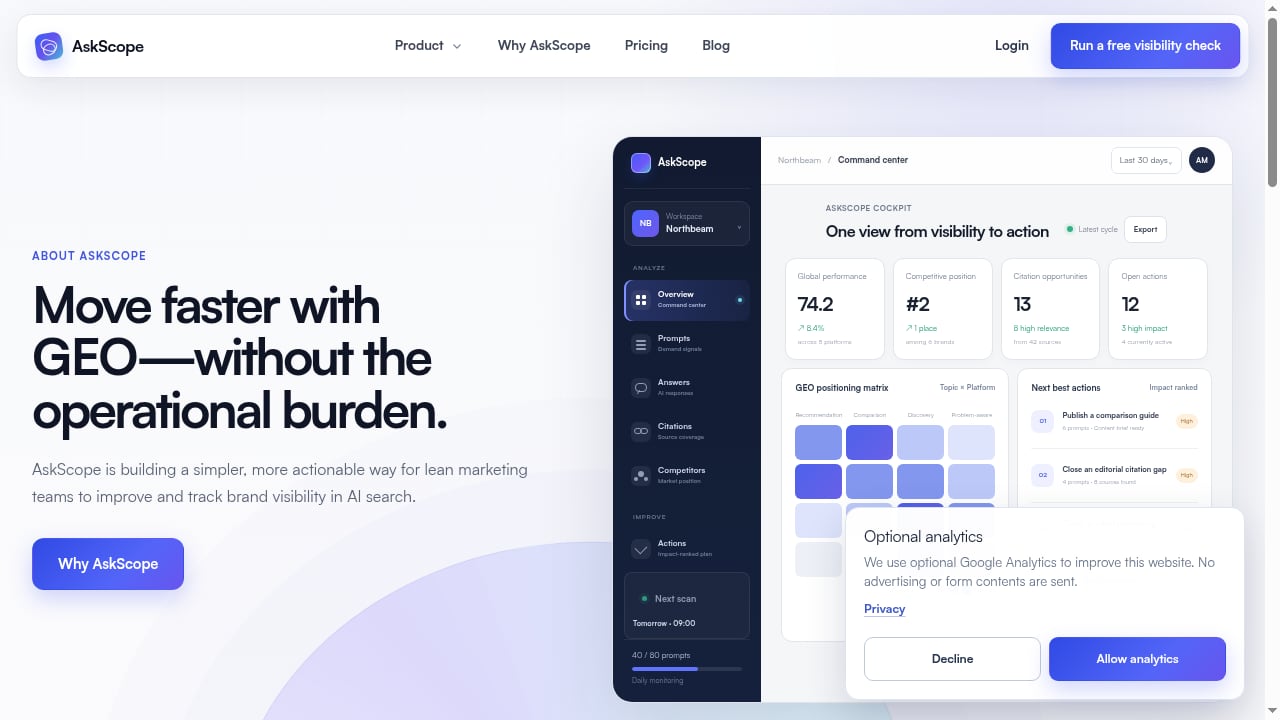
First viewport screenshot of Customers are asking AI. Is your brand in the answer?.
Traditional SEO tracked rankings on a results page. AI search skips the list. Platforms like ChatGPT, Perplexity, Google AI Mode, and Copilot synthesize an answer and name a handful of providers. Buyers increasingly treat that answer as a shortlist.
For consultants, three things shift:
- Discovery becomes recommendation-based. You are not competing for a click; you are competing for a mention inside a generated answer.
- Authority signals matter more than keywords. AI systems pull from your site, LinkedIn, podcasts, directories, reviews, and third-party articles to decide who is credible.
- Answers vary by prompt. A generic question ("best marketing consultants") and a specific one ("B2B positioning consultant for fintech in London") can return completely different names.
That variability is why guessing does not work. You need to observe what AI platforms actually say about your practice and your competitors.
What AI visibility looks like for a consulting practice
First viewport screenshot of Customers are asking AI. Is your brand in the answer?.
AI visibility is not one number. For consultants, it breaks into four observable signals:
- Mentions — how often your name or firm appears in answers to relevant prompts.
- Share of voice — your mentions compared with named competitors across the same prompt set.
- Citations — which sources the AI platform used to justify naming you (your site, a guest article, a directory profile).
- Accuracy — whether the description of your services, specialties, and location is correct.
A consultant who appears in 6 of 40 tracked prompts but is described inaccurately has a different problem than one who appears in 2 of 40 but is described perfectly. Treating both as "low visibility" hides the real fix.
If you want benchmarks for how often AI answers cite sources at all, see this breakdown of citation rate in AI search, which explains what a healthy citation pattern looks like across ChatGPT, Perplexity, and Google AI Mode.
How to measure AI search visibility without a big team
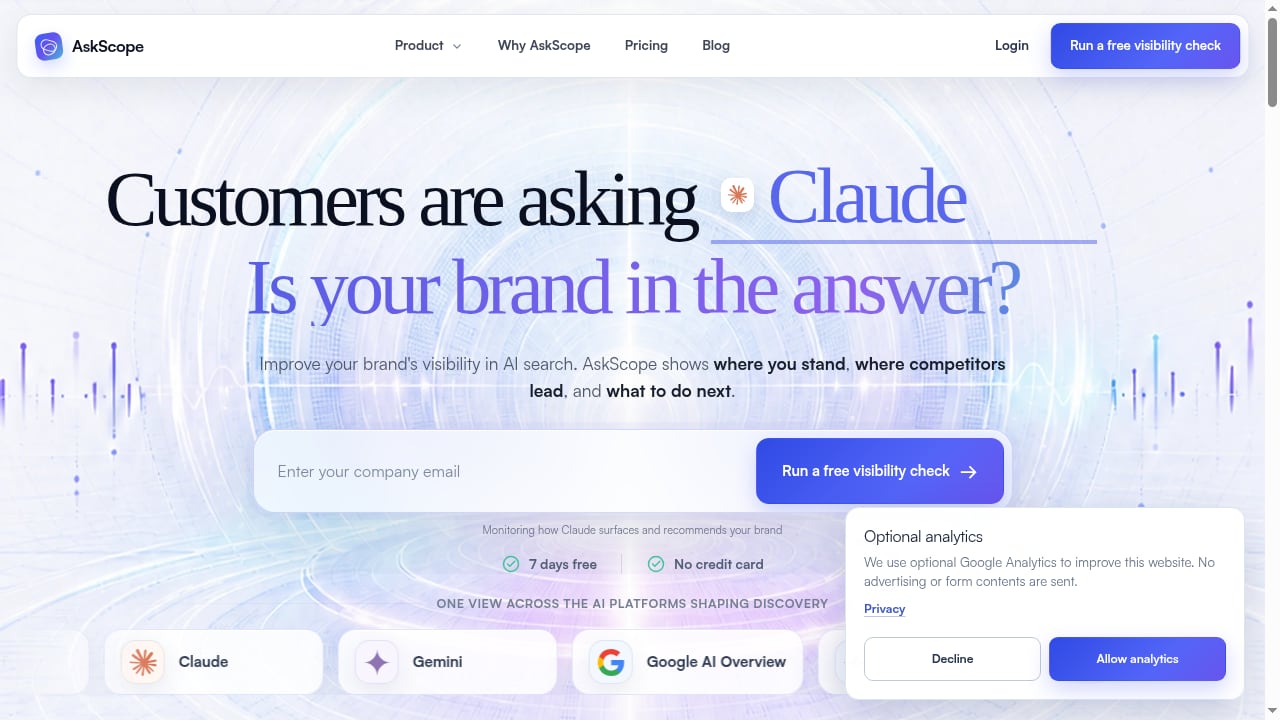
First viewport screenshot of Customers are asking AI. Is your brand in the answer?.
You do not need an enterprise stack. You need a repeatable loop: monitor, analyze, act.
Step 1: Build a prompt set that mirrors client questions
Write 20–40 prompts a real prospect would type. Mix three types:
- Category prompts: "best operations consultants for SaaS companies"
- Problem prompts: "who helps reduce churn in mid-market fintech"
- Comparison prompts: "independent consultant vs agency for go-to-market strategy"
Include your city or region if you serve local clients. Keep the set stable so month-over-month comparisons mean something.
Step 2: Record what the AI actually says
Run each prompt in your priority platforms and log: whether you were mentioned, which competitors appeared, what sources were cited, and whether the description was accurate. Doing this manually for 40 prompts across three platforms is slow and inconsistent — which is where a monitoring tool earns its place.
AskScope, for example, runs a free visibility check with seven days of daily ChatGPT monitoring across 40 prompts, then shows where your brand stands, where competitors lead, and which sources shape the answers. That evidence-first approach matters: a visibility score should trace back to real AI responses, not a modeled estimate.
Step 3: Trace citations to their source
When a competitor is named and you are not, look at what the AI cited. Common patterns for consultants:
- A competitor's own site has a clear service page answering the exact question.
- A third-party listicle or directory includes them but not you.
- Their LinkedIn or podcast appearances are indexed and referenced.
Citation analysis turns a vague "we need more content" instinct into a specific target: the page or profile that needs to exist or improve.
Step 4: Act on the highest-leverage gap
Prioritize by effort versus likely impact. Usually the fastest wins are:
- Adding a direct FAQ or service page that answers a tracked prompt in plain language.
- Correcting inconsistent business information across directories and profiles.
- Earning one or two credible third-party mentions on sites AI platforms already cite in your niche.
- Publishing comparison or "who should hire me" content that matches how buyers phrase decisions.
Then re-run the same prompts. GEO is a loop, not a campaign.
Choosing tools: what consultants actually need
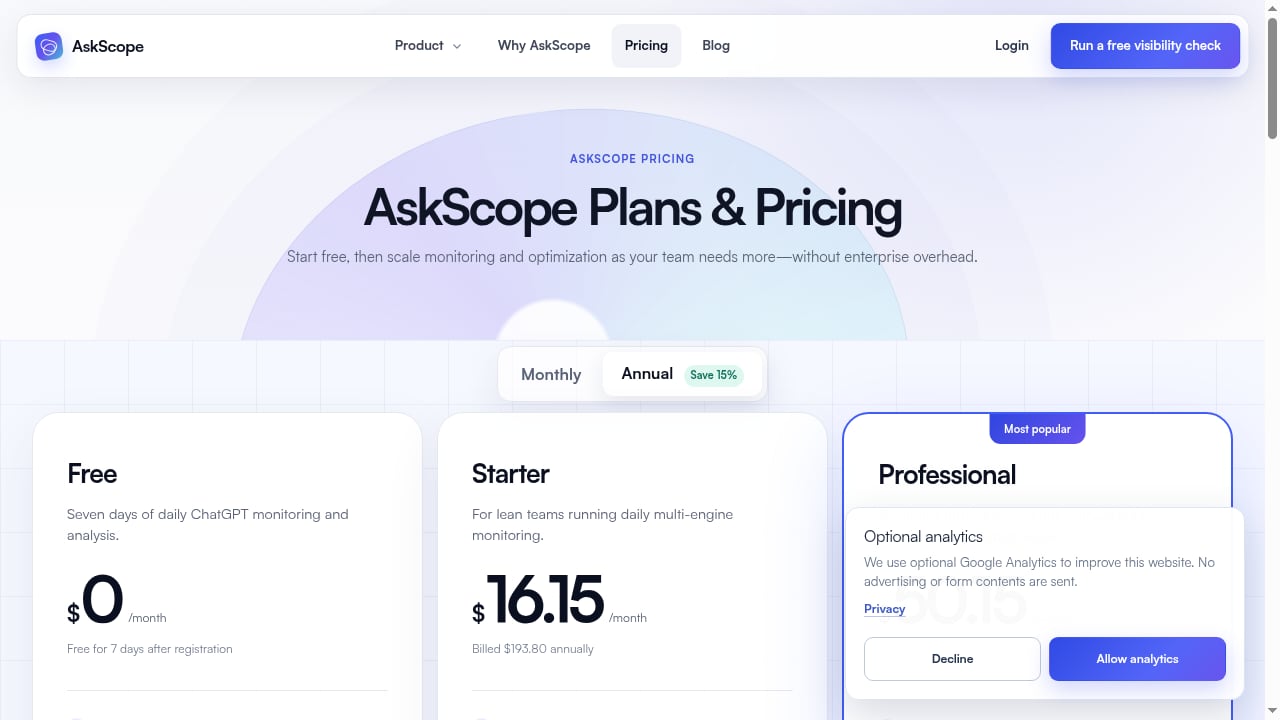
First viewport screenshot of Customers are asking AI. Is your brand in the answer?.
Most "AI tools for consultants" lists focus on research, meeting notes, and proposals. Those are useful, but they do not improve whether AI platforms recommend you. For that, you need visibility monitoring and GEO workflow software.
When comparing options, ask five questions:
| Evaluation criterion | Why it matters for a consultant |
|---|---|
| Prompt-level tracking | You need to know which specific questions you appear in, not just a single score |
| Competitor comparison | Share of voice against named rivals is the metric clients and partners understand |
| Citation evidence | You must see which sources drive the answers to fix them |
| Prioritized actions | A dashboard without next steps creates work, not results |
| Price fit for a small practice | Enterprise platforms are overkill for a 1–10 person firm |
For a broader comparison of platforms by capability, see this roundup of AI search optimization tools and what to track. If you want to understand how competitor tracking works in practice, this guide on monitoring competitor AI presence walks through mentions, share of voice, and citations.
A practical note on budget: start with a free tier or trial, run your prompt set for two weeks, and only upgrade once you can see a clear gap worth closing. AskScope follows this model — free to start, scaling with team needs — which suits lean practices that cannot justify a large platform before proving ROI.
A 30-day AI visibility plan for consultants
Week 1 — Baseline. Define 30 prompts. Record mentions, competitors, and citations across ChatGPT, Perplexity, and Google AI Mode. Note accuracy issues in how your practice is described.
Week 2 — Diagnose. Identify the three prompts where a competitor appears and you do not, and the three where you appear but are described incorrectly. For each, find the cited source.
Week 3 — Fix. Publish or update one page per high-value prompt. Correct directory and profile inconsistencies. Pitch one third-party mention on a source AI platforms already cite.
Week 4 — Retest. Re-run the same prompts. Compare mention rate, share of voice, and citation sources. Keep what moved; drop what did not.
Document everything. Over a quarter, this log becomes the evidence you use to refine positioning — and, if you work with clients on their own AI visibility, a template you can reuse.
Where consultants get this wrong
- Chasing volume over relevance. Fifty generic blog posts will not beat one page that directly answers a tracked buying question.
- Ignoring third-party sources. AI answers often cite external publications, directories, and reviews more than your own site.
- Treating one platform as the whole picture. ChatGPT, Perplexity, and Google AI Mode surface different sources and different competitors.
- Measuring once. AI answers shift as models update and competitors publish. Monthly tracking is the minimum.
Related reading
- Top 10 AI Visibility Monitoring & GEO Software 2026 - Compare the top 10 AI visibility monitoring and GEO software products for 2026. Evidence-based rankings, evaluation criteria, pricing, and buying guidance.
- Top 10 Enterprise Agentic Marketing Platforms 2026 - A 2026 buyer's guide to the top 10 enterprise agentic marketing platforms, ranked on governance, data quality, integrations, and measurable outcomes.
Sources and further reading
- 15 Best AI Tools for Consultants in 2026 (Reviewed) - Best AI tools for consultants in 2026, ranked by use case. Compare 15 picks from ChatGPT for research to Flowcase for proposals, with pricing for each.
- Best AI Tools for Consultants & Coaches in 2026 | Meet Sona - I tested 7 AI tools for consultants and coaches so you don't have to. Real pricing, verified reviews, free plan details and a practical selection framework.
- AI Search Consultant | Get Found in AI Platforms - Work with an AI search consultant to improve your brand's visibility across ChatGPT, Google AI, Copilot, Claude, Perplexity, and more.
FAQ
Do consultants need GEO if they already rank well on Google?
Often yes. Traditional rankings and AI mentions overlap but are not identical. AI platforms frequently cite third-party sources, not just top-ranking pages, so a strong Google position does not guarantee you appear in generated answers.
How long does it take to improve AI search visibility?
Early movement can appear within weeks when you fix a clear content or citation gap on a tracked prompt. Broader share-of-voice gains typically take one to three months of consistent publishing and citation building.
Can I track AI visibility manually?
Yes, for a small prompt set. Manual tracking becomes unreliable past roughly 20 prompts across multiple platforms because answers vary and you need consistent historical records. Monitoring software exists to remove that operational burden.
What is the single most useful metric for a consultant?
Share of voice against the competitors you actually lose deals to. It converts an abstract visibility score into a number you can explain to a partner or client.
Does being mentioned in AI answers actually generate leads?
It influences the shortlist stage, where buyers decide who to contact. Attribution is imperfect, but appearing accurately in answers to high-intent prompts is a reasonable proxy for being considered.
Conclusion
AI search has added a new layer between your expertise and your next client: the generated answer. For consultants, the winning approach is not more content for its own sake — it is a disciplined loop of monitoring the prompts that matter, analyzing which sources shape the answers, and acting on the clearest gaps.
Start small. Pick 30 prompts, record your baseline this week, and fix one citation gap before the month ends. Visibility in AI answers compounds the same way reputation does: slowly, then all at once.