
Attract Patient Traffic with AI: A GEO Playbook for Practices
Patients no longer start with ten blue links. They ask an AI assistant a full question: "Who is the best pediatrician for a child with anxiety near me?" The answer is a short list, often with no click required. If your practice is not in that answer, you are invisible at the exact moment a patient decides to book.
Attracting patient traffic with AI means being present, accurate, and trusted inside AI-generated answers. This playbook shows how to monitor what AI says about your practice, fix the gaps, and turn AI visibility into booked appointments.
Why AI search changes patient acquisition

GEO vs. SEO: what changes when the answer replaces the result page.
Traditional search rewarded ranking. AI search rewards being recommended. The difference matters for healthcare because patients ask nuanced, high-stakes questions that AI answers directly.
- Answers replace results. A patient asking about a specialist gets a synthesized recommendation, not a directory.
- Trust signals decide inclusion. AI systems cross-reference reviews, credentials, locations, and consistency before naming a provider.
- Intent is specific. Queries like "dermatologist for sensitive skin who sees working professionals" match practices on detail, not just city keywords.
This is why practices that appear in AI answers often see higher-quality leads: the patient arrives pre-qualified by the AI's own matching.
What "AI visibility" actually means for a practice
First viewport screenshot of Customers are asking AI. Is your brand in the answer?.
AI visibility is not one number. It is a set of observable facts about how AI systems describe and recommend you.
- Mention rate — how often your practice appears when patients ask relevant questions.
- Position and framing — whether you are named first, described accurately, or listed as an also-ran.
- Citation sources — which pages, directories, and reviews the AI used to form its answer.
- Competitor share — which nearby practices get recommended instead of you, and why.
You cannot improve what you do not measure. Start by running the same prompts a patient would use, across multiple AI platforms, and record the answers.
The Monitor, Analyze, Act loop for patient traffic
First viewport screenshot of Customers are asking AI. Is your brand in the answer?.
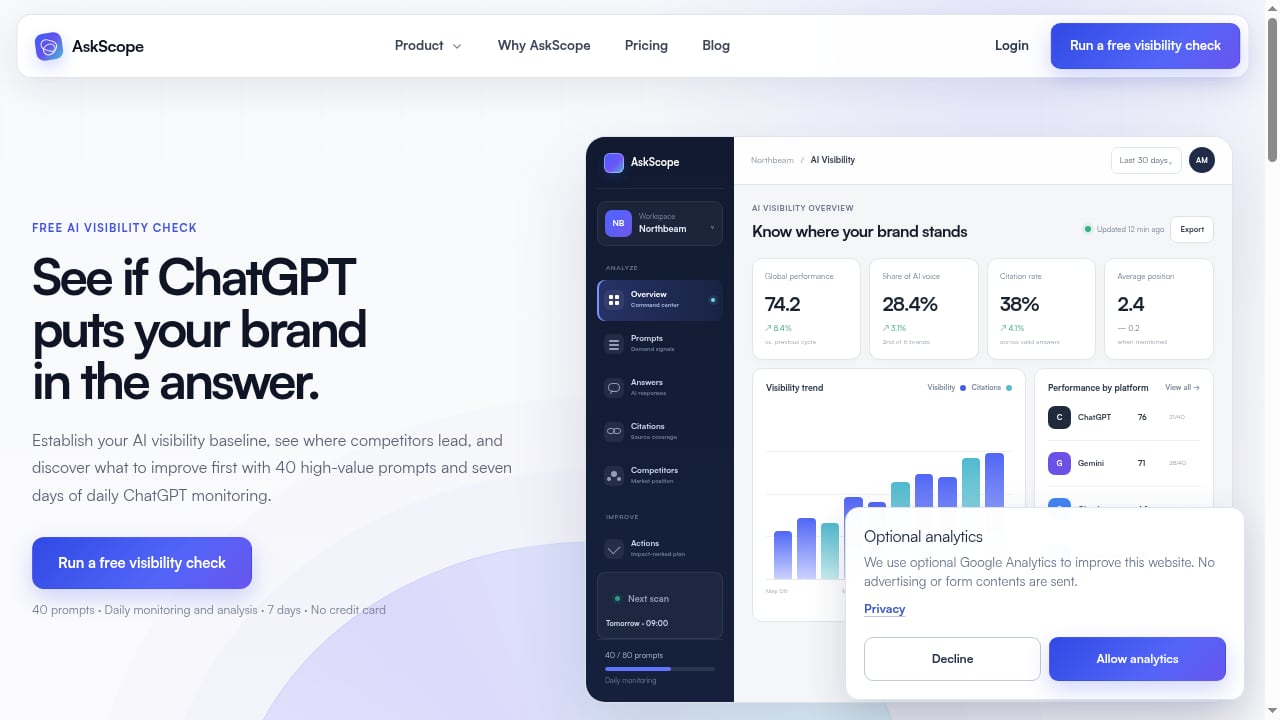
AskScope, a self-serve GEO platform for lean marketing teams, structures AI visibility work as a continuous loop: monitor AI answers, analyze why competitors win, and act on prioritized recommendations. Here is how that loop maps to a medical practice.
1. Monitor: track the prompts patients actually use
Build a prompt set that mirrors real patient language. Examples:
- "Best family doctor in [city] for busy professionals"
- "Pediatrician experienced with autism spectrum children near me"
- "Cardiologist who explains things clearly to elderly patients"
- "Urgent care open late between downtown and the airport"
Run these across ChatGPT, Google AI Overviews, Gemini, and Perplexity. Note who appears, what is said about them, and whether your practice is mentioned at all. A free visibility check with seven days of daily ChatGPT monitoring across 40 prompts is a practical starting point before committing budget.
2. Analyze: find the evidence behind the answer
When a competitor is recommended and you are not, the reason is usually traceable. Citation analysis shows which sources shaped the AI answer — a hospital profile, a review aggregator, a local news piece, or a well-structured service page.
Ask three questions:
- Which of my pages or profiles were cited, and which were ignored?
- Where does competitor information appear that mine does not?
- Are my hours, services, locations, and provider names consistent everywhere?
Inconsistency is the silent killer. If your hours differ between Google Business Profile and your site, AI systems treat the data as unreliable and may filter you out before a patient ever sees you.
3. Act: fix the gaps in priority order
Not every fix matters equally. Prioritize by proximity to booking intent.
- Correct core data first. Name, address, phone, hours, insurance accepted, and specialties must match across every platform.
- Build answer-shaped content. FAQ pages, service descriptions with clear benefits, and provider bios with specific expertise areas perform better in AI answers than generic marketing copy.
- Strengthen citations. Earn mentions on authoritative local and medical directories that AI systems already trust.
- Close competitor gaps. If a rival is cited for a service page you lack, create a better one.
A worked example: from invisible to recommended
Imagine a two-location dermatology practice. A patient asks, "Best dermatologist for sensitive skin in [city]." The AI names two competitors and skips the practice entirely.
Monitor: The practice runs the prompt daily and confirms it appears in zero of five relevant queries.
Analyze: Citation analysis shows the AI relied on a local health directory and two competitor service pages. The practice's own sensitive-skin page exists but is thin and buried, and its second location's hours are wrong on one directory.
Act: The team corrects the directory hours, rewrites the sensitive-skin page around patient questions, adds an FAQ block, and earns two new directory citations. Within weeks, the practice begins appearing in the AI answer for that prompt — and for adjacent ones.
This is the compounding effect: each fix improves multiple prompts at once.
Choosing the right AI visibility approach
First viewport screenshot of Customers are asking AI. Is your brand in the answer?.
Not every practice needs the same toolset. Use this decision guide.
| Situation | Best first move |
|---|---|
| Solo practice, no budget | Free visibility check, manual prompt tracking, fix core data |
| Small multi-location practice | GEO platform with prompt monitoring and citation analysis |
| Lean marketing team, multiple brands | Platform with prioritized tasks and content workflows |
| Enterprise health system | Centralized monitoring plus local execution support |
For teams comparing options, it helps to see how tools differ in model coverage, citation depth, and GEO workflow. Reviews such as Top 10 AI Search Visibility Tracking Software for 2026 and Top 10 AI Marketing & Brand Visibility Platforms 2026 break these down by team fit and pricing signals. If you are specifically weighing a lean-team GEO tool against broader suites, AskScope vs SE Ranking: AI Visibility Software Compared is a useful side-by-side.
Common mistakes that cost patient traffic
- Optimizing only for traditional keywords. Ranking for "family medicine [city]" does not guarantee inclusion in a conversational AI answer.
- Ignoring off-site data. AI systems verify credibility across many sources; your website alone is not enough.
- Publishing generic health content. AI rewards demonstrated expertise, not keyword-stuffed pages.
- Treating visibility as a one-time audit. AI answers shift as models update and competitors publish. Monitoring must be continuous.
Related reading
- AskScope vs Track AI Answers vs Adobe for Business - Compare AskScope, Track AI Answers, and Adobe for Business for AI visibility and GEO. See which fits lean marketing teams tracking AI answers.
- AskScope vs Am I on AI? vs AuditAE: AI Visibility Tools - Compare AskScope, Am I on AI?, and AuditAE for AI search visibility: monitoring depth, citation analysis, pricing models, and which fits lean marketing teams.
Sources and further reading
- Semrush for healthcare | Reach more patients in search and AI - Help patients find your practice before competitors do. Optimize for Google, local search, and AI health recommendations. Try Semrush free for 7 days.
- TrustBuilt.AI | AI Visibility for Local Businesses - Get found, understood, and chosen by AI search engines. AEO & GEO optimization for local businesses.
- nGage - Capture patient feedback via voice, video, or text of patients or employees across the healthcare journey with NRC Health's AI-powered platform, nGage.
FAQ
How long does it take to see results from AI visibility work?
Some fixes, like correcting inconsistent hours or adding FAQ blocks, can influence AI answers within weeks. Broader authority building through citations and content typically compounds over one to three months.
Do I need a GEO platform, or can I track AI answers manually?
Manual tracking works for a handful of prompts. Once you need daily monitoring across multiple models, competitor benchmarking, and citation analysis, a platform saves significant time and reduces blind spots.
Does AI search replace traditional SEO for healthcare?
No. Traditional SEO still drives Google and Maps traffic. AI visibility is an additional layer that captures patients who ask conversational questions and never click a link.
What is the single most important fix for AI visibility?
Data consistency. If your practice information conflicts across platforms, AI systems may exclude you regardless of how good your content is.
Conclusion
Attracting patient traffic with AI is not about gaming a new algorithm. It is about being accurate, authoritative, and present wherever AI systems look for evidence. Run the prompts your patients use, analyze the citations behind the answers, and fix the gaps in priority order. Practices that build this monitoring habit now will compound their visibility as AI search becomes the default starting point for care decisions.
Start with a free visibility check, then scale into a continuous Monitor, Analyze, Act loop. The patients are already asking. Make sure the answer includes you.