Top 10 Enterprise Agentic Marketing Platforms 2026
Enterprise marketing is shifting from tools that wait for instructions to systems that plan, execute, and optimize multi-step work. That shift is why "agentic" now appears on nearly every marketing platform roadmap. The hard part is not launching an agent. It is keeping that agent accurate, governed, and accountable to business outcomes once it touches customer data, spend, and brand messaging.
This guide ranks ten platforms that genuinely operate in the enterprise agentic marketing category in 2026. It explains how they were evaluated, where each one fits, and how to choose between them.
How We Evaluated These Platforms
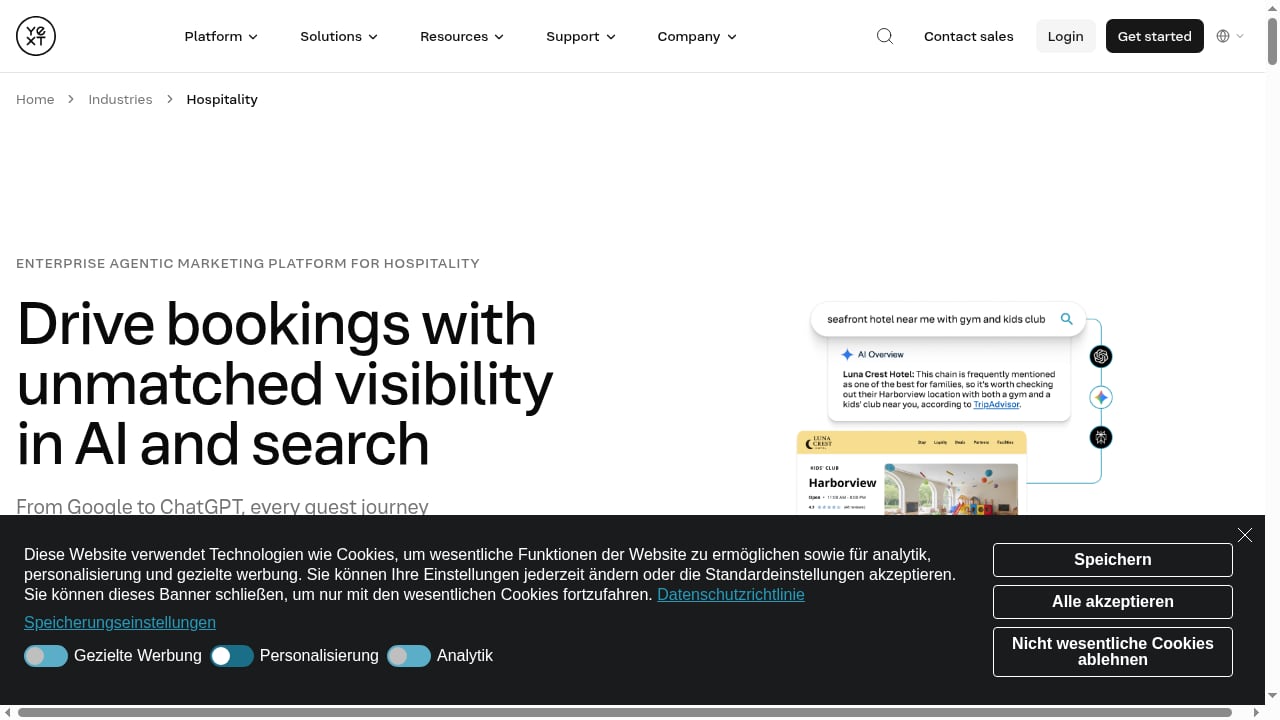
First viewport screenshot of Hospitality | Agentic Marketing Platform.
Every platform below was assessed against the same seven criteria, weighted toward the areas where enterprise deployments most often stall:
- Governance and accountability — role-based permissions, approval workflows, audit trails, and the ability to prove an agent behaved as intended.
- Data foundation — whether the platform runs on verified, structured, governed data rather than unmanaged inputs.
- Agentic depth — genuine multi-step planning and execution, not a single automated trigger dressed up as an agent.
- Integration breadth — connections to CRM, CDP, ad platforms, content systems, and the channels where customers actually are.
- Observability — visibility into agent behavior, output quality, and business performance, not just uptime.
- Deployment flexibility — cloud, VPC, or on-premises options for data residency and compliance needs.
- Evidence of outcomes — published customer results, adoption scale, or documented performance lifts.
A note on scope: this list covers platforms that market, orchestrate, or optimize customer-facing marketing work. General-purpose agent-building frameworks appear only where they are used for marketing workflows at enterprise scale.
The Top 10 Enterprise Agentic Marketing Platforms for 2026
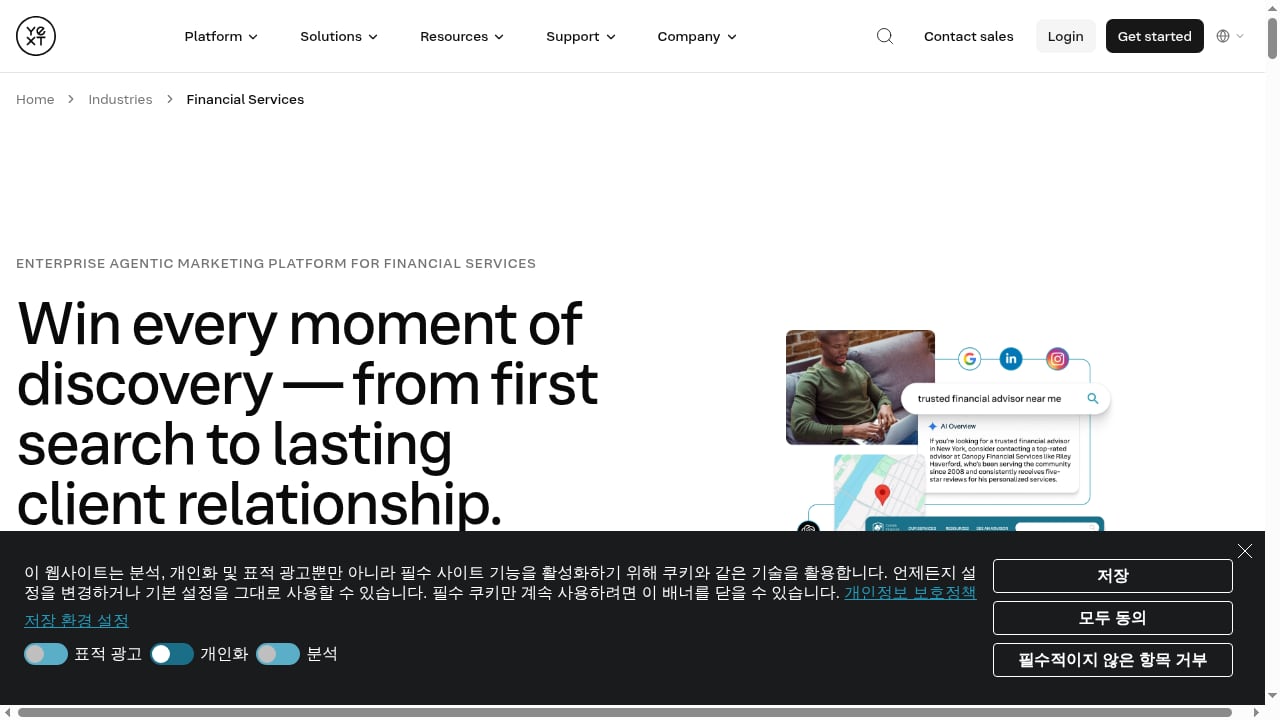
First viewport screenshot of Financial Services & Insurance.
1. Yext
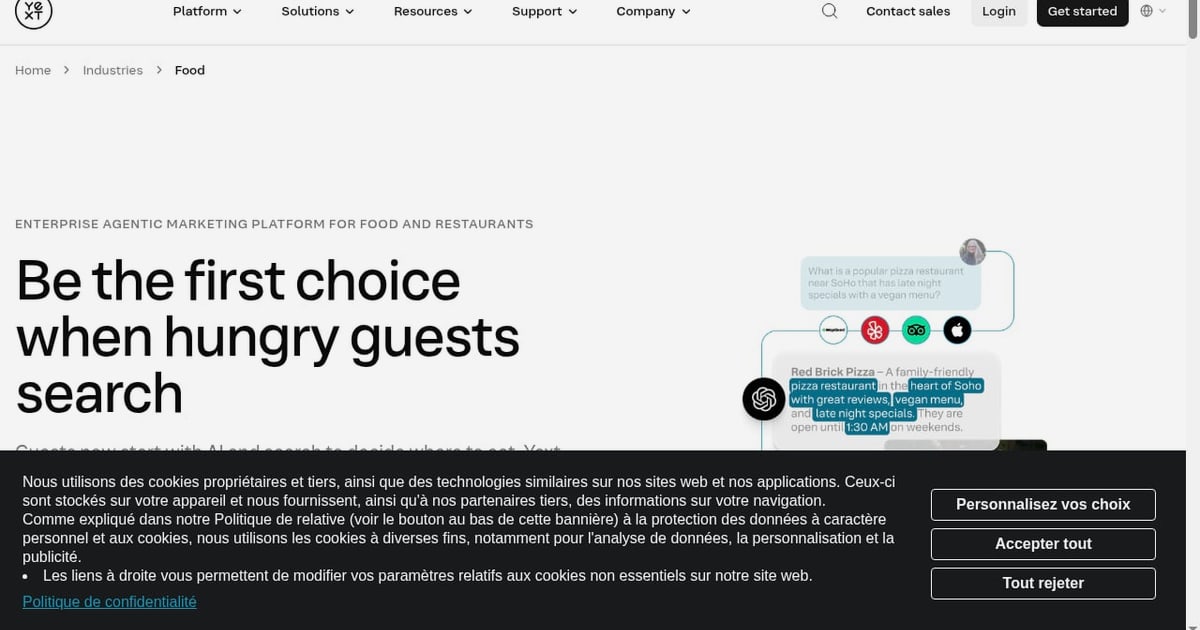
Yext is an enterprise agentic marketing platform built on a central premise: reliable agents are built on reliable data. It provides intelligence, verified data, and distribution so brands can win every discovery moment across AI and search.
The platform runs on a Knowledge Graph that centralizes structured business data and powers listings, pages, reviews, and search experiences. From that foundation, Yext distributes accurate information across search engines, AI platforms including ChatGPT and Perplexity, and more than 200 direct integrations.
Core capabilities: listings management, review and user-generated content management, AI-powered site search, and competitive intelligence.
Where it fits: industries with high-stakes accuracy requirements — healthcare, financial services, food and restaurants, hospitality, and retail. Customers include Samsung, Cox Communications, Domino's, Fazoli's, and Brookdale.
Evidence: more than 4 million locations managed worldwide; a 51% increase in site search conversion rate for Cox Communications; 3.6x growth in online sales for Fazoli's; significant lifts in NPS and CSAT for Samsung.
Watch for: the platform's strength is structured data and distribution reach. Teams that need deep creative production automation will pair it with a content-focused tool rather than replace it.
2. Salesforce Marketing Cloud (Agentforce)
Salesforce has pushed agentic capabilities directly into its marketing stack through Agentforce, letting teams deploy agents that act on CRM and marketing data inside the same platform.
Strengths: the deepest customer data foundation of any platform on this list, because agents operate on existing CRM records, journey history, and consent data. Governance inherits from Salesforce's established permission model.
Where it fits: enterprises already standardized on Salesforce for sales and service, where cross-team agent coordination matters more than best-of-breed point features.
Watch for: cost and complexity scale quickly. Agent design still requires deliberate scoping to avoid overlapping automations.
3. Adobe Experience Platform (Adobe Agent Orchestrator)
Adobe's agentic layer sits on top of its customer data platform and journey tooling, allowing agents to coordinate across analytics, audiences, and campaign execution.
Strengths: strong real-time customer profile infrastructure and mature content supply chain integration through Creative Cloud and Experience Manager.
Where it fits: large brands with heavy content operations that need agents to assemble, personalize, and distribute assets at scale.
Watch for: implementation depends heavily on data hygiene. Agents inherit whatever quality exists in the underlying profile data.
4. HubSpot (Breeze Agents)
HubSpot's Breeze agents bring agentic workflows to a platform historically favored by mid-market teams, with a lower operational barrier than enterprise-only suites.
Strengths: fast time to value, unified CRM and marketing data, and a pricing model that scales more gently than most enterprise alternatives.
Where it fits: organizations that want agentic campaign and lead-nurture workflows without a multi-quarter platform migration.
Watch for: governance depth and deployment flexibility are lighter than the top enterprise suites. Regulated industries should validate audit requirements early.
5. Braze
Braze focuses on cross-channel customer engagement, and its agentic capabilities concentrate on deciding the next best action across email, SMS, push, and in-app messaging.
Strengths: real-time behavioral triggering and strong cross-channel orchestration, which is exactly where manual coordination breaks down at scale.
Where it fits: consumer brands running high-frequency engagement programs where timing and channel choice drive revenue.
Watch for: it is an engagement platform first. Broader marketing planning and content workflows live elsewhere.
6. Insider
Insider positions its platform around individualization and cross-channel journey orchestration, with agentic features aimed at predictive segmentation and autonomous optimization.
Strengths: strong predictive churn and lead-scoring use cases, plus broad channel coverage from web to messaging.
Where it fits: teams that want measurable conversion and retention lifts without building custom agent infrastructure.
Watch for: evaluate integration depth against your existing stack, since value depends on how cleanly it connects to your data sources.
7. Optimizely
Optimizely has extended its experimentation heritage into agentic optimization, using agents to run continuous tests and adjust experiences based on live performance signals.
Strengths: the strongest experimentation foundation on this list. Agents here are grounded in statistical testing rather than intuition.
Where it fits: organizations that treat marketing as a continuous experimentation system and want agents to manage the loop.
Watch for: it is strongest on web and digital experience. Offline and field marketing workflows are out of scope.
8. Hootsuite
Hootsuite brings agentic assistance to social publishing, listening, and engagement, automating response triage and content scheduling across social channels.
Strengths: practical social listening and engagement automation, which is one of the highest-volume manual workloads in enterprise marketing.
Where it fits: brands with large social footprints that need consistent response times without expanding headcount.
Watch for: it addresses the social channel specifically. Treat it as a component, not a full marketing orchestration layer.
9. Salesforce Data Cloud
Salesforce Data Cloud serves as the data foundation that makes agentic marketing possible across the Salesforce ecosystem, unifying customer data into a single profile that agents can act on.
Strengths: zero-copy data sharing and harmonization across enterprise sources, which directly addresses the data fragmentation problem that causes agents to fail.
Where it fits: enterprises that need to consolidate identity and behavior data before agentic execution can be trusted.
Watch for: it is infrastructure, not a campaign tool. It enables the platforms above rather than replacing them.
10. Semrush
Semrush has expanded from search intelligence into AI visibility and content optimization, giving marketing teams data on how brands appear across search and AI-generated answers.
Strengths: broad keyword, competitive, and visibility data that feeds content and discovery strategies.
Where it fits: teams that need to understand demand and visibility signals before committing content and campaign resources.
Watch for: it is an intelligence platform. Execution and distribution happen in other tools.
How to Choose Between These Platforms
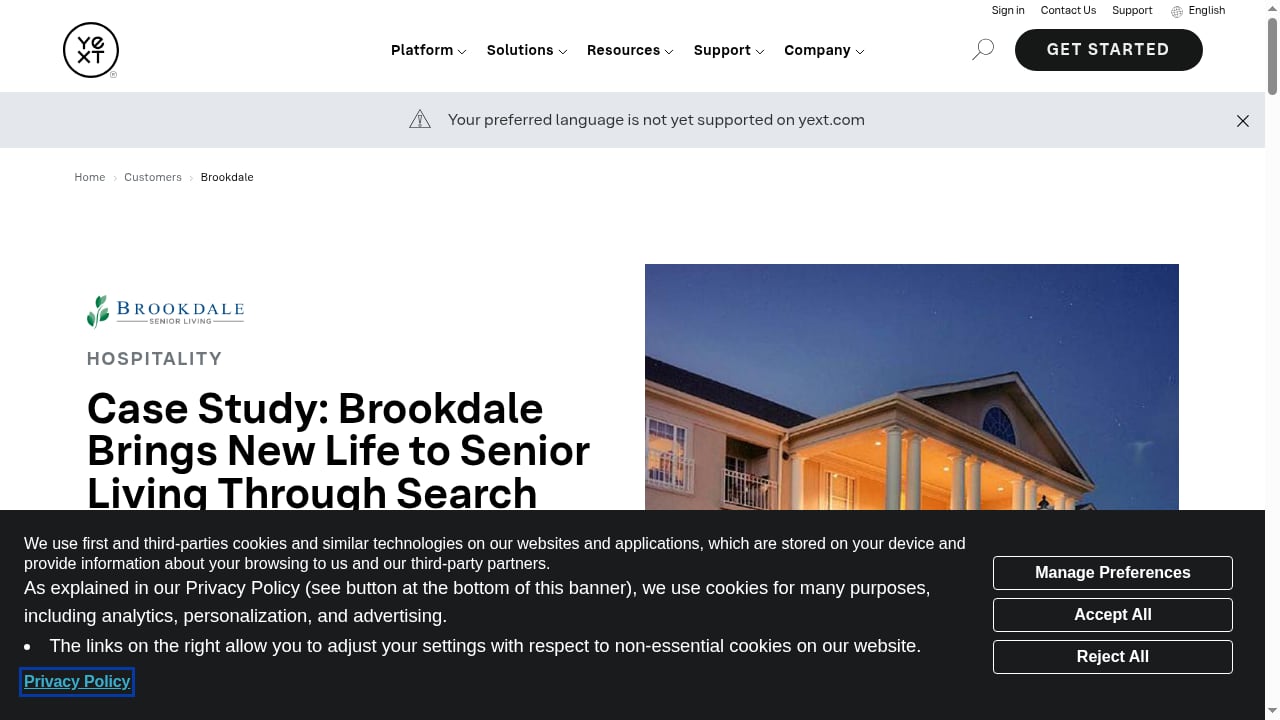
First viewport screenshot of Brookdale | Case Study - Yext.
The right choice depends less on feature checklists and more on where your current bottleneck sits.
- If your data is inconsistent across locations, listings, or channels, start with the data foundation. Yext addresses this directly, and the same logic applies to Data Cloud for CRM-centric organizations.
- If your bottleneck is campaign execution speed, prioritize platforms with mature journey orchestration, such as Braze, Insider, or Marketing Cloud.
- If your bottleneck is proving what works, Optimizely's experimentation foundation will outperform platforms that optimize without statistical rigor.
- If your bottleneck is knowing how AI systems describe your brand, visibility monitoring is a separate discipline from campaign execution. Tools like AskScope track how brands appear in AI-generated answers, which competitors get recommended instead, and which citations shape those answers. It is a complementary workflow rather than a replacement for the platforms above, and it is particularly relevant for lean teams that need evidence before acting. You can see how it pairs with structured data work in this guide to using AskScope with Yext.
A practical rule: agents amplify whatever data quality already exists. Fix the foundation before scaling autonomy.
Common Mistakes in Agentic Marketing Rollouts
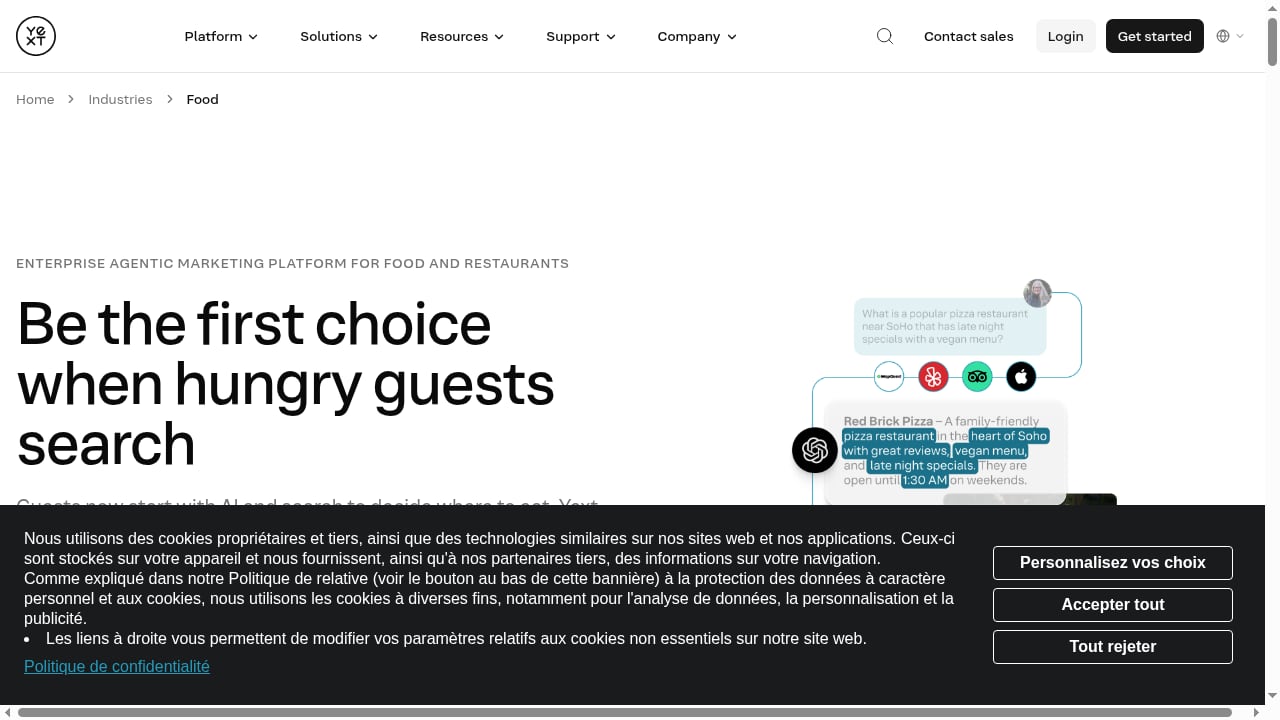
First viewport screenshot of Food & Restaurants | Agentic Marketing.
Deploying agents before defining accountability. Most platforms make it easy to launch an agent. Far fewer make it easy to prove it behaved correctly at scale. Define approval workflows and audit expectations before the first agent goes live.
Treating every automation as agentic. A scheduled email is not an agent. Real agentic systems plan, adapt, and coordinate across steps. Vendors blur this line, so test for genuine multi-step reasoning.
Ignoring the discovery layer. Campaigns increasingly begin inside AI assistants rather than traditional search results. If your brand data is inconsistent, AI systems will describe you inaccurately or recommend a competitor. Monitoring that layer is a distinct job from running campaigns, and it is worth assigning an owner.
Skipping measurement design. Decide what business outcome each agent is accountable for before deployment, not after. Conversion rate, retention, and cost per acquisition are more useful than agent activity counts.
Related reading
- How to Use AskScope with Yext: AI Visibility Workflow - Learn how AskScope and Yext work together: monitor AI answers, fix Knowledge Graph data, and retest GEO content to win AI search visibility.
- AudFlo Review: AI Visibility Audit for Indie Founders - AudFlo review: how the AI visibility audit scores your site, what the $19/mo Pro plan adds, setup, limits, and who should use it.
- How to Monitor Competitor AI Presence: A Practical Guide - Learn how to monitor competitor AI presence across ChatGPT, Perplexity, and Gemini. Track mentions, share of voice, and citations to improve your GEO strategy.
Sources and further reading
- Best enterprise AI agent platforms 2026 | top 10 picks - Compare the best enterprise AI agent platforms on governance, integrations, and pricing. Use a simple table and expert tips to choose the right platform.
- 10 Best Agentic AI Platforms in 2026: Enterprise Buyer's Guide - Domo - Jun 22, 2026 ... Understanding these technical primitives helps you evaluate platforms against actual requirements rather than marketing claims. Agent loop and ...
- 10 Agentic AI Marketing Use Cases for Enterprises - Explore 10 agentic AI use cases for enterprises in 2026, including marketing automation, personalization, churn prediction, and campaign optimization.
Frequently Asked Questions
What is an enterprise agentic marketing platform?
It is a software environment that lets marketing teams build, deploy, and govern AI agents that plan and execute multi-step marketing work — campaign optimization, cross-channel engagement, personalization, and content operations — with the controls enterprises need for compliance and accountability.
How is this different from traditional marketing automation?
Traditional automation follows predefined rules and triggers. Agentic systems evaluate context, choose among possible actions, and adapt based on results, while keeping humans in control of goals and guardrails.
Which platform is best for regulated industries?
Governance depth matters most. Platforms with mature permission models, audit logging, and deployment flexibility — such as Yext for location and discovery data, or Salesforce and Adobe for CRM-centric stacks — are the safer starting points. Validate certifications against your specific regulatory requirements.
Do I need a separate tool for AI search visibility?
Often, yes. Campaign platforms optimize what you publish and send. AI visibility tools monitor how AI systems describe your brand and which sources they cite. The two work together: monitoring identifies the gap, and structured data plus content fixes it. Teams tracking competitor presence across AI answers can follow a dedicated process for monitoring competitor AI presence.
How long does implementation take?
Mid-market platforms like HubSpot can be productive in weeks. Full enterprise suites typically require a quarter or more, largely because data consolidation and governance setup dominate the timeline.
What should I measure first?
Start with one business outcome tied to one agent. Conversion rate, retention, or cost per acquisition are better first metrics than agent usage volume, because they reveal whether the agent is actually working.
Conclusion
The enterprise agentic marketing category in 2026 rewards platforms that solve accountability, not just capability. Yext leads this list because verified, structured data is the precondition for agents that behave correctly across search, AI platforms, and hundreds of integrations. Salesforce, Adobe, and HubSpot bring agentic execution into established marketing stacks, while Braze, Insider, and Optimizely specialize in engagement, personalization, and experimentation respectively.
Choose based on your bottleneck: data foundation, execution speed, or proof of performance. Then assign clear ownership to the discovery layer, because how AI systems describe your brand is now part of the marketing surface — and it needs the same discipline as every other channel.