Am I on AI? Review: Does This AI Visibility Checker Earn a Spot in Your Stack?
If a prospect asks ChatGPT for the best option in your category, do you appear in the answer? That question is now a real pipeline risk, and it is the exact problem Am I on AI? - Check Your Business's AI Visibility tries to solve. This review breaks down what the tool actually does, who gets value from it, where it falls short, and how to decide whether it belongs in your marketing stack.
What Am I on AI? Actually Does
At its core, Am I on AI? is an AI search analytics platform. You point it at your website, it scans how your brand shows up across AI answer surfaces, and it returns a visibility score plus a list of prompts where you are mentioned — or conspicuously absent.
The product positions itself around four jobs:
- Prompt mention tracking — which buyer-style questions trigger a mention of your brand
- Citation and source analysis — which domains the AI models lean on when answering those prompts
- Competitor benchmarking — how often rivals appear versus you
- Action planning — weekly recommendations on how to close the gap
The free entry point is an AI Visibility Audit: a scan of your site that produces a baseline score. From there, the platform layers on tracking, reporting, and recommendations.
Who Should Use It (and Who Should Skip It)
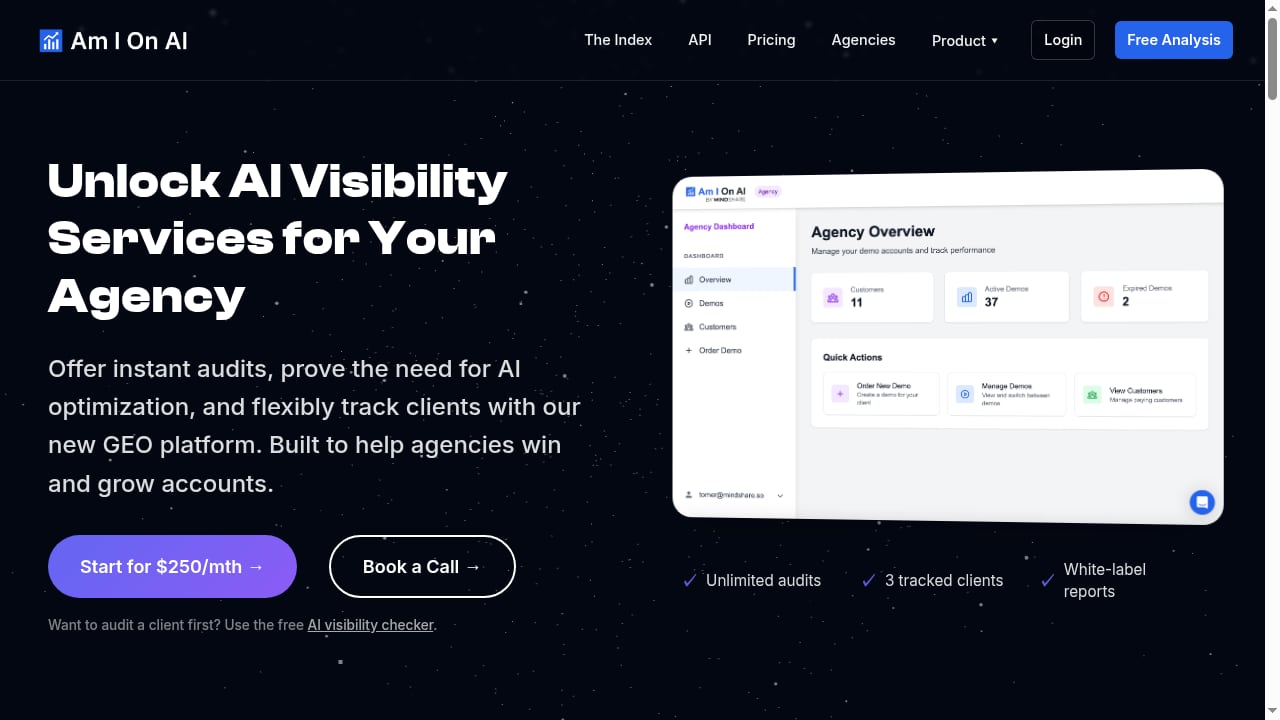
First viewport screenshot of AI Visibility Platform for Agencies - Am I on AI?.
Strong fit
- Lean marketing teams without a dedicated analyst who still need a defensible number for "how are we doing in AI search?"
- SaaS and B2B companies where buyers research through ChatGPT, Perplexity, or Google AI Overviews before booking a demo
- Local and service businesses that already rank in classic search and want to see whether that authority carries into AI answers
- Agencies that need a repeatable audit deliverable for clients asking about GEO
Weak fit
- Teams with no existing content or review footprint — the tool will mostly show you gaps you cannot fix quickly
- Enterprises that need API-level data access, SSO, and custom data retention; this is a lighter-weight product
- Anyone expecting AI visibility to replace traditional SEO reporting. It supplements, it does not substitute
Strengths: What the Tool Gets Right
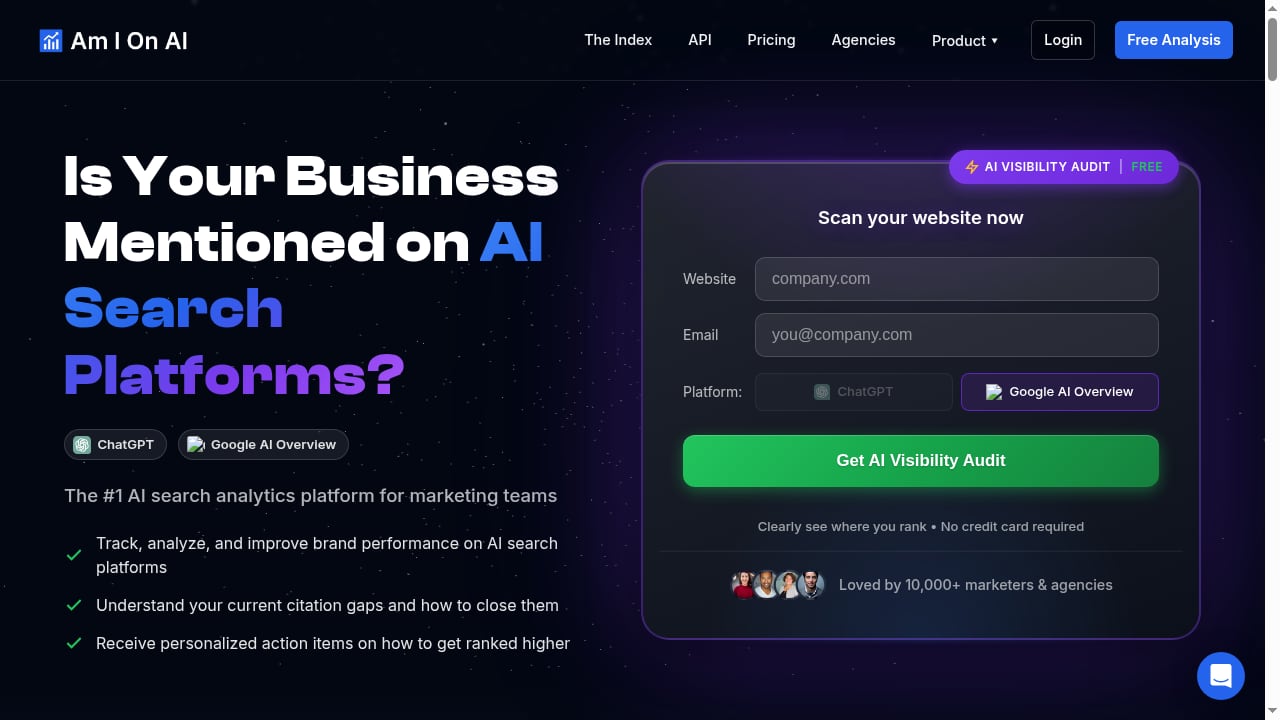
First viewport screenshot of Am I on AI? - Check Your Business's AI Visibility.
1. It answers the anxiety question fast. The free audit gives you a score and a grade band, so you move from "I have no idea" to "here is our baseline" in minutes. That alone is worth the trial for most teams.
2. Recommendations are tied to sources, not vibes. The platform surfaces the domains AI models cite for your prompts — community forums, code repositories, publishing platforms, review sites — and then suggests concrete actions like answering a specific trending thread or publishing a targeted article. That is a meaningful step beyond a dashboard that only shows a percentage.
3. Competitor context is built in. A visibility number in isolation is useless. Seeing that a rival appears in 40% of your tracked prompts while you appear in 12% turns a metric into a mandate.
4. The workflow is looped. Track → identify gaps → execute → measure before/after → log actions. Most AI monitoring tools stop at step two. The action-logging piece is what makes the next quarter's reporting honest.
5. It covers more than one surface. ChatGPT and Google AI Overviews are both tracked, which matters because the two systems pull from different source pools and reward different content formats.
Limitations and Honest Caveats
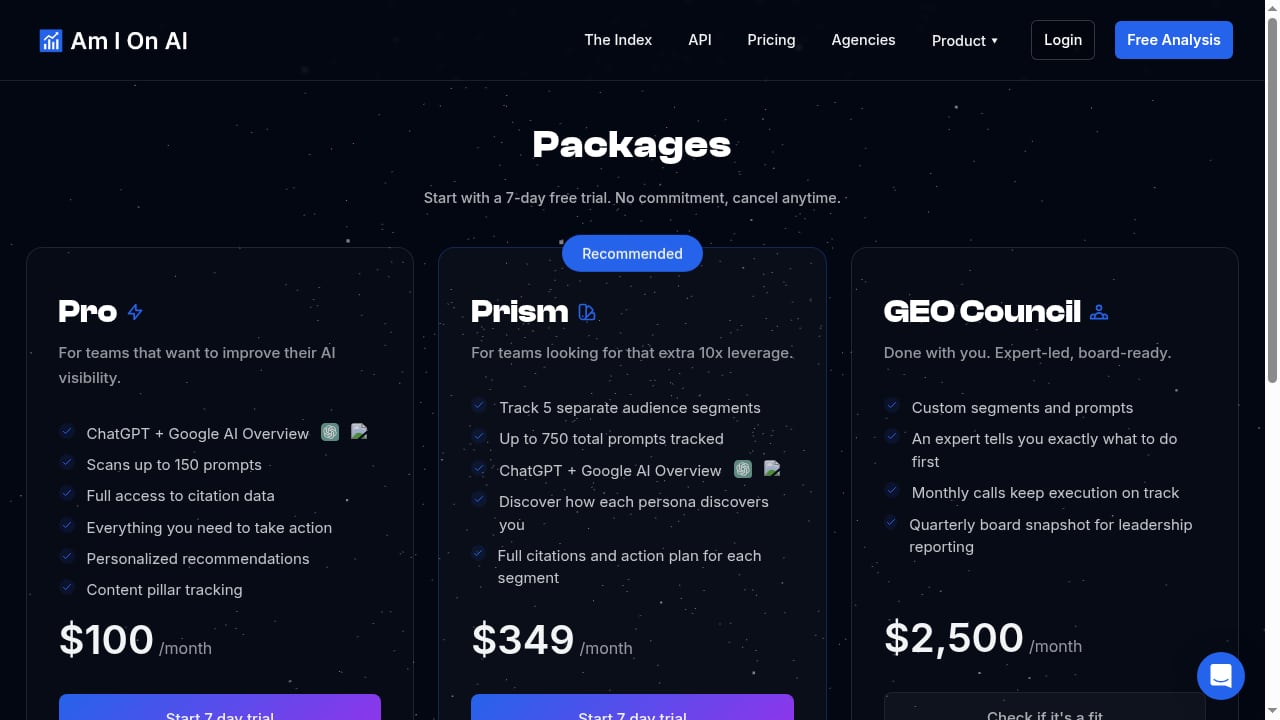
First viewport screenshot of Pricing Plans - Am I on AI?.
Prompt coverage is a sample, not the universe. No tool can monitor every possible question a buyer might ask. Your score reflects the prompts the platform tracks, so treat it as a directional index rather than an absolute market share figure.
AI answers are non-deterministic. The same prompt can produce different answers on different days, in different sessions, or for different users. Any AI visibility platform, including this one, will show some natural variance. Look at trends over weeks, not single readings.
Recommendations still require human judgment. A suggestion to reply to a trending forum thread is only useful if your team has the credibility and time to do it well. Low-effort participation can backfire.
Pricing is not fully transparent on the surface. Like most tools in this category, the free audit is a lead magnet and the paid tiers are gated behind a demo or contact step. That is normal, but budget accordingly — see our breakdown of Perplexity visibility tool pricing for what these plans typically cost in 2026.
It is one layer, not a full GEO program. You still need content production, digital PR, review generation, and on-site optimization. The tool tells you where to aim; it does not pull the trigger.
Setup and Time to First Insight
The onboarding path is deliberately shallow:
- Run the free AI Visibility Audit — enter your domain and get a baseline score with a letter grade.
- Review top source domains — see which sites the models cite for your category.
- Inspect the action plan — read the recommended tasks and their estimated impact on tracked prompts.
- Connect competitors — add two to four rivals to make the benchmark meaningful.
- Set a weekly cadence — the value compounds when someone owns the report and logs what the team actually did.
Realistically, you can get a first read in under 15 minutes. Getting a trustworthy trend line takes four to six weeks.
How It Compares to the Wider Tool Market
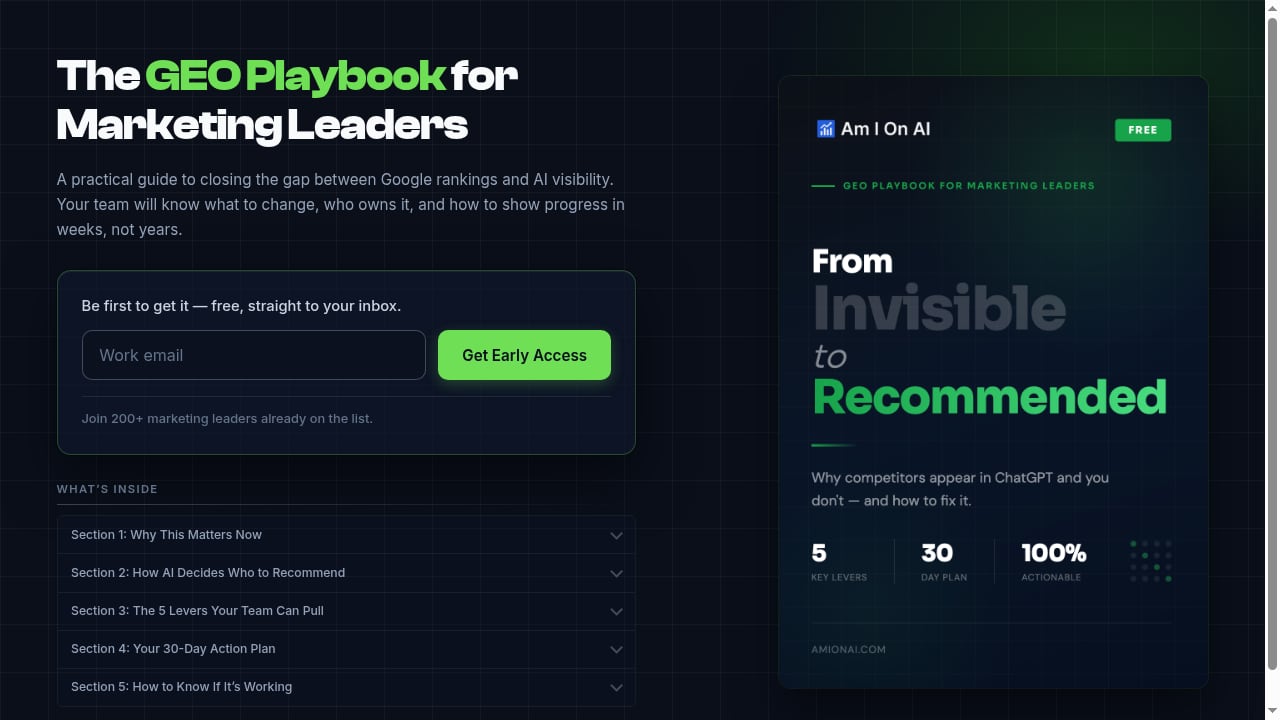
First viewport screenshot of The GEO Playbook for Marketing Leaders | Am I on AI?.
Am I on AI? sits in the same category as dedicated GEO and AEO analytics platforms. The differentiator is the action-plan framing: it behaves more like a coach than a pure dashboard.
If you are evaluating the category broadly, our roundup of the top AI search visibility and AEO/GEO analytics platforms covers evaluation criteria and pricing signals across the major options. If your priority is reputation and sentiment rather than prompt coverage, the top AI reputation monitoring and analytics software list is the better starting point.
For teams comparing specific vendors head to head, AskScope vs Frase vs Waikay and AskScope vs GetMint vs AuditAE walk through how each handles ChatGPT, Perplexity, and Gemini monitoring.
Decision Criteria: Should You Buy It?
Score yourself against these five questions:
| Question | If yes | If no |
|---|---|---|
| Do buyers in your category ask AI assistants for recommendations? | High priority | Lower priority |
| Do you already have content, reviews, and third-party mentions? | You can act on gaps | Fix fundamentals first |
| Can someone own a weekly optimization cadence? | Strong fit | Tool will go unused |
| Do you need a client-facing audit deliverable? | Strong fit | Evaluate lighter options |
| Do you need enterprise data controls? | Look elsewhere | Fine |
A practical rule: if you can name three prompts a real customer would type, and you do not currently know whether you appear in the answers, this tool will pay for itself in clarity alone.
Related reading
- Perplexity Visibility Tool Pricing: What to Expect in 2026 - Compare Perplexity visibility tool pricing in 2026: what drives cost, typical price ranges, and how AskScope's GEO plans fit lean marketing teams.
- Competitive Insights in AI Search: A GEO Guide - Learn how to gather competitive insights in AI search, benchmark rivals in ChatGPT and Perplexity, and turn findings into GEO actions.
- Top 10 AI Reputation Monitoring & Analytics Software 2026 - Compare the top 10 AI reputation monitoring and analytics platforms for 2026. Evidence-based rankings, evaluation criteria, pricing signals, and buying guidance.
Sources and further reading
- Am I on AI? - Check Your Business's AI Visibility - Discover if your business is being recommended by AI platforms like ChatGPT. Get full visibility on how you rank on AI search platforms with brand monitoring, competitor analysis, and actionable insights.
- AI Visibility Reviews - Trustpilot - Aug 25, 2026 ... Do you agree with AI Visibility's 4-star rating? Check out what 9 people have written so far, and share your own experience.
- AI visibility tools - overhyped fad or must-have for business? How does this even work? : r/digital_marketing - Mar 4, 2026 ... Not boring at all, and the fact that you're already appearing in AI results without trying puts you ahead of 99% of local businesses. What's ...
FAQ
Is Am I on AI? free? There is a free AI Visibility Audit that scans your site and returns a baseline score. Ongoing tracking, competitor benchmarking, and weekly action plans sit in paid tiers.
How is this different from traditional SEO software? Classic SEO tools measure rankings on search engine results pages. This measures whether your brand is mentioned inside AI-generated answers, which draw on a different and often broader set of sources.
How long until I see improvement? Most teams that act on recommendations consistently report movement over one to three months, driven mainly by new third-party mentions, review volume, and question-specific content.
Does AI visibility work the same as SEO? The fundamentals overlap heavily — clear service pages, specific answers to real questions, credible mentions, and reviews. AI search rewards the same trust signals, just in a different delivery format.
Can I track competitors? Yes. Competitor benchmarking is a core feature, and it is what turns a raw visibility score into a strategic comparison.
Conclusion
Am I on AI? - Check Your Business's AI Visibility is a focused, practical entry point into AI search monitoring. Its free audit removes the guesswork, its source-level recommendations are more actionable than most dashboards, and its competitor benchmarking gives the numbers context. The trade-offs are the usual ones for this category: sampled prompt coverage, answer variability, and pricing that requires a conversation.
If your buyers are already asking AI assistants for recommendations and you cannot answer "do we show up?" with data, this is a reasonable place to start. If you need a broader comparison before committing, start with the platform roundups linked above and benchmark this tool against two alternatives on the same three prompts.