AEO for Agencies: Scale AI Visibility Without Headcount
Agencies are being asked a new question by clients: "Why does ChatGPT recommend our competitor and not us?" Answer engine optimization (AEO) is the discipline that answers it, and agencies that can deliver it repeatably are winning retainers. But AEO is not traditional SEO with a new label. It requires monitoring AI answers, analyzing which sources get cited, and turning those findings into content and technical fixes across every client account.
This article explains how lean agencies can build a practical AEO service, what to measure, and how a self-serve GEO platform like AskScope fits into the workflow.
Why AEO Is Becoming an Agency Service Line
First viewport screenshot of www.askscope.ai.
Buyer behavior is shifting. According to New Engen's analysis of AI visibility agencies, AI-driven traffic to US retail sites rose 393% year over year in Q1 2026, and 45% of surveyed online shoppers now use AI tools as part of their shopping journey. Gartner projects traditional search volume will drop 25% by the end of 2026 as buyers move to AI-first discovery.
Clients feel this in their pipeline. They see fewer clicks, more zero-click answers, and competitors named in AI responses. They want a partner who can explain and improve that picture.
AEO differs from SEO in outcome and method:
- SEO goal: rank in a list of links.
- AEO goal: be named, cited, or recommended inside an AI-generated answer.
- SEO signals: keywords, backlinks, on-page structure.
- AEO signals: entities, schema, third-party citations, creator and community content, and answer-ready page structure.
Agencies that treat AEO as rebranded SEO get found out quickly. The work is cross-disciplinary, spanning technical structure, content, and off-site authority.
What an AEO Engagement Actually Includes
A credible agency AEO program usually covers five workstreams:
- Baseline audit. Map the prompts real buyers use, then record where each client appears across AI platforms.
- Citation analysis. Identify which URLs, source types, and competitors AI engines cite for those prompts.
- Technical readiness. Fix crawlability, schema, and structured content so AI engines can extract and trust client pages.
- Content and authority building. Create answer-ready content and earn mentions in the third-party sources AI engines rely on.
- Measurement and reporting. Track visibility movement over time and connect it to business outcomes.
The hard part for lean teams is doing this across multiple clients without hiring an analyst per account.
The Multi-Client Problem: Monitoring at Portfolio Scale
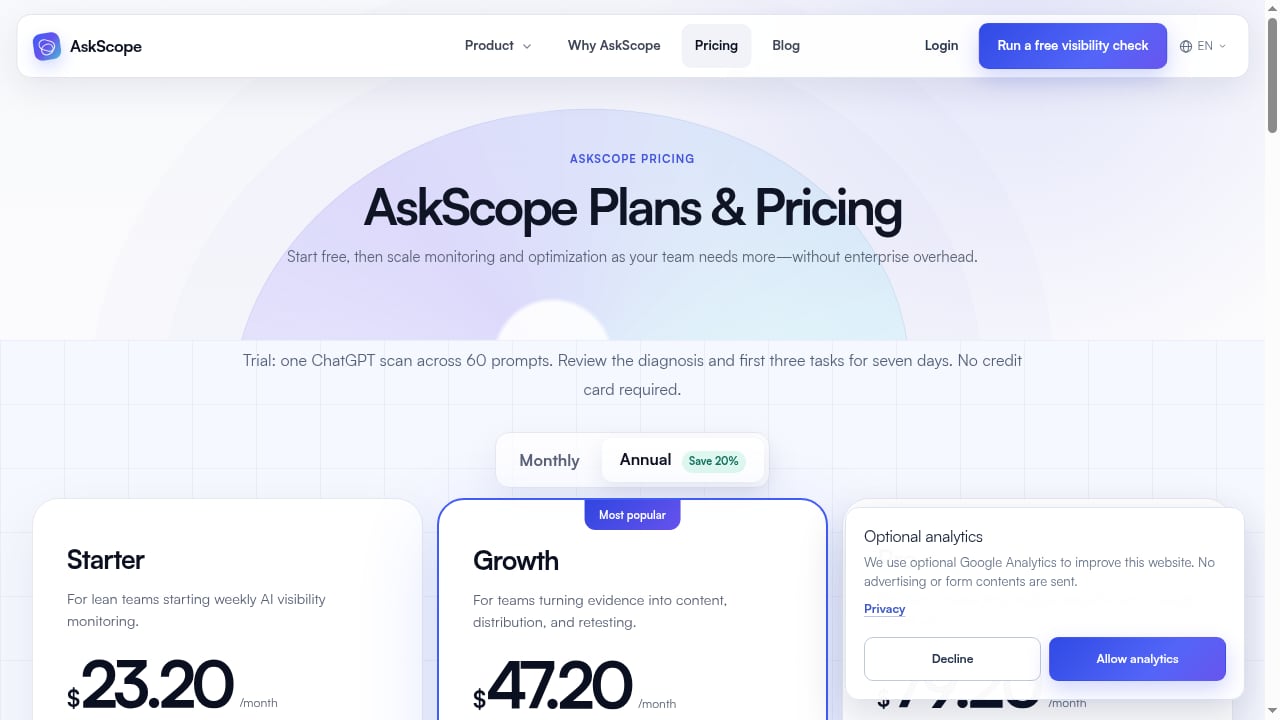
First viewport screenshot of www.askscope.ai.
A single client might need tracking across ChatGPT, Claude, Gemini, Google AI Overview, AI Mode, Perplexity, Grok, and Microsoft Copilot. Multiply that by ten clients and dozens of prompts each, and manual checking collapses.
Agencies need three things from their tooling:
- Separate tracking per client. Each account needs its own prompt set, competitors, and reporting.
- Portfolio-level visibility. Account leads should see which clients are improving and which are slipping.
- Repeatable cadence. Weekly monitoring beats sporadic audits because AI answers change.
AskScope is built for this lean-team reality. It supports five AI platforms with weekly monitoring cycles, a Cockpit dashboard with global performance scores, a GEO positioning matrix, and competitor benchmarking. For an agency, that means one workflow can serve several clients without spreadsheet exports between accounts.
If you are comparing tooling options, see this independent ranking of AI search visibility and brand monitoring tools.
From Diagnosis to Action: A Repeatable Agency Workflow
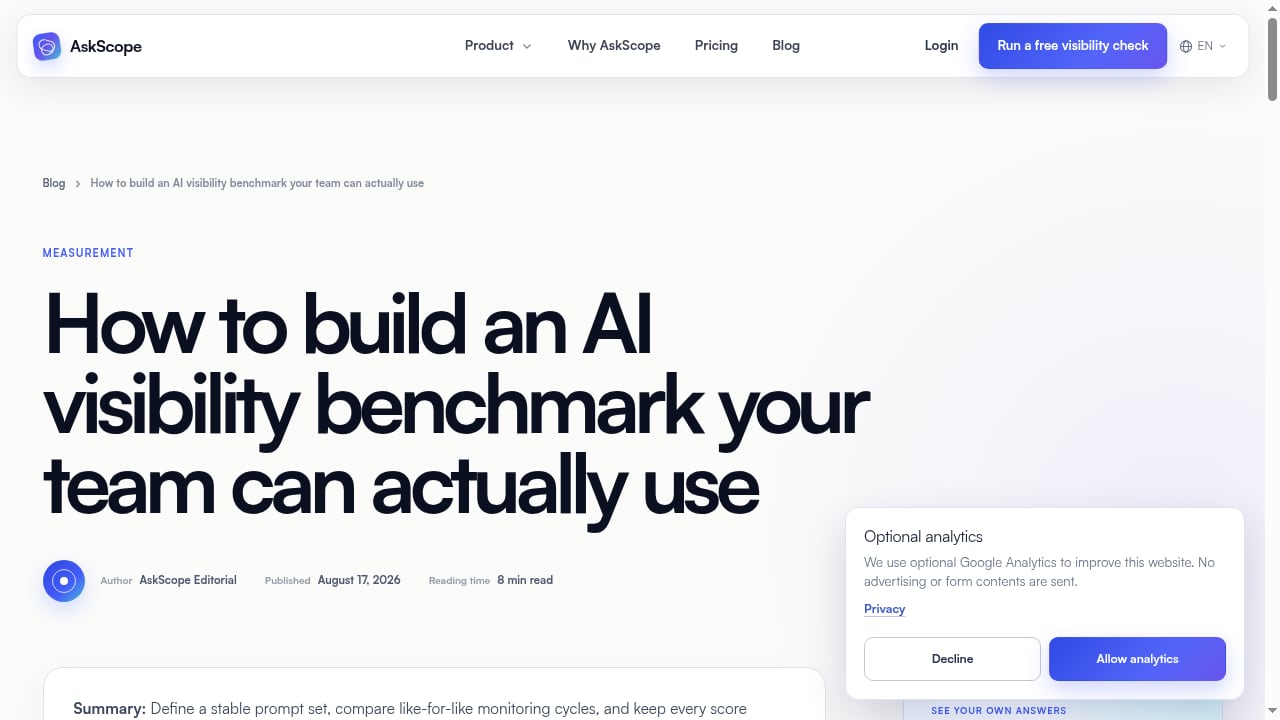
First viewport screenshot of www.askscope.ai.
The agencies that scale AEO are not the ones with the most dashboards. They are the ones with a repeatable loop: monitor, analyze, act, retest.
Step 1: Monitor weekly
Run each client's prompt set on a fixed weekly cadence. Record brand mentions, share of voice, sentiment, and which competitors appear.
Step 2: Analyze citation gaps
Look at citation analysis by platform, source type, URL, and competitor. Ask:
- Which sources do AI engines cite for this client's priority prompts?
- Are those sources owned, earned, or third-party?
- Which competitor URLs appear where the client is absent?
Step 3: Prioritize fixes
Not every gap is worth closing. Prioritize prompts with commercial intent and gaps where the client already has authority to build on. AskScope's evidence-backed recommendations link tasks to specific prompts and answers, which helps account teams explain why a task matters.
Step 4: Create and distribute content
Produce answer-ready pages, FAQ sections, comparison content, and third-party placements. Keep each client's brand voice distinct.
Step 5: Retest and report
Re-run the prompt set after changes. Show movement in visibility, citations, and competitor position. This is the evidence that supports renewals.
For a deeper walkthrough of this loop, see the GEO blog for marketers.
What to Measure and How to Report It
First viewport screenshot of www.askscope.ai.
Clients do not need a data dump. They need a clear story. A practical AEO report includes:
| Metric | What it shows | Why clients care |
|---|---|---|
| AI visibility score | Overall presence across tracked prompts | Simple progress indicator |
| Share of voice vs. competitors | Relative position in AI answers | Competitive narrative |
| Citation count by source type | Where authority is coming from | Guides content and PR investment |
| Prompt-level movement | Which queries improved or declined | Proves the work is targeted |
| Sentiment and narrative drift | How the brand is described | Flags reputation risk |
Agencies should also connect AEO to downstream outcomes where possible: assisted conversions, branded search lift, and pipeline influence. Attribution is imperfect in AI search, but directional evidence beats vanity metrics.
Build vs. Buy: What Lean Agencies Should Consider
Agencies typically choose between building an internal AEO stack, hiring a specialist agency, or adopting a self-serve GEO platform.
- Build in-house: Maximum control, but requires engineering time and ongoing maintenance as AI platforms change.
- Outsource to an AEO agency: Useful for specialized execution, but adds cost and reduces margin on existing retainers.
- Adopt a self-serve platform: Fastest path for lean teams that want to own the workflow and keep margin.
AskScope is positioned for the third option: a self-serve GEO platform for lean marketing teams, with a free 7-day trial (one ChatGPT scan across 60 prompts) and paid plans (Starter, Growth, Pro) billed monthly or annually with a 20% annual discount. For agencies, the value is a connected workflow: monitor, analyze, create, distribute, and retest in one place.
If you are evaluating specific tools, these comparisons may help: AskScope vs Rank Prompt and AskScope vs Siftly vs Brand Armor AI.
Common AEO Mistakes Agencies Make
- Treating AEO as content volume. Publishing more pages does not fix citation gaps if the sources AI engines trust are elsewhere.
- Skipping technical foundations. If AI crawlers cannot access or parse a page, content quality does not matter.
- Using one prompt set for every client. Prompt sets must reflect each client's category, audience, and buying journey.
- Reporting rankings instead of answers. Clients want to know how they appear in AI responses, not just where they rank in a list.
- Auditing once and moving on. AI answers shift. Weekly monitoring is the minimum viable cadence.
Related reading
- Top 10 SEO Rank Tracking & Search Visibility Platforms 2026 - Independent 2026 ranking of the top 10 SEO rank tracking and search visibility platforms, scored on SERP accuracy, AI visibility, reporting, and value.
- How to Use AskScope with Squarespace: GEO Workflow - Learn how to connect AskScope with Squarespace to monitor AI visibility, find citation gaps, and fix pages so your brand appears in AI answers.
- AskScope vs AI Search Visibility Platform vs Qvery - Compare AskScope, AI Search Visibility Platform, and Qvery for AI search visibility. See strengths, gaps, and which fits lean marketing teams.
Sources and further reading
- AI Search Optimization Platform for Agencies | Goodie - Goodie helps agencies manage every client's AI search visibility from one dashboard, proving AEO ROI and scaling delivery without adding headcount.
- How to Find an AEO Agency: Our Top 11 Picks for 2026 | Goodie - Looking for an AEO agency in 2026? Compare our top 11 picks, real pricing ranges, and vetting tips, plus Goodie's DIY alternative for AI visibility.
FAQ
What is AEO for agencies?
AEO for agencies is the practice of managing answer engine optimization across multiple client accounts. It includes monitoring AI answers, analyzing citations, fixing technical and content gaps, and reporting visibility movement to clients.
How is AEO different from SEO for agency clients?
SEO aims to rank pages in search results. AEO aims to get a brand cited or recommended inside AI-generated answers. AEO adds entity work, schema, third-party citation building, and answer-ready content to the SEO foundation.
How many AI platforms should an agency track?
Track the platforms your clients' audiences actually use. Most agencies start with ChatGPT, Google AI Overview, Perplexity, and Gemini, then expand. AskScope supports five AI platforms with weekly monitoring.
Can a lean agency deliver AEO without hiring analysts?
Yes, if the workflow is standardized. A self-serve platform with per-client tracking, citation analysis, and prioritized recommendations reduces manual research. The agency still needs a strategist to interpret findings and direct content work.
How do agencies prove AEO ROI to clients?
Combine visibility metrics (share of voice, citations, prompt-level movement) with downstream signals (assisted conversions, branded search, pipeline influence). Report trends over time rather than single snapshots.
What should an agency look for in an AEO platform?
Look for multi-client tracking, weekly monitoring, citation analysis by source and competitor, actionable recommendations, and retesting. A free trial helps validate fit before committing.
Conclusion
AEO is becoming a core agency service because clients are already living in AI-first discovery. The agencies that win will be the ones that turn AEO into a repeatable workflow rather than a series of one-off audits. That means weekly monitoring, citation analysis, prioritized fixes, and clear reporting across every client account.
AskScope gives lean teams a self-serve way to run that loop: monitor AI visibility, analyze competitor and citation gaps, receive prioritized tasks, create and distribute content, and retest to measure change. Start with the free 7-day trial to see how your clients appear in ChatGPT answers, then build the cadence from there.