Top 10 AI Visibility Tracking and Generative Engine Optimization Software Products for 2026
AI answer engines have become the first stop for product research, vendor shortlists, and buying decisions. When ChatGPT, Perplexity, Gemini, or Google AI Overviews respond to a question, they often name a handful of brands and skip the rest. Tracking whether your brand is in that answer—and optimizing the content that shapes it—is now a distinct software category: AI visibility tracking and generative engine optimization (GEO).
This review ranks ten products that genuinely belong to that category. It excludes tools that only monitor traditional search rankings, and it excludes platforms that are adjacent but not built for AI answer visibility. Every ranked product is evaluated against the same criteria, with evidence drawn from vendor documentation and independent 2026 comparisons.
How we evaluated these products
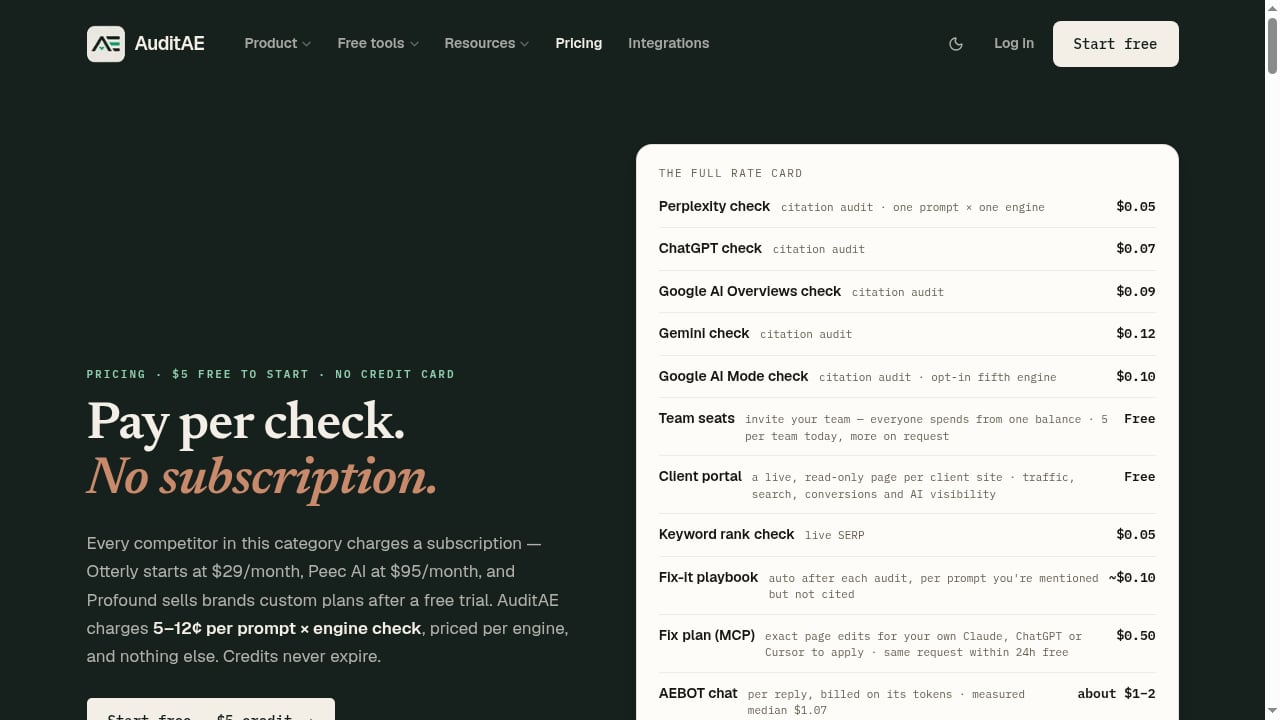
First viewport screenshot of Pricing — From 5¢ Per Check, No Subscription | AuditAE.
We scored each platform on six factors that determine whether a tool can actually improve AI visibility, not just report it:
- Model coverage: How many answer engines are tracked (ChatGPT, Perplexity, Gemini, Google AI Overviews, Copilot, Claude, Grok, and others).
- Prompt-level depth: Whether you can see the exact questions that trigger brand mentions, not just an aggregate score.
- Citation and source analysis: Whether the tool traces AI answers back to the pages, forums, and data sources that shaped them.
- GEO actionability: Whether it produces prioritized recommendations, content briefs, or automated fixes—or stops at a dashboard.
- Competitive benchmarking: Whether you can compare your share of voice against specific competitors.
- Pricing transparency and team fit: Entry price, scaling model, and whether the tool suits lean teams or enterprise procurement.
We weighted actionability and citation depth heavily because monitoring alone does not change outcomes. A tool that shows you a gap but not how to close it leaves most of the work undone.
The top 10 AI visibility and GEO software products for 2026
First viewport screenshot of Learn — AI Visibility Guides, Engine Deep-Dives & Research | AuditAE.
1. Profound
Profound is the most-funded platform in the category, with a $96M Series C in early 2026 and customers including Ramp, MongoDB, Figma, and DocuSign. Its differentiator is the Prompt Volumes dataset, which estimates how often specific queries are asked across LLMs—effectively a search-volume metric for AI. It tracks 10+ engines, including GPT-5.2, and adds industry benchmarks through the Profound Index.
Strengths: Best-in-class prompt prioritization data, strong enterprise governance (SOC 2 Type II, multi-region), deep competitive citation benchmarking, and embedded autonomous agents.
Watch-outs: The $99 Starter plan is effectively ChatGPT-only; real multi-engine usefulness starts at the $399 Growth tier. It is overkill for small teams validating the channel.
Best for: Enterprise GEO programs that need to prioritize thousands of prompts and prove governance.
2. OtterlyAI
OtterlyAI is built by marketers for marketers—co-founded in Vienna in 2024 by the team behind Usersnap. It tracks brand visibility and citations across ChatGPT, Google AI Overviews, Google AI Mode, Gemini, Perplexity, and Microsoft Copilot, and pairs that with a free GEO Audit, AI Crawler Simulation, AI Keyword Research, and Query Fan-Out tools. It was recognized as a Gartner Cool Vendor for AI in Marketing 2025 and partners with Semrush.
Strengths: Six engines covered on every paid plan, including Copilot, which most competitors gate. Transparent monthly pricing starting at $29, no annual lock-in, and a free toolkit anyone can test.
Watch-outs: Less enterprise-specific tooling than Profound or AthenaHQ, and no native GA4 attribution dashboard yet.
Best for: Marketing-led teams and agencies that want broad engine coverage without enterprise pricing.
3. AthenaHQ
AthenaHQ is a Y Combinator–backed AEO platform built by former Google Search and DeepMind engineers. It tracks ChatGPT, Perplexity, Google AI Overviews, Google AI Mode, Gemini, Claude, Copilot, and Grok, with all engines unlocked at the Starter tier. Customers include SoFi, ZoomInfo, Wix, and Volkswagen.
Strengths: All 8+ engines on the entry plan, native GA4 and Google Search Console integration for attribution, unlimited seats with role-based access, and brand impersonation alerts that catch AI hallucinations.
Watch-outs: Credit-based usage means heavy tracking can exhaust your plan quickly; ROI dashboards require analytics setup.
Best for: Enterprise teams that need to connect AI visibility lifts to pipeline and revenue.
4. Peec AI
Peec AI is a European platform popular with agencies managing multiple clients. It tracks 9+ engines, including DeepSeek, and offers unlimited seats and free pitch workspaces—useful for agencies that need to demo visibility data before a contract.
Strengths: Multi-client workflows, broad engine coverage at a mid-market price (around €85/month), and unlimited seats that make agency economics work.
Watch-outs: Less depth in automated content generation than full GEO suites; reporting is stronger than execution.
Best for: European agencies and multi-client teams that need scalable seat access.
5. Scrunch AI
Scrunch AI focuses on optimization rather than pure monitoring. It tracks ChatGPT, Claude, Gemini, and Google AI Overviews, and its persona-based prompt testing lets teams see how different buyer personas receive different answers.
Strengths: Persona-driven prompt modeling, optimization-focused workflows, and actionable recommendations tied to content changes.
Watch-outs: Custom pricing with no public entry tier; narrower engine coverage than Profound or AthenaHQ.
Best for: Optimization-focused teams that want to model buyer personas in AI answers.
6. Semrush AI Toolkit
Semrush added an AI Toolkit as an add-on to its existing SEO suite. It tracks ChatGPT, Google AI Overviews, Gemini, and Grok, and integrates natively with Semrush's keyword, backlink, and content tools.
Strengths: Native integration with an established SEO workflow, familiar interface for existing Semrush users, and combined traditional-plus-AI reporting.
Watch-outs: It is an add-on, not a standalone GEO platform; citation depth and GEO actionability trail specialist tools.
Best for: Existing Semrush users who want AI visibility data inside their current dashboard.
7. Ahrefs Brand Radar
Ahrefs Brand Radar overlays AI mention data on top of its backlink and keyword database. It tracks ChatGPT, Google AI Overviews, and Perplexity, and shows which pages and domains are cited in AI answers.
Strengths: Backlink and AI mention overlay in one place, strong domain-level citation data, and reliable data infrastructure.
Watch-outs: Limited engine coverage compared with specialists; no dedicated GEO content workflow.
Best for: Ahrefs users who want AI visibility data without leaving their existing toolset.
8. Writesonic GEO
Writesonic combines visibility tracking with an AI writer. It tracks ChatGPT, Perplexity, and Gemini, and connects visibility gaps to content generation so teams can produce optimized drafts in the same platform.
Strengths: Visibility plus AI writing in one subscription (starting around $49/month), useful for content teams that need to move from insight to draft quickly.
Watch-outs: Content quality still requires editorial oversight; citation analysis is lighter than dedicated monitoring platforms.
Best for: Content teams that want tracking and creation in a single tool.
9. SE Ranking AI Tracker
SE Ranking's AI Tracker focuses on Google AI Overviews specifically, with cached SERP analysis and AIO presence tracking at around $65/month. It is a practical entry point for teams that want to understand AI Overviews before expanding to other engines.
Strengths: Affordable AIO-focused tracking, cached SERP evidence, and integration with SE Ranking's broader SEO toolkit.
Watch-outs: Narrow engine coverage; not a full GEO platform.
Best for: Teams starting with Google AI Overviews and wanting a low-cost entry point.
10. Rankscale AI
Rankscale AI is a budget-friendly GEO entry point at around $19/month. It tracks ChatGPT, Perplexity, and Gemini, and provides prompt-level visibility data for small teams testing the channel.
Strengths: Lowest entry price in this list, simple prompt-level tracking, and quick setup.
Watch-outs: Limited engine coverage, lighter citation analysis, and fewer GEO execution features.
Best for: Small teams and solo marketers validating AI visibility for the first time.
How to choose between these tools
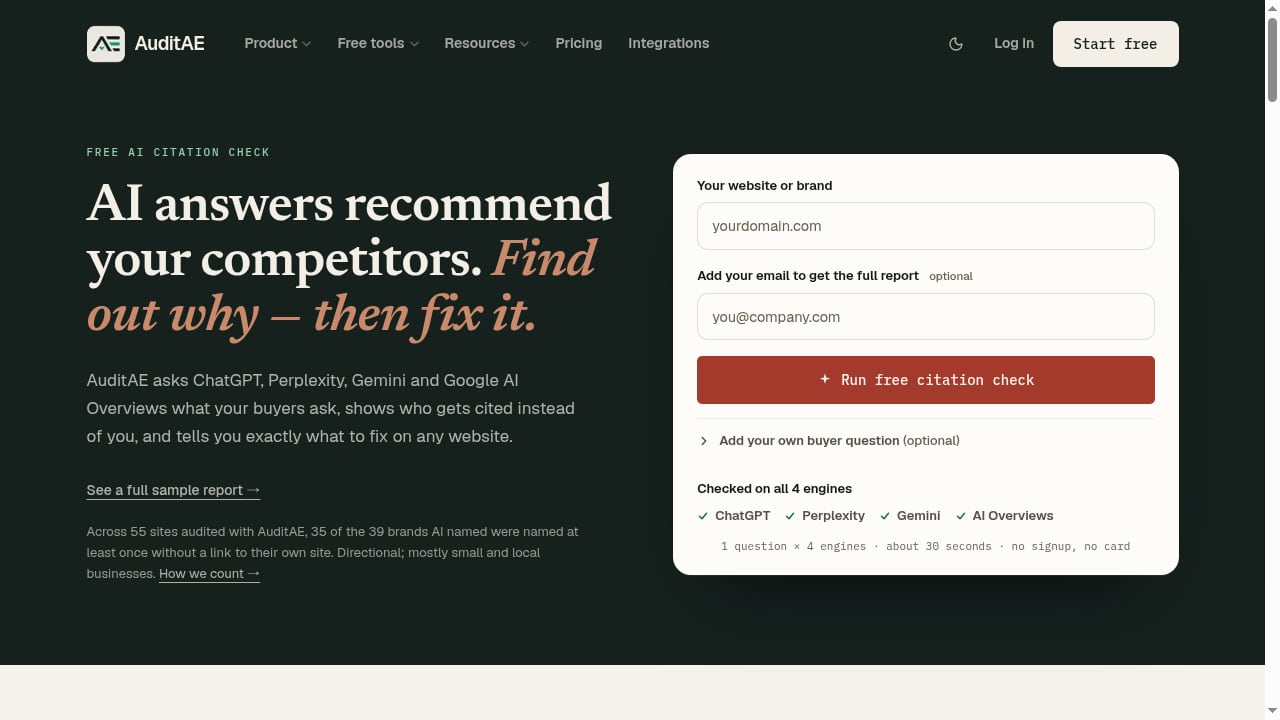
First viewport screenshot of AuditAE: AI Search Visibility, Found and Fixed.
The right choice depends on whether you need monitoring, optimization, or both.
- If you need to prioritize thousands of prompts at enterprise scale: Profound or AthenaHQ.
- If you need broad engine coverage at a fair price: OtterlyAI.
- If you are an agency managing multiple clients: Peec AI.
- If you want to model buyer personas: Scrunch AI.
- If you already live in Semrush or Ahrefs: the native add-ons reduce tool sprawl.
- If you need tracking plus content creation: Writesonic GEO.
- If you are validating the channel on a small budget: SE Ranking AI Tracker or Rankscale AI.
One adjacent workflow worth noting: some lean teams pair a monitoring platform with a fix-oriented tool. For example, AuditAE shows which questions ChatGPT, Perplexity, Gemini, and Google AI Overviews answer with your competitors and returns specific edits to close the gap, at 5–12¢ per check with $5 free. It is not a full GEO suite, but it complements a monitoring dashboard when the bottleneck is execution rather than measurement. For a broader comparison of monitoring-first platforms, see our Top 10 AI search visibility tracking software for 2026.
If your priority is a continuous monitor–analyze–act loop for a lean marketing team, AskScope is a relevant adjacent option: it monitors prompts, analyzes citations, and generates prioritized tasks, with a free visibility check covering seven days of daily ChatGPT monitoring across 40 prompts. It is not ranked here because it sits closer to the monitoring-and-workflow side than the full GEO suite side, but it is worth evaluating alongside the tools above. You can also compare it directly in our AskScope vs BrightEdge comparison for lean teams.
What to expect from AI visibility data in 2026
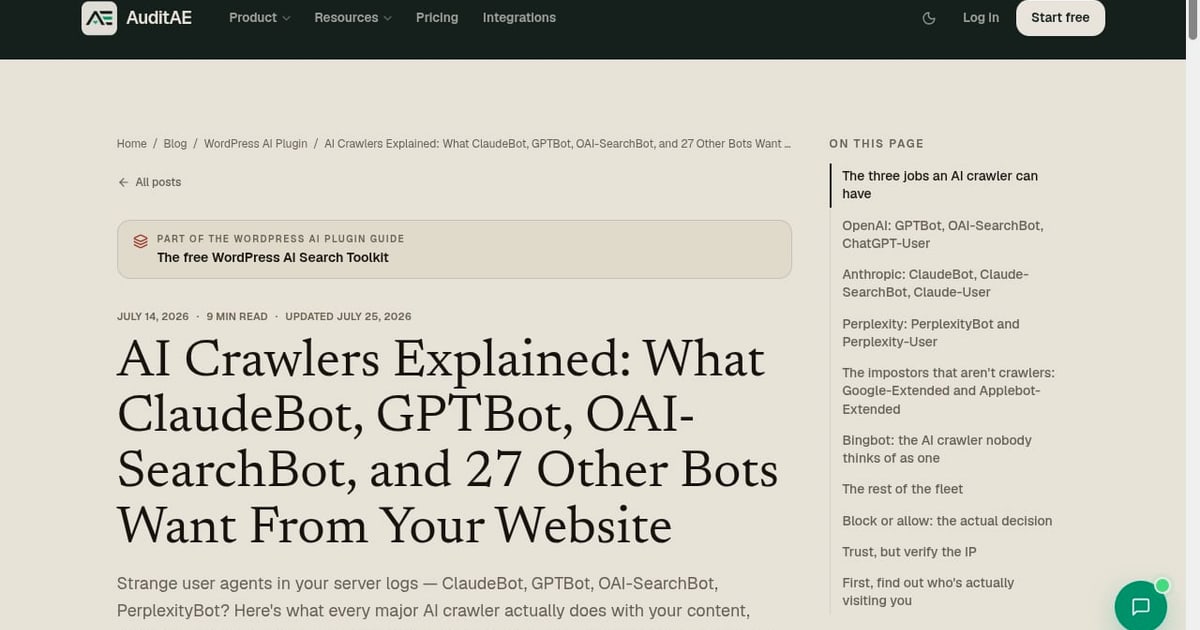
First viewport screenshot of AI Crawlers List 2026: ClaudeBot, GPTBot, OAI-SearchBot.
AI citations are volatile. Independent analyses report 40–60% month-over-month variance in AI citations, and roughly 80% of LLM citations do not rank in Google's top 100 for the same query. That means a single snapshot is not enough. The tools that earn their subscription are the ones that track trends over time, separate signal from noise, and connect every metric to the actual AI answers behind it.
It also means evaluation should focus on statistical rigor. A platform that samples too few prompts will produce scores that swing unpredictably. Ask vendors how many prompts they run, how often, and whether they store historical data you can audit.
Related reading
- AskScope vs Brand Armor AI vs BrightEdge: AI Visibility Compared - Compare AskScope, Brand Armor AI, and BrightEdge for AI visibility and GEO. See which fits lean marketing teams tracking AI answers, citations, and gaps.
- SE Ranking Review 2026: AI SEO Software That Gets Results - Evidence-based SE Ranking review: AI visibility tracking, keyword tools, pricing, setup, and ideal users. See if it gets results for your team.
- Attract Patient Traffic with AI: A GEO Playbook for Practices - Learn how to attract patient traffic with AI search visibility. Monitor AI answers, fix data gaps, and win recommendations in ChatGPT and AI Overviews.
Sources and further reading
- The 10 Best AI Visibility Tools for 2026 - Compare the 15 best AI visibility tools for 2026, ranked by AI model coverage, monitoring depth, GEO features, and pricing. Updated May 2026.
- 15 Best GEO Tools For 2026: Generative Engine Optimization - Master the Answer Engine era. Discover the top 15 Generative Engine Optimization (GEO) tools to drive brand visibility in ChatGPT, Perplexity, and Google AI.
- The 25 Best AI SEO Tools in 2026 - Twenty-five tools below cover the serious end of the market. They range from $19/month indie tools to $5,000/month enterprise platforms
FAQ
What is the difference between AI visibility tracking and GEO software?
AI visibility tracking measures whether and how your brand appears in AI-generated answers. GEO software goes further by recommending or automating changes to content, citations, and source presence to improve those answers. Many platforms do both, but the depth of optimization varies widely.
Which AI engines should a tracking tool cover in 2026?
At minimum, ChatGPT, Google AI Overviews, Perplexity, and Gemini. Enterprise teams should also look for Copilot, Claude, and Grok. Coverage matters because citation overlap between engines is low—one study found only 11% of cited domains overlap between ChatGPT and Perplexity.
How much does AI visibility software cost?
Entry-level tools start around $19–$29 per month. Mid-market platforms run $85–$200 per month. Enterprise platforms with governance, attribution, and high prompt volumes start around $399 per month and scale into custom contracts.
Can I track AI visibility without a dedicated platform?
You can manually prompt engines and log mentions, but you cannot scale it. Manual tracking misses prompt variations, cannot measure share of voice against competitors, and produces no citation data. Dedicated platforms exist because the measurement problem is too large for spreadsheets.
Do I need GEO software if I already use traditional SEO tools?
Traditional SEO tools track rankings and backlinks. They do not tell you which prompts trigger AI mentions or which sources AI models cite. If AI answers influence your pipeline, you need visibility data from the AI layer, even if you keep your SEO stack.
Conclusion
The AI visibility and GEO software market has matured quickly. In 2026, the meaningful differences are no longer whether a tool tracks ChatGPT, but how deep its citation analysis goes, how many engines it covers on your plan, and whether it helps you act on what it finds.
Start with your constraint. If you cannot see where you stand, choose a monitoring-first platform with broad engine coverage. If you can see the gap but cannot close it, add a fix-oriented workflow. And if you are evaluating for a lean team, prioritize transparent pricing and a free trial over feature checklists—because in this category, the tool you actually use weekly beats the one with the longest feature list.