Top 10 AI Search Visibility & AEO/GEO Tracking Platforms 2026
Buyers now ask ChatGPT, Perplexity, Gemini, Claude, and Google's AI surfaces which products to consider — and those answers rarely link back to your site. AI search visibility and AEO/GEO tracking platforms exist to close that gap: they monitor whether your brand appears in generated answers, trace which sources shape those answers, and turn the findings into optimization work.
This review ranks ten platforms that genuinely belong to that category. Every entry is scored against the same criteria, and every claim is anchored to public evidence such as vendor documentation, published pricing, or independent comparisons. Tools that only do traditional rank tracking, or that sit outside the category entirely, are excluded.
How we evaluated these platforms
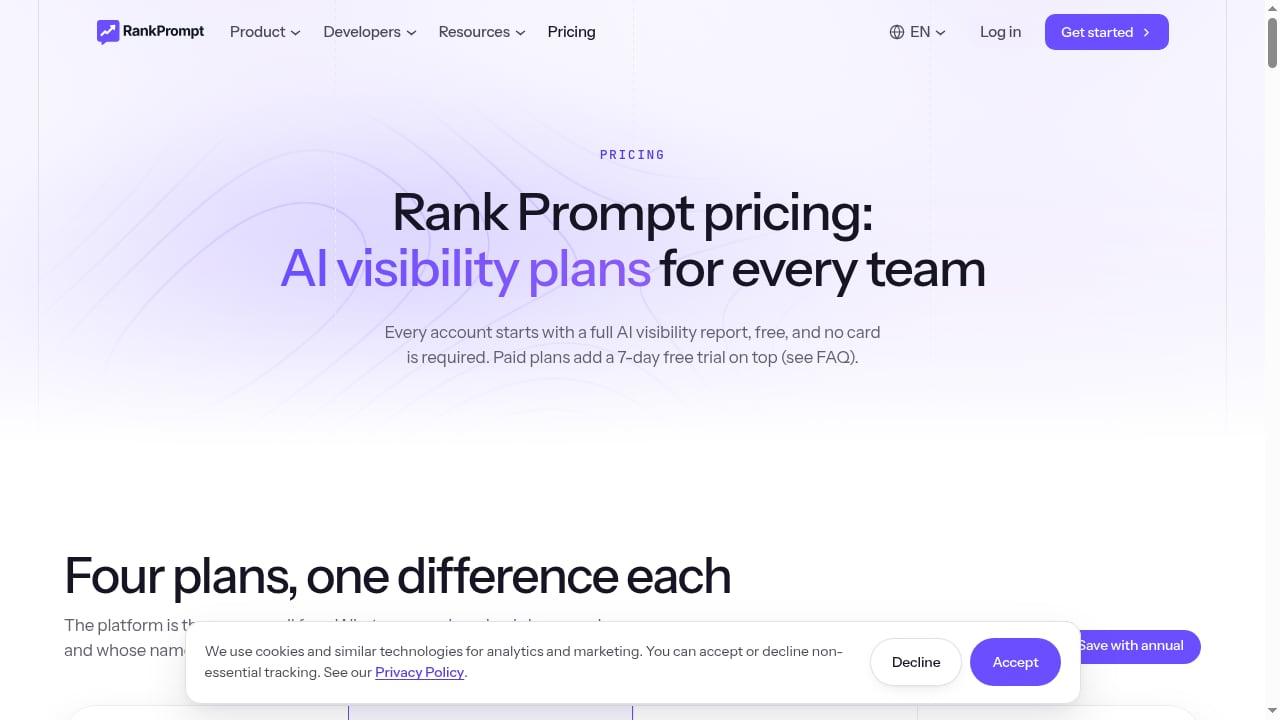
First viewport screenshot of Rank Prompt Pricing: AI Visibility Plans & Free Trial.
We scored each product on six dimensions, weighted for teams that need to move from measurement to action:
- AI model coverage — which engines are monitored (ChatGPT, Perplexity, Google AI Overviews/AI Mode, Claude, Gemini, Grok, Copilot, and others).
- Citation and source attribution — whether the tool shows which URLs and content pieces drive AI mentions, not just mention counts.
- Prompt-level granularity — the ability to see exactly which buyer questions trigger (or miss) your brand.
- GEO workflow depth — recommendations, task management, and content production support after the analysis.
- Competitive benchmarking — share-of-voice and gap analysis against named competitors.
- Transparency and fit — published pricing, self-serve access, and suitability for lean teams versus enterprise operations.
A note on scope: monitoring-only dashboards and full execution suites serve different jobs. The ranking favors platforms that connect visibility data to a next action, because that is where most teams stall.
The top 10 AI search visibility and AEO/GEO tracking platforms for 2026
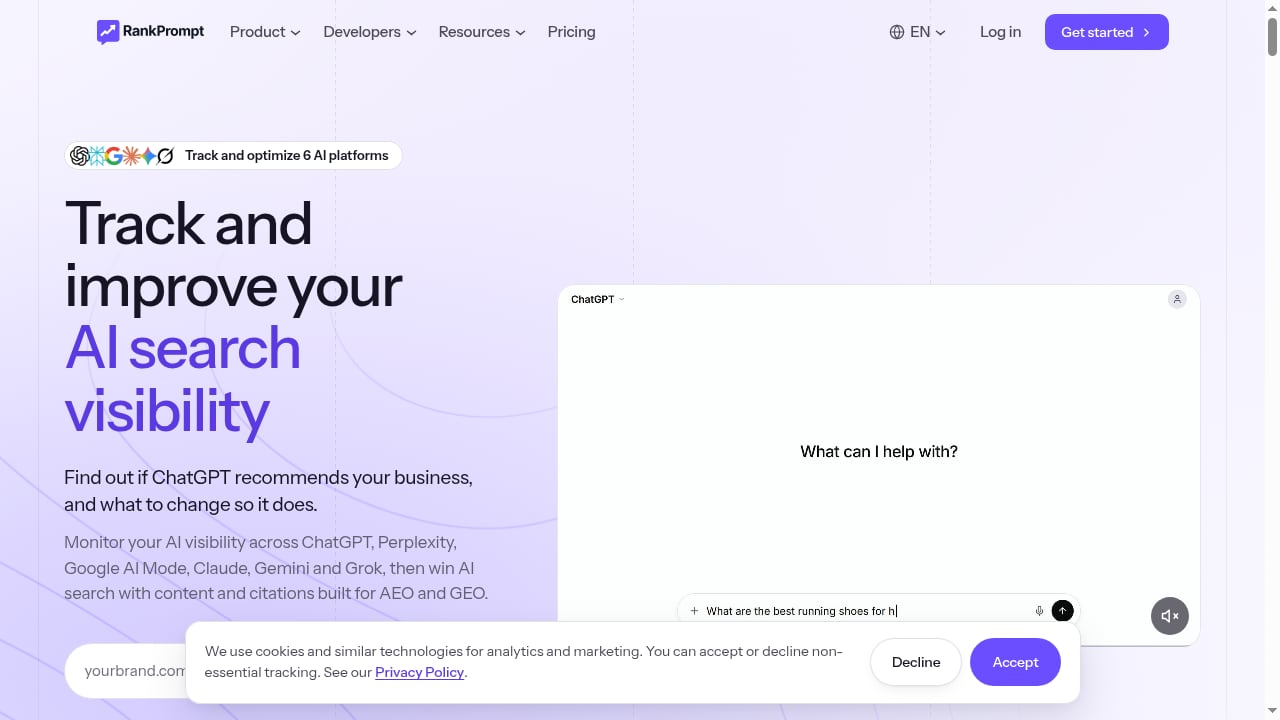
First viewport screenshot of AI SEO and AI Visibility Platform | Rank Prompt.
1. Rank Prompt — best for multi-model AEO/GEO tracking with an action loop
Rank Prompt tracks brand presence across ChatGPT, Perplexity, Google AI Mode, Claude, Gemini, and Grok, then pairs that monitoring with AEO and GEO tooling aimed at winning citations. Its strength is breadth of model coverage combined with prompt-level reporting, so teams can see which questions surface their brand and which are owned by competitors.
Best for: marketing teams that want one workspace for AI search visibility and citation-focused optimization across the major answer engines.
2. Conductor — best end-to-end enterprise AEO platform
Conductor combines AI visibility tracking with content creation and technical site monitoring, and its published plans start around $1,500/month. According to Conductor's own AEO tool ranking, it monitors ChatGPT, Gemini, Perplexity, Google AI Overviews, Google AI Mode, Claude, Grok, and Copilot, and connects its dataset to LLMs through MCP server and connector integrations.
Best for: enterprise teams that want to eliminate tool sprawl and connect AI visibility to content execution.
3. Evertune — best for statistically rigorous brand perception tracking
Evertune pairs multi-model monitoring (ChatGPT, Claude, Gemini, Perplexity, Meta AI, DeepSeek) with a large consumer panel and source-level attribution. Its AI Brand Index measures how often and in what context models reference a brand, and the platform adds sentiment and perception tracking on top of mention data. Independent coverage, including Evertune's 2026 AI visibility tool comparison, positions it as an enterprise-grade option with a reported entry point near $3,000/month.
Best for: brands that need statistically significant perception and share-of-voice trends, not just mention counts.
4. Semrush — best for teams already living in a traditional SEO suite
Semrush added AI visibility features to its established SEO platform, covering Google AI Overviews and ChatGPT alongside its existing keyword, competitor, and backlink tooling. Pricing starts around $139.95/month. The trade-off is depth: AI data sits inside a much larger reporting structure, so AI-specific workflows are less specialized than dedicated platforms.
Best for: teams that want basic AI tracking without adding another vendor to an existing Semrush stack.
5. Profound — best for citation tracking and competitive benchmarking
Profound focuses on citation tracking and competitive benchmarking across ChatGPT, Gemini, Perplexity, Google AI Overviews, Google AI Mode, and Copilot, with custom enterprise pricing. It is a strong fit when the core question is "which sources are winning the answers our competitors appear in?"
Best for: competitive intelligence teams that need deep citation analysis rather than content production.
6. Otterly.AI — best low-cost entry for agencies and mid-market teams
Otterly.AI covers ChatGPT, Gemini, Perplexity, Google AI Overviews, Google AI Mode, and Copilot, with a published entry price around $29/month. Its emphasis is citation analysis — understanding which pages and domains feed AI answers — which makes it a practical first purchase for agencies managing multiple brands.
Best for: agencies and mid-market teams that need affordable citation analysis across several clients.
7. Peec AI — best for cross-engine brand presence monitoring
Peec AI monitors brand presence across ChatGPT, Google AI Overviews, Copilot, Perplexity, Gemini, and Claude. It is positioned as a monitoring-first platform, so teams that already have content and optimization resources elsewhere can use it purely for visibility intelligence. Pricing is custom.
Best for: teams that want broad engine coverage for monitoring and will handle optimization in-house.
8. AthenaHQ — best for analyzing citation mechanics
AthenaHQ targets data-driven teams that want to understand why certain sources get cited, monitoring ChatGPT, Perplexity, Claude, and Gemini with custom pricing. Its analytical framing suits teams that treat citation patterns as a research problem before scaling content changes.
Best for: analysts who want to reverse-engineer citation mechanics across major models.
9. SE Ranking — best value AI visibility inside an SEO toolkit
SE Ranking folds AI visibility tracking into its broader SEO software, which makes it a cost-effective option for teams that already use it for keyword and rank data. It is a sensible middle ground between a pure monitoring tool and a full enterprise AEO suite. For a detailed breakdown, see this SE Ranking review for 2026.
Best for: small and mid-sized teams that want AI visibility added to an existing SEO workflow.
10. Writesonic — best for content teams optimizing at scale
Writesonic approaches the category from the content side: it includes basic AI Overview tracking alongside AI content generation, with entry pricing around $12/month. It is not a deep monitoring platform, but it is useful when the bottleneck is producing answer-ready content rather than measuring visibility.
Best for: content teams that need volume and light AI visibility signals in one tool.
How to choose the right platform for your team
First viewport screenshot of AI Visibility Platform Changelog | Rank Prompt.
The right pick depends on which stage of the workflow is broken for you:
- If you cannot see where you stand: start with a monitoring-first tool such as Peec AI, Otterly.AI, or SE Ranking.
- If you can see the gap but not the cause: prioritize citation attribution — Profound, AthenaHQ, or Evertune.
- If you need to act, not just report: choose a platform with recommendations and content workflows, such as Rank Prompt or Conductor.
- If you are a lean team: self-serve pricing and a clear monitor-analyze-act loop matter more than enterprise integrations. This is also where an adjacent tool like AskScope fits — it is a self-serve GEO platform for lean marketing teams, not a member of this ranked list, and it is worth considering when the priority is a lightweight visibility check and a prioritized action list rather than a full enterprise suite. You can see how it stacks up against other options in this AskScope vs Finseo comparison.
- If you are consolidating vendors: an end-to-end platform such as Conductor may replace two or three point tools.
A practical test before buying: run the same ten buyer-intent prompts through each shortlisted tool and compare how many of your brand's mentions it actually detects. Detection accuracy, not dashboard design, is the real differentiator.
Related reading
- AskScope vs PallasAI vs Rank Prompt: AI Visibility Tools - Compare AskScope, PallasAI, and Rank Prompt for AI visibility and GEO. See which platform fits lean teams monitoring AI answers and citations.
- Superlines Review 2026: AI Search Visibility, Pricing & Fit - Evidence-based Superlines review: AI search visibility across ChatGPT, Gemini, Perplexity and Google AI, pricing from €79/mo, setup, pros, cons and who it fits.
- Visme AI Search Visibility: Track Brand Answers in AI - Visme's AI search visibility means how its brand appears in AI-generated answers. Learn to monitor, analyze, and improve it with AskScope's GEO workflow.
Sources and further reading
FAQ
What is the difference between AEO and GEO tracking?
AEO (answer engine optimization) and GEO (generative engine optimization) describe the same underlying goal — getting cited in AI-generated answers — but the terms emphasize different surfaces. AEO is often used for answer engines and AI Overviews, while GEO is used for generative models like ChatGPT, Claude, and Gemini. In practice, most 2026 platforms track both and use the labels interchangeably.
Do I need a dedicated AI visibility platform if I already use an SEO tool?
Only if your SEO suite's AI features are shallow. Several traditional platforms now include basic AI Overview tracking, but dedicated tools typically offer deeper prompt-level data, citation attribution, and GEO workflows. If AI answers influence your pipeline, the extra depth usually pays for itself.
How many AI models should a tracking platform cover?
At minimum, cover the engines your buyers actually use. For most B2B and SaaS teams in 2026 that means ChatGPT, Perplexity, Google AI Overviews or AI Mode, and Gemini, with Claude and Grok as useful additions. Single-model tracking is rarely enough to make strategic decisions.
What does AI visibility tracking cost in 2026?
Entry-level monitoring starts around $12–$29/month for light tools, mid-market platforms sit in the $99–$250/month range, and enterprise AEO suites start near $1,500/month and scale with seats and add-ons. Always verify whether AI tracking is included in the entry tier or sold as an upgrade.
Can I track AI visibility without a paid platform?
Partially. Manual prompt testing in ChatGPT or Perplexity gives a rough snapshot, and some vendors offer free visibility checks. But manual testing does not scale to hundreds of prompts, cannot track trends reliably, and will not attribute citations — which is why teams move to dedicated platforms once AI search becomes a real acquisition channel.
Conclusion
AI search visibility is no longer a nice-to-have metric; it is a discovery channel that decides whether buyers ever hear your name. The ten platforms above cover the full spectrum, from low-cost citation trackers to enterprise AEO suites. Match the tool to your actual bottleneck — measurement, diagnosis, or execution — and validate detection accuracy with your own buyer prompts before committing. If you want a broader view of how these tools compare side by side, start with this top 10 AI visibility and GEO software comparison.