Top 10 AI Search Visibility and AEO/GEO Analytics Platforms 2026
AI assistants now answer buying questions directly, often citing just two to five sources per response. If your brand is not in that small citation set, you are invisible to the user who never clicks. This guide ranks the top 10 AI search visibility and AEO/GEO analytics platforms for 2026, explains how we evaluated them, and helps you choose the right fit for your team size and budget.
How We Evaluated These Platforms
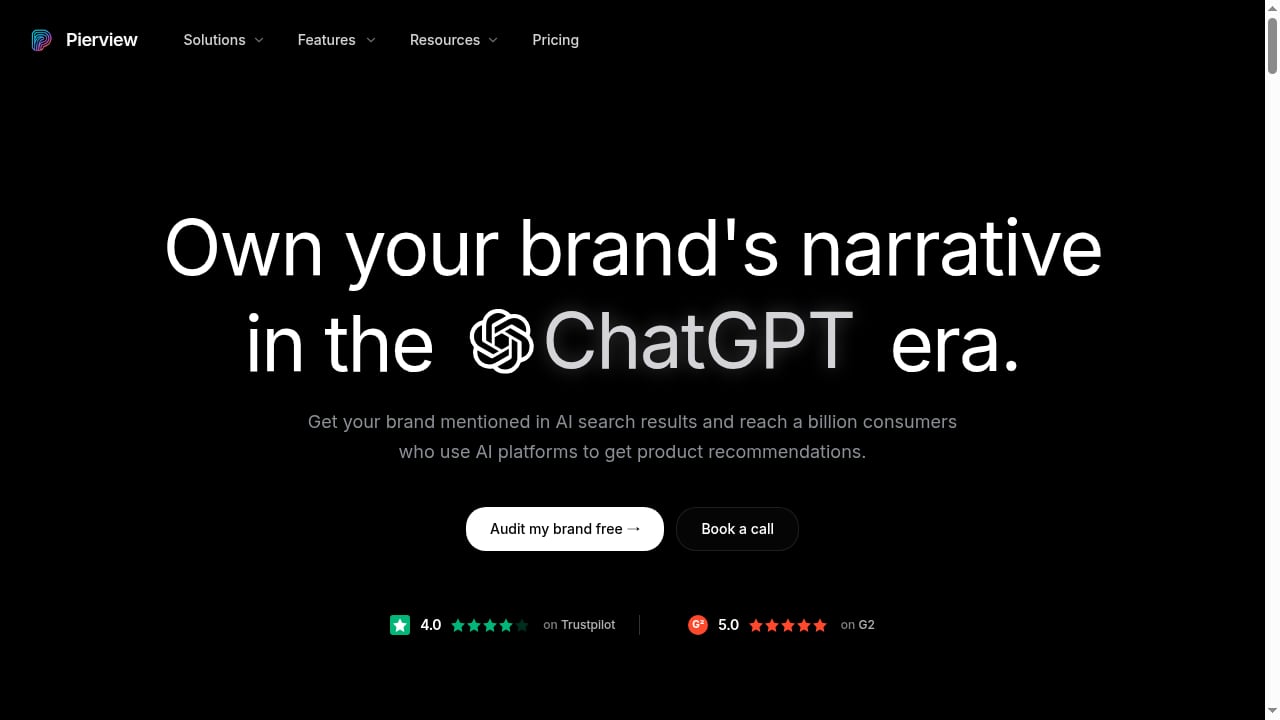
First viewport screenshot of Pierview | Boost Your Brand's Visibility in AI Search.
We scored every product against nine criteria, weighted in this order:
- AI engine coverage — Does it track ChatGPT, Gemini, Perplexity, Claude, Copilot, and emerging models, or only one or two?
- Data method — Proprietary real-query sampling at scale versus a hand-picked prompt set.
- Citation and source tracking — Can it show which URLs the AI cited, how often, and in what context?
- Execution depth — Monitor-only, monitor plus recommendations, or full content and schema production.
- Schema and structured-data output — Does it generate the markup fixes, or leave them to a developer?
- Price and pricing model — Published pricing, seat-based versus usage-based, and total cost at scale.
- Self-serve versus done-for-you — Software you run yourself versus a service that runs it for you.
- Attribution and integrations — Can you tie an AI citation to a pipeline deal, CRM, or CMS?
- Compliance and enterprise readiness — SOC 2, SSO, data residency, and audit logs.
We used vendor product pages, public documentation, and buyer sentiment from communities as signals. Where pricing is not public, we say so rather than guess. No vendor paid for placement.
The Top 10 AI Search Visibility and AEO/GEO Analytics Platforms for 2026
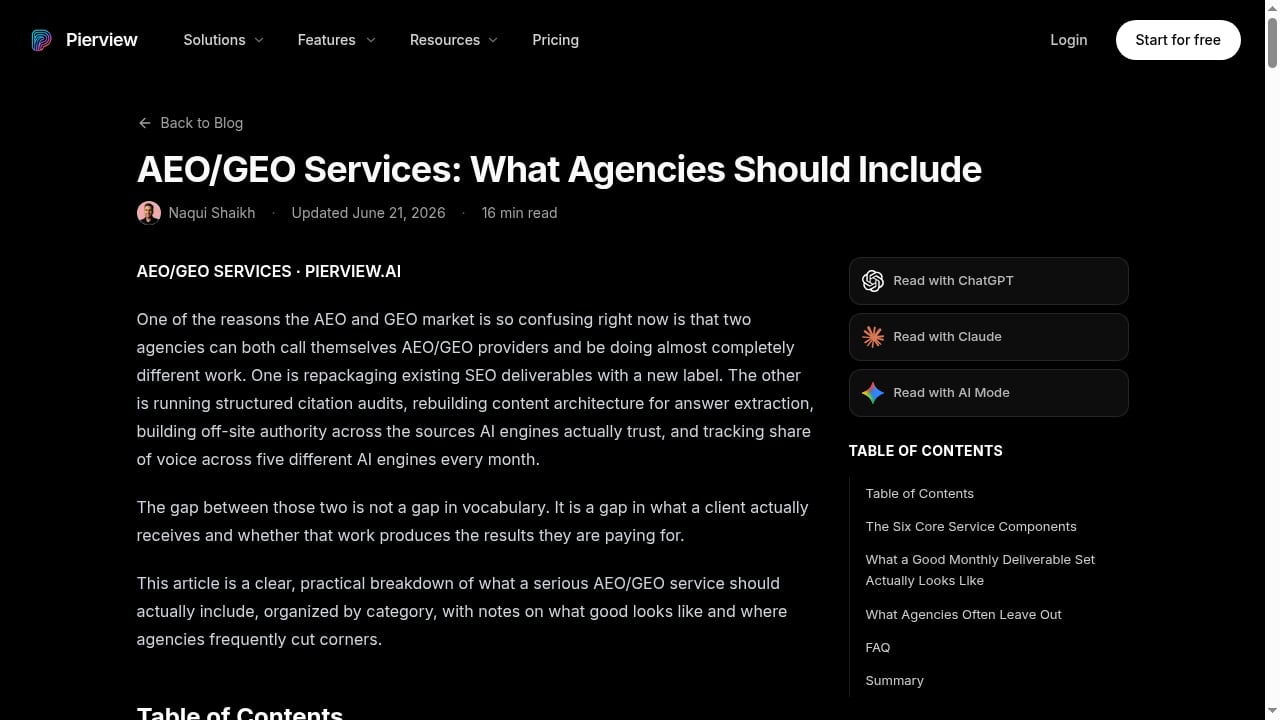
First viewport screenshot of Pierview | Boost Your Brand's Visibility in AI Search.
1. Evertune
Best for: Enterprises and agencies that need statistically significant, multi-model AI visibility data with source-level attribution.
Evertune combines multi-model monitoring across ChatGPT, Claude, Gemini, Perplexity, Meta AI, and DeepSeek with a proprietary AI Brand Index that tracks how often and in what context models reference your brand. Its standout capability is source attribution at scale: it traces every AI mention back to the specific pages and content types that drove it. It also offers sentiment and perception tracking plus prioritized optimization recommendations. The platform leans enterprise, so smaller teams may find the depth and cost heavier than needed.
2. Conductor
Best for: Large enterprises that want AEO layered onto an existing enterprise SEO suite.
Conductor unifies search intelligence with content creation. Its AI Visibility Intelligence module monitors brand portrayal across major LLMs, while Conductor Creator generates content aligned with brand voice. Technical AEO monitoring runs 24/7 audits and alerts to keep key assets accessible to AI crawlers. ROI tracking connects AI-driven traffic to conversions. The trade-off is that Conductor is a broad platform, so teams wanting a lightweight, AI-only tool may pay for capability they do not use.
3. Profound
Best for: Teams that want the deepest measurement using real-prompt data.
Profound is cited for its real-query data method, pulling live AI responses at scale rather than relying on a curated prompt list. That approach produces more reliable trend data across non-deterministic AI answers. It is a strong fit for teams that treat AI visibility as a measurement discipline and need defensible numbers for leadership. The depth comes with a learning curve and pricing that reflects its data infrastructure.
4. AthenaHQ
Best for: Teams that need to tie AI visibility to revenue attribution.
AthenaHQ focuses on connecting AI citations to business outcomes, helping teams see which visibility gains correlate with pipeline and revenue. It monitors brand presence across major engines and provides competitive benchmarking. If your leadership asks "what did AI visibility actually earn us," this is the platform built to answer that question. Teams that only need mention tracking may find the attribution layer more than they need.
5. Gauge
Best for: Teams that want a full-stack GEO toolkit with an agentic content engine.
Gauge runs a "Track, Understand, Act" workflow: it monitors brand mentions across ChatGPT, Claude, Gemini, and Perplexity, provides deep citation analytics, and includes an agentic content engine that drafts articles optimized for AI search. This makes it a close-the-loop option for teams that want to move from insight to published content without switching tools. The content engine is a differentiator, but teams with strict editorial controls should review output quality carefully.
6. BrightEdge
Best for: Enterprises already invested in a traditional SEO platform that want an AEO layer.
BrightEdge has added AI-visibility dashboards on top of its established keyword and ranking infrastructure. For enterprises with existing SEO contracts, layering AEO features onto a platform they already pay for can be more efficient than evaluating standalone tools. The AI visibility module is an extension rather than a purpose-built AI-native platform, so teams wanting AI-first depth may prefer a dedicated tool.
7. Otterly.ai
Best for: Solo marketers and small teams that need an affordable monitoring entry point.
Otterly.ai is frequently cited as the cheapest monitoring entry point, with pricing starting around $29 per month. It tracks brand mentions across major LLMs and provides prompt-level insights. It is monitor-only, so it tells you the problem but does not fix it. For teams establishing a baseline before investing in execution tooling, it is a practical first step.
8. Scrunch AI
Best for: Teams that want dedicated AI brand monitoring without enterprise overhead.
Scrunch AI focuses on AI brand monitoring across major engines, tracking mentions, citations, and competitive positioning. It sits in the dedicated monitoring category, meaning it surfaces visibility data but leaves content production to your existing workflow. It is a reasonable fit for teams that already produce content at volume and need data to guide it.
9. Rankscale
Best for: Teams that want straightforward AI visibility tracking at a moderate price.
Rankscale provides AI visibility monitoring across major models with a focus on prompt-level tracking and competitive benchmarking. It does not include content creation or optimization execution, so it fits teams that need measurement only. Its positioning is simpler and more accessible than enterprise suites, making it a candidate for growth-stage teams testing the category.
10. Peec AI
Best for: Brands that want AI visibility monitoring with a clean, accessible interface.
Peec AI tracks brand mentions across AI engines and presents insights in a format non-technical teams can act on. It belongs to the dedicated monitoring tier, so it is best paired with an internal or external content team that can execute on the gaps it surfaces. It is a solid option for teams that want visibility data without a heavy platform commitment.
Monitor-Only vs. Close-the-Loop: The Decision That Matters Most
The single most decision-relevant axis in this market is whether a platform just shows you where you stand or also helps you produce the content and schema that earn citations.
- Monitor-only tools (Otterly.ai, Scrunch AI, Rankscale, Peec AI) tell you the problem. They are cheaper and faster to deploy, but they require your team to act on the data.
- Monitor-plus-recommendations tools (Evertune, AthenaHQ) add prioritized guidance but stop short of production.
- Close-the-loop platforms (Conductor, Gauge) combine measurement with content generation and sometimes schema output, so teams can act without switching tools.
If your team already produces content at volume, pure monitoring may be enough. If you need to write, structure, and distribute answer-optimized content at scale, you are looking at a different category with different pricing.
For a deeper comparison of how specific tools handle GEO workflows, see our AskScope vs Frase vs Waikay comparison.
How to Choose the Right Platform for Your Team
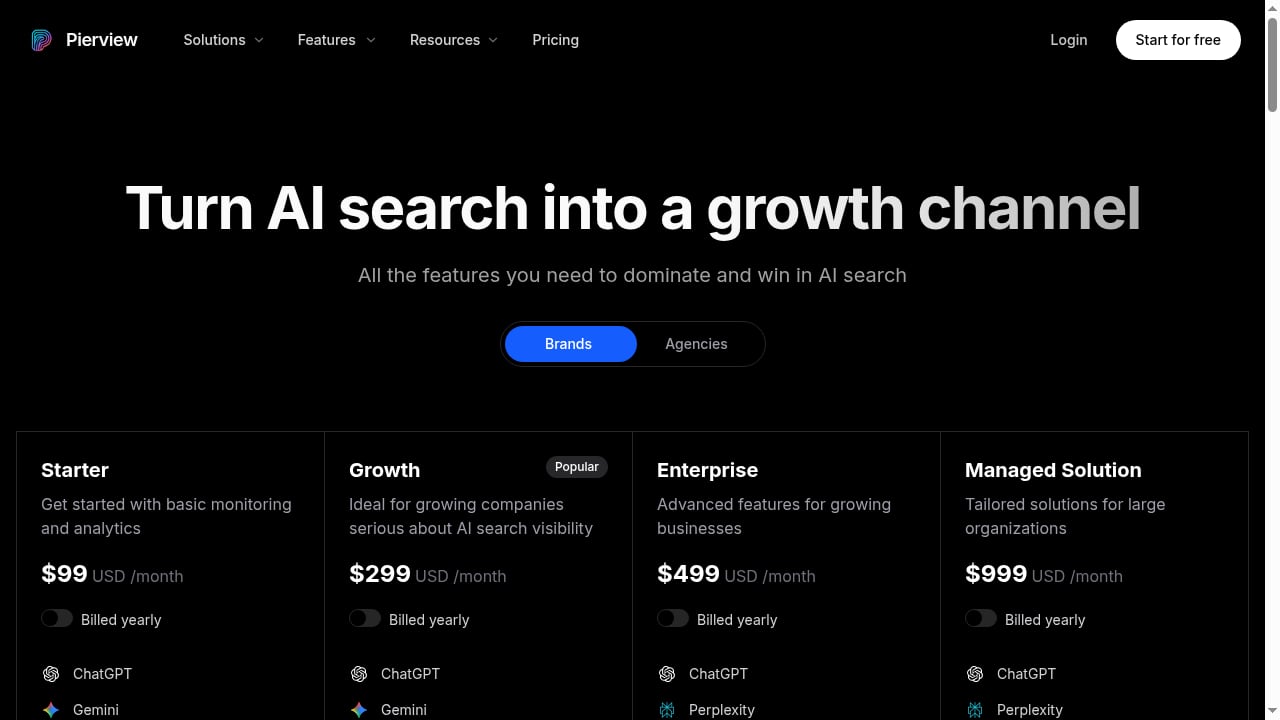
First viewport screenshot of Pierview | Boost Your Brand's Visibility in AI Search.
Solo marketers and small teams
Start with an affordable monitoring tool to establish a baseline. Otterly.ai or Peec AI can show you where you stand before you invest in execution. If you need a self-serve GEO platform built for lean teams, AskScope offers a free visibility check with seven days of daily ChatGPT monitoring across 40 prompts, which is a low-risk way to see your starting position.
Growth-stage teams running active content programs
You likely need close-the-loop tooling. Gauge or Conductor can connect measurement to production. If you want to compare lean-team options specifically, our AskScope vs GetMint vs AuditAE comparison breaks down how each monitors ChatGPT, Perplexity, and Gemini.
Enterprises with existing SEO contracts
Layer AEO features onto platforms you already pay for, such as BrightEdge or Conductor, before evaluating standalone options. Evertune and AthenaHQ are worth evaluating when you need statistically rigorous data or revenue attribution.
Consultants and agencies
You need multi-client visibility tracking and clear reporting. Our guide to AI search for consultants covers how to track and improve visibility across clients with a 30-day plan.
Pricing Signals at a Glance
| Platform | Pricing Model | Entry Point |
|---|---|---|
| Evertune | Enterprise | Custom |
| Conductor | Enterprise | Custom |
| Profound | Usage-based | Custom |
| AthenaHQ | Enterprise | Custom |
| Gauge | Subscription | Custom |
| BrightEdge | Enterprise | Custom |
| Otterly.ai | Subscription | ~$29/mo |
| Scrunch AI | Subscription | Custom |
| Rankscale | Subscription | Moderate |
| Peec AI | Subscription | Custom |
Where vendors do not publish pricing, request a quote and ask about seat-based versus usage-based models, since total cost can look very different at scale.
Common Mistakes When Choosing an AEO/GEO Tool
First viewport screenshot of Pierview | Boost Your Brand's Visibility in AI Search.
- Choosing on price alone. A $29/month tracker tells you the problem but does not fix it. Budget for execution, whether in tooling or headcount.
- Ignoring data method. A curated prompt set is not the same as real-query sampling at scale. Ask how the vendor collects data.
- Skipping citation tracking. Brand mention counts without source attribution leave you unable to optimize the pages that actually drive citations.
- Forgetting compliance. SOC 2, SSO, and data residency are table stakes for large procurement teams. Flag them early.
Related reading
- AskScope vs AI Search Visibility Tracking & Optimization Tool - Compare AskScope and the AI Search Visibility Tracking & Optimization Tool for GEO workflows, pricing, and AI answer monitoring.
- AskScope vs Siftly: AI Search Visibility Tools Compared - Compare AskScope and Siftly for tracking brand mentions across AI engines. See which GEO platform fits lean marketing teams and startup budgets.
Sources and further reading
- 10 Best AI Search Agencies for B2B SaaS in 2026 (GEO, AEO & AI ... - I
- The 10 Best AI Visibility Tools for 2026 - Compare the 15 best AI visibility tools for 2026, ranked by AI model coverage, monitoring depth, GEO features, and pricing. Updated May 2026.
- The best AEO/GEO companies & platforms in 2026 - A 2026 guide to the best AEO/GEO platforms and agencies, from $29/mo monitors to enterprise suites and done-for-you services, compared by AI engines, price and execution.
FAQ
What is the difference between AEO and GEO?
AEO (answer engine optimization) and GEO (generative engine optimization) are closely related practices. Both focus on structuring content, schema, and authority signals so AI systems cite your source when composing an answer. The terms overlap heavily, and neither replaces classic SEO—both extend it into AI-driven surfaces.
Do I need a dedicated AI visibility platform if I already use an SEO tool?
Not necessarily. If your existing SEO suite has added an AI-visibility module, you may be able to layer AEO features onto it. However, dedicated platforms often provide deeper citation tracking and AI-specific data methods that general SEO tools do not.
How many AI engines should a platform track?
At minimum, track ChatGPT, Gemini, and Perplexity, since these cover the majority of consumer AI search. Claude, Copilot, and regional models like DeepSeek add coverage for specific audiences. Single-model tracking is insufficient for a complete picture.
Can I start with a free tool?
Yes. Several vendors offer free visibility checks or trial periods. AskScope, for example, offers a free visibility check with seven days of daily ChatGPT monitoring across 40 prompts. HubSpot also offers a free one-shot AI Search Grader. These are useful for establishing a baseline before committing budget.
What is a good citation rate in AI search?
Citation rates vary by industry and query type. What matters most is tracking your rate over time and against competitors. For benchmarks and improvement tactics, see our guide to citation rate in AI search.
Conclusion
The AI search visibility and AEO/GEO analytics market has matured quickly. In 2026, the choice comes down to three questions: How many engines do you need to track? Do you need monitoring only or close-the-loop execution? And what is your realistic budget and team capacity?
Start by establishing a baseline with an affordable monitoring tool, then invest in execution capability as your content program scales. Enterprises should evaluate whether layering AEO onto existing SEO platforms is more efficient than adopting a standalone tool. Lean teams should prioritize self-serve platforms that connect metrics to evidence and reduce operational burden.
Whichever path you choose, the goal is the same: move from unseen to known to trusted to recommended in the AI answers your buyers actually see.
For a broader comparison of monitoring and GEO software, see our Top 10 AI visibility monitoring and GEO software guide.