How to Monitor Competitor AI Presence: A Practical Guide
Buyers increasingly ask AI assistants for software recommendations before they ever visit a search results page. If ChatGPT, Perplexity, or Gemini recommends your competitors instead of you, you lose the deal before the first click. Monitoring competitor AI presence means systematically tracking which brands AI models mention, how often, in what context, and which sources shape those answers. This guide explains what to track, how to set up a repeatable workflow, and how to turn competitor intelligence into content and GEO actions.
What "competitor AI presence" actually means
First viewport screenshot of Customers are asking AI. Is your brand in the answer?.
AI answers are not ranked lists. A model synthesizes a response from training data, retrieval sources, and prompt context. Competitor AI presence covers several distinct signals:
- Mention rate: how often a competitor appears in answers to your target prompts.
- Share of voice: the proportion of AI answers where each brand is named relative to others.
- Position and prominence: whether a competitor is recommended first, listed among options, or mentioned as an afterthought.
- Sentiment and framing: whether the model describes them as a leader, a budget option, or a niche player.
- Citations: which URLs, review sites, and documents the AI used to form its answer.
Tracking only mention counts gives you a scoreboard without a playbook. The citation layer is what tells you where to intervene.
Why traditional rank tracking misses this
First viewport screenshot of Customers are asking AI. Is your brand in the answer?.
A brand can rank first on Google and still be absent from AI answers. AI models draw on different signals: entity clarity, third-party authority, structured data, and how frequently a brand appears in the sources models retrieve. Research cited by Omniscient Digital suggests a large share of B2B software buyers now begin research in an AI chatbot rather than a search engine, which means AI answer share is becoming a leading indicator of pipeline.
That shift creates a measurement gap. Your SEO dashboard shows impressions and clicks. It does not show that ChatGPT recommended three competitors and never mentioned you.
Step 1: Build a prompt set that mirrors buyer questions
Start with 20 to 50 prompts grouped by intent:
- Category discovery: "best AI visibility tools for small marketing teams"
- Comparison: "AskScope vs Clearscope"
- Problem-led: "how do I track brand mentions in ChatGPT"
- Brand-adjacent: "alternatives to [competitor name]"
Keep prompts stable over time so you can measure change. Add new prompts when you launch products or enter new categories, but version your prompt set so historical comparisons stay valid.
Step 2: Capture answers on a schedule
First viewport screenshot of Customers are asking AI. Is your brand in the answer?.
AI answers vary by model, by day, and by phrasing. A one-time check tells you almost nothing. Run your prompt set weekly or daily, and record:
- Which brands appear in each answer
- The order in which they appear
- The exact phrasing used around each brand
- Any URLs or sources cited
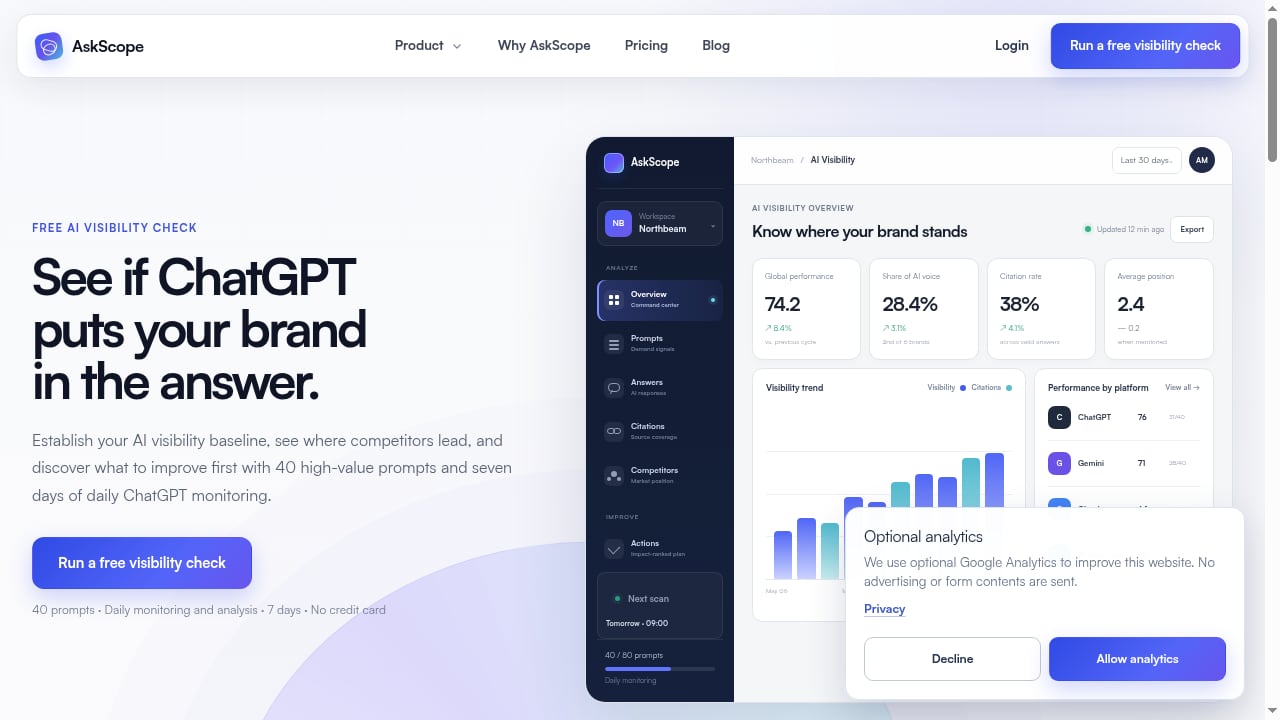
Manual checking works for a handful of prompts, but it breaks down quickly. This is where a dedicated platform helps. AskScope runs daily ChatGPT monitoring across 40 prompts on its trial, tracking mentions, positions, and changes over time, and it analyzes competitors to show who AI recommends instead of you. For lean teams, that replaces a spreadsheet that would otherwise go stale within a week.
Step 3: Analyze citations, not just mentions

What citation gaps reveal about your competitors' AI visibility editorial illustration.
Citation analysis is the most actionable part of competitor AI monitoring. When a competitor is cited, note the source type:
| Source type | What it signals | Typical action |
|---|---|---|
| Review platforms | Strong third-party validation | Improve review coverage and recency |
| Comparison articles | Editorial inclusion | Pitch or publish your own comparison content |
| Documentation | Product clarity | Tighten entity and feature descriptions |
| Community threads | Peer recommendation | Participate where relevant |
If the same competitor keeps getting cited from one domain, that domain is shaping the model's view of your category. Either get represented there or build a stronger alternative source.
Step 4: Benchmark share of voice over time
A single snapshot shows who is winning today. Trend data shows whether you are closing the gap. Track share of voice per prompt cluster and per model, then compare against your own mention rate. Useful patterns to watch:
- A competitor gaining share in a cluster where you are absent
- A competitor losing share after a pricing or positioning change
- New entrants appearing in prompts you considered settled
Connecting this to downstream behavior makes the data more useful. Pairing AI visibility data with session-level analytics, as described in this guide to using AskScope with Microsoft Clarity, helps you see whether AI-referred visitors actually engage once they arrive.
Step 5: Turn findings into GEO actions
Monitoring without action is expensive reporting. Each finding should map to a task:
- Competitor cited from a listicle you are missing from → pitch or create an equivalent asset.
- Competitor described more clearly than you → rewrite your positioning and entity descriptions.
- Competitor absent from a prompt you own → publish content that directly answers that prompt.
- Competitor winning on sentiment → address the underlying proof gap with case studies or data.
AskScope's workflow connects metrics to evidence, then surfaces prioritized recommendations and tasks, with content creation and distribution tools so you can act and retest. That retest step matters: GEO is iterative, and the only way to know a change worked is to re-run the same prompts.
Choosing a monitoring approach
| Approach | Best for | Trade-off |
|---|---|---|
| Manual prompt checks | Very early exploration | Not scalable, inconsistent |
| Single-model trackers | Teams focused on ChatGPT only | Blind to other engines |
| Multi-engine platforms | Teams with real GEO programs | Higher cost, more setup |
| Analytics-integrated tools | Teams linking AI to revenue | Broader platform commitment |
Start with a free visibility check to see whether you have a problem worth solving. If competitors dominate your category prompts, move to a recurring monitoring setup before investing in content production.
Common mistakes to avoid
- Tracking too many prompts. Fifty well-chosen prompts beat five hundred random ones.
- Ignoring citation sources. Mentions tell you what happened; citations tell you why.
- Changing prompts constantly. You lose your baseline and cannot measure progress.
- Treating AI visibility as a one-off audit. Models and sources shift continuously.
- Skipping the action layer. Insights that do not become tasks do not change outcomes.
Sources and further reading
- Top 5 tools to monitor your brand's presence in AI search (Perplexity ... - Apr 16, 2025 ... Top 5 tools to monitor your brand's presence in AI search (Perplexity, ChatGPT, Gemini, Claude, and more) ; Mangools - Comparison across six ...
- The 12 Best AI Visibility Monitoring Tools in 2026 - Find the best AI visibility monitoring tools to measure brand presence across AI platforms and connect it to growth.
FAQ
How is monitoring competitor AI presence different from traditional competitor SEO?
Traditional competitor SEO tracks rankings and organic traffic on search engines. AI presence tracking measures how often competitors appear in generated answers, how they are framed, and which sources the model used. The signals overlap, but the outputs and optimization levers differ.
Which AI platforms should I monitor?
Start with the platforms your buyers actually use. ChatGPT is the most common starting point, followed by Perplexity, Gemini, and Google AI Overviews. If your audience is technical, add Claude. Multi-engine coverage matters because recommendations differ by model.
How often should I run competitor checks?
Weekly is a reasonable baseline for most teams. Daily monitoring is useful during launches, category shifts, or when a competitor makes a major positioning change. Consistency matters more than frequency.
Can I monitor competitors without a paid tool?
Yes, for a small prompt set. Manual checks across five to ten prompts are feasible weekly. Beyond that, tracking becomes error-prone and hard to compare over time, which is when a dedicated platform pays for itself.
What should I do when a competitor outranks me in AI answers?
Identify the citation sources behind their mentions, check whether you are represented there, and close the gap with content or third-party coverage. Then re-run the same prompts to verify the change. For a broader view of how AI visibility platforms differ, see this Brand Armor AI review and this comparison of user behavior analytics software for connecting visibility to on-site behavior.
Conclusion
Monitoring competitor AI presence is not about vanity metrics. It is about knowing which brands AI models recommend in your category, why those recommendations happen, and what you can change to earn a mention. Build a stable prompt set, capture answers on a schedule, analyze citations, benchmark share of voice, and convert every finding into a task you can retest. Teams that treat AI visibility as an ongoing workflow rather than a quarterly report will be the ones recommended when buyers ask.