How to Use AskScope with Yext: AI Visibility Workflow
AI assistants like ChatGPT and Perplexity rarely invent facts about your brand. They assemble answers from whatever structured and unstructured data they can find. That creates a split problem for marketing teams: you need to know what AI is saying about you, and you need a reliable system to correct the underlying data.
AskScope and Yext solve different halves of that problem. AskScope shows you how your brand appears in AI-generated answers and what sources shape them. Yext keeps your verified business data accurate and distributes it across search engines, AI platforms, and 200+ integrations. Used together, they form a measurable loop: detect the visibility gap, fix the data or content behind it, then retest.
Why AI visibility and data accuracy are two different jobs
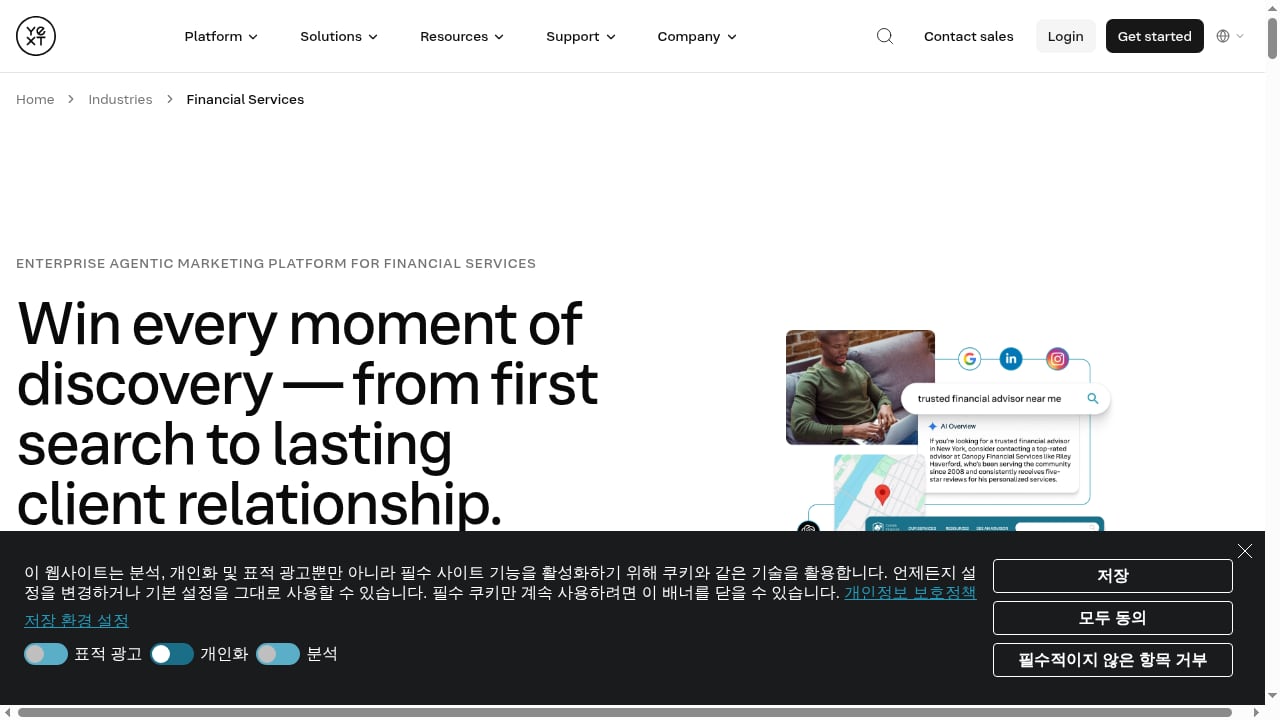
First viewport screenshot of Financial Services & Insurance.
Most teams approach AI search with one tool and one question: "Are we mentioned?" That question is necessary but incomplete. A brand can be mentioned with wrong hours, an outdated service line, or a competitor's location. Monitoring without a data fix just documents the error repeatedly.
AskScope handles the monitoring layer. It tracks mentions, positions, and changes over time across AI answers, analyzes which competitors get recommended instead, and traces the citations shaping those answers. Its recommendations and tasks turn findings into specific actions, and its content creation and distribution tools let teams publish GEO content and retest it.
Yext handles the data and distribution layer. Its Knowledge Graph centralizes structured data that powers listings, pages, reviews, and search experiences. Yext states its value proposition plainly: reliable agents are built on reliable data. With 4M+ locations managed worldwide, it is built for enterprises that need consistency at scale across healthcare, financial services, restaurants, hospitality, and retail.
How the two platforms fit together
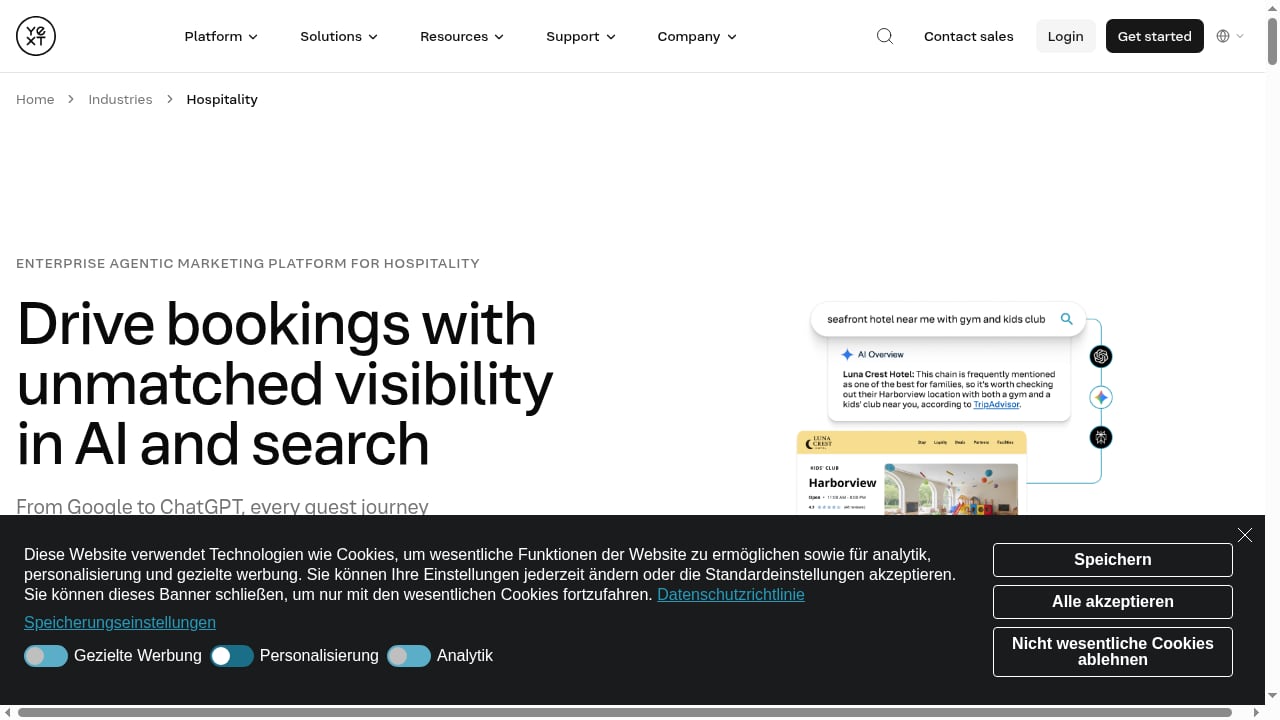
First viewport screenshot of Hospitality | Agentic Marketing Platform.
Think of the workflow as four stages.
- Detect. AskScope monitors AI answers and surfaces where your brand is missing, misrepresented, or losing to a competitor.
- Diagnose. Citation analysis in AskScope shows which sources the AI relied on — a directory listing, a review page, a location page, or third-party content.
- Fix. Yext updates the Knowledge Graph record, pushes corrected data to listings and pages, and manages reviews or user-generated content that influence the answer.
- Retest. AskScope re-runs prompts and tracks whether mentions, positions, and citations improved.
The loop matters more than any single step. Without step 3, you have reporting. Without step 4, you cannot prove the fix worked.
Setup: connecting the workflow
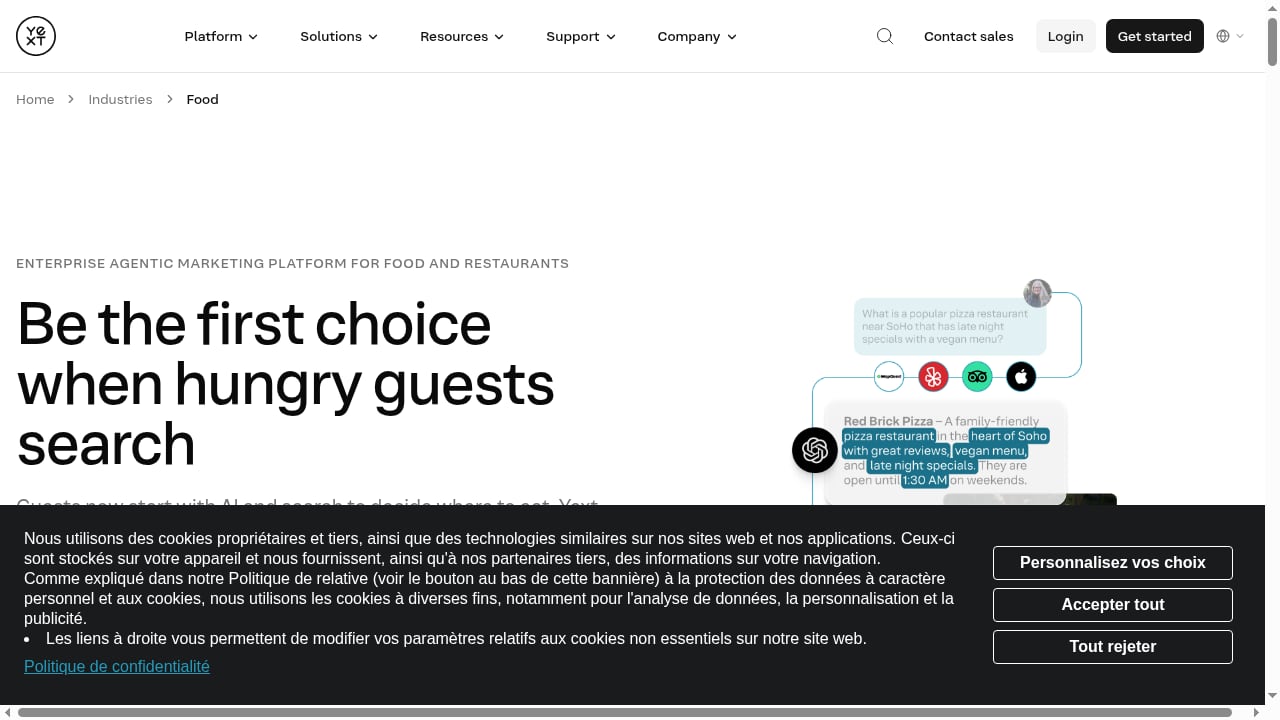
First viewport screenshot of Food & Restaurants | Agentic Marketing.
Exact UI paths change as both products evolve, so treat this as a configuration checklist rather than a click-by-click script.
Step 1: Establish your AskScope baseline
Start with a free visibility check or the seven-day free trial, which includes daily ChatGPT monitoring across 40 prompts. Build prompt sets around real customer questions, not brand slogans. For a restaurant group, that means prompts like "best gluten-free Italian near [city]" rather than "[brand] gluten-free menu."
Group prompts by intent: discovery, comparison, location, and support. This grouping later tells you which Yext data category to fix first.
Step 2: Map AskScope findings to Yext entities
When AskScope flags a missing or wrong mention, identify the entity it belongs to in Yext — a location, a provider, a service, or a product. A wrong holiday hours answer usually maps to a location entity. A missing specialty answer maps to a provider or service entity.
This mapping step is where most teams save time. It converts a vague "AI visibility problem" into a specific data record with an owner.
Step 3: Fix the source, not just the symptom
Use AskScope citation analysis to see which sources the AI referenced. If the citation points to a directory listing, correct it in Yext and let the platform distribute the update. If the citation points to thin or outdated page content, use AskScope's content tools to create or refresh the page, then publish it through your normal channels.
Step 4: Schedule retests
Re-run the same prompt set after the data propagates. Track three numbers: mention rate, average position in the answer, and citation source mix. Improvement in all three is a strong signal. Improvement in mentions with no change in citations often means the AI found you through a different path — worth investigating.
Practical examples
Multi-location healthcare. A clinic network notices ChatGPT recommends a competitor for a specific specialty in two cities. AskScope citation analysis shows the AI is pulling from an outdated third-party directory. The team corrects the provider and location data in Yext, and the next monitoring cycle shows the brand appearing in the answer.
Restaurant group. A brand sees strong mentions but wrong hours during holidays. The fix is not content — it is structured location data. Yext updates hours across listings, and AskScope confirms the answer changed. This is the clearest case for the pairing: the monitoring tool found it, but only the data platform could fix it.
Retail with seasonal inventory. A retailer wants to appear in "where to buy [product]" answers. AskScope shows the brand is cited only from marketplace pages. The team builds dedicated product and store pages, distributes them, and retests. Yext's proof points in this space are relevant: Cox Communications reported a 51% increase in site search conversion rate, and Fazoli's saw 3.6x growth in online sales.
When to use AskScope alone vs. with Yext
| Situation | AskScope alone | AskScope + Yext |
|---|---|---|
| Lean team, single location | Sufficient | Overkill |
| Multi-location brand | Useful for monitoring | Strong fit |
| Regulated industry data | Limited fix capability | Better data governance |
| Heavy review/UGC influence | Partial visibility | Full management |
| Enterprise with 200+ listings | Manual fixes only | Scaled distribution |
The deciding factor is usually whether your problem is knowledge or data. If you do not know what AI says, AskScope is the starting point. If you know what is wrong but cannot fix it consistently across many locations, Yext is the missing layer.
Common mistakes to avoid
First viewport screenshot of Customers are asking AI. Is your brand in the answer?.
- Treating AI visibility as a content-only problem. Many wrong answers come from structured data errors, not weak copy.
- Fixing data without retesting. You cannot confirm the AI picked up the change without a repeatable prompt set.
- Using brand-name prompts only. Customers ask category questions, and those are the answers that drive discovery.
- Ignoring citations. The citation mix tells you which channel to prioritize next.
If you are still evaluating the monitoring side, this AskScope vs Clearscope comparison covers how the two tools differ for lean marketing teams. For a broader view of tracking rivals in AI answers, see this guide to monitoring competitor AI presence. And if you want to connect AI discovery to on-site behavior, the AskScope and Microsoft Clarity workflow shows how that handoff works.
Related reading
- AudFlo Review: AI Visibility Audit for Indie Founders - AudFlo review: how the AI visibility audit scores your site, what the $19/mo Pro plan adds, setup, limits, and who should use it.
- Top 10 User Behavior Analytics Software Products 2026 - Discover the top 10 user behavior analytics software for 2026. Compare features, pricing, and use cases to find the right tool for your team.
Sources and further reading
- Creating & Customizing Templates | Scope Health - Learn how to create custom templates with AI, from scratch, or from your existing notes.
- Connect Intelligent Cloud User Manual - Nexxiot - 9.1.2 Ask Scope AI or Search ... Provide guidance to Nexxiot clients on how to use Connect Intelligent Cloud's full range of functionalities.
- AI Trading Assistant — Scope360° - AI-powered insights for your trading journal. Analyze patterns, find your edge, and improve performance with the Scope360° AI Assistant.
FAQ
Does AskScope integrate directly with Yext?
They serve complementary roles rather than a single native integration. AskScope monitors AI answers and citations; Yext manages and distributes structured data. Teams connect them through a shared workflow and shared entity naming.
Which tool should I buy first?
Start with AskScope if you lack visibility into what AI says about you. Add Yext when you have multi-location or regulated data that needs consistent, scaled correction.
How long until AI answers reflect a Yext data fix?
It varies by platform and source. Some citations update quickly; others lag. This is why scheduled retesting in AskScope matters more than a one-time check.
Can AskScope work for a small business?
Yes. The free visibility check and seven-day trial with daily ChatGPT monitoring across 40 prompts are designed for lean teams that need evidence before committing budget.
What is the single most useful AskScope metric?
Citation source mix. It tells you not just whether you appear, but which sources you need to influence next.
Conclusion
AskScope and Yext answer two questions that AI search forces every brand to confront: what is the AI saying, and is the data behind it correct? AskScope gives you the evidence and the retest loop. Yext gives you the verified data and the distribution reach to change the answer at scale. Start by mapping a handful of high-intent prompts to your Yext entities, fix one visible error, and retest. The first confirmed improvement will tell you more than any dashboard ever could.