Top 10 AI Reputation Monitoring & Analytics Software 2026
Buyers in 2026 face a new problem: the conversation about a brand no longer happens only on review sites, social platforms, and news pages. It also happens inside AI answers. A prospect asks ChatGPT, Perplexity, or Gemini for a recommendation, and the model produces a summary that may include praise, omissions, outdated claims, or a competitor's name instead of yours. Traditional online reputation management (ORM) tools were built to watch reviews and mentions on public platforms. AI reputation monitoring and analytics software watches what large language models say, how they say it, and which sources shape those answers.
This guide ranks ten products that genuinely belong to that category. It is not a list of every AI analytics tool or every review-management suite. We explain our criteria, cite evidence for each entry, and flag where a product fits only part of the job. Where an adjacent workflow matters — for example, turning AI visibility findings into content action — we note it, but we do not force unrelated tools into the ranking.
What counts as AI reputation monitoring and analytics software
First viewport screenshot of SEO for AI - Dolor Sit.
For this review, a product qualifies if it does at least two of the following:
- Monitors brand mentions, sentiment, or factual accuracy inside AI-generated answers from models such as ChatGPT, Gemini, Claude, Perplexity, or Copilot.
- Tracks prompts, topics, or competitor share of voice across AI engines.
- Analyzes citations and sources that influence how models describe a brand.
- Provides reporting or alerts that connect AI answer changes to reputation risk or opportunity.
Products that only manage reviews on Google, Yelp, or social platforms are adjacent, not core. Products that only analyze enterprise data warehouses are a different category entirely. We excluded general BI and data-science platforms unless they offer a genuine reputation-monitoring capability.
Evaluation criteria
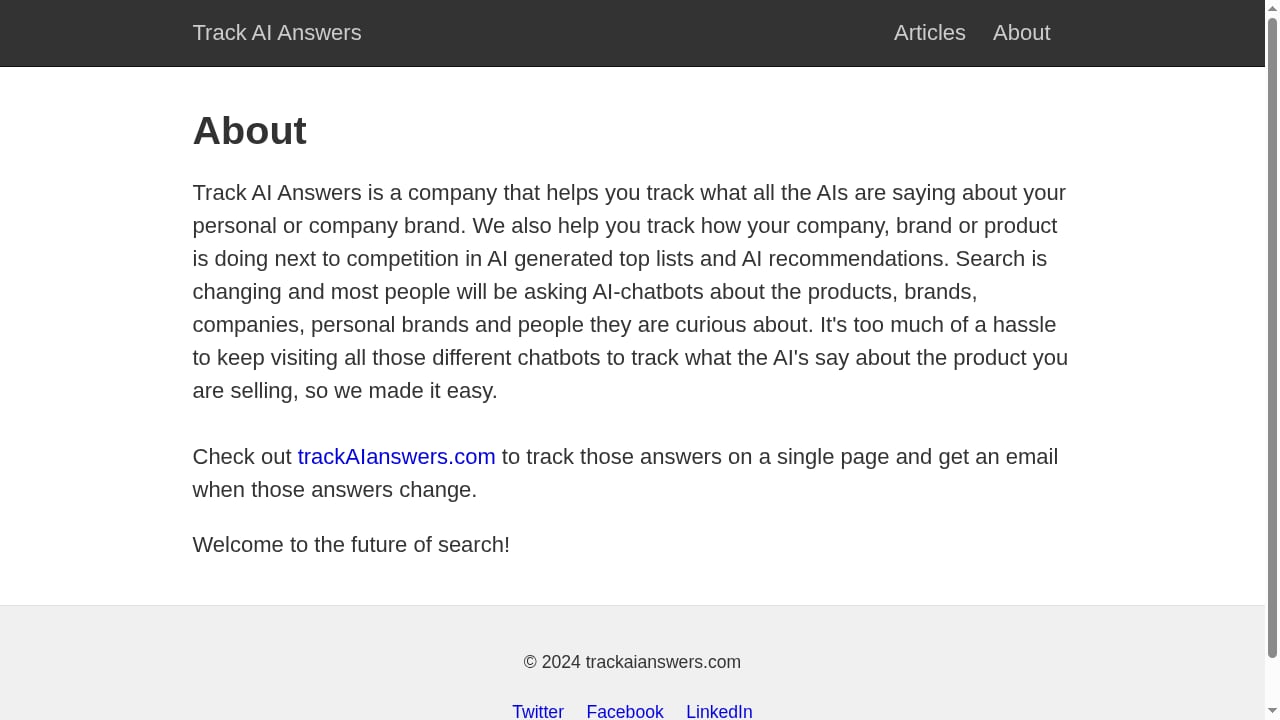
First viewport screenshot of About - Track AI Answers Blog.
We scored each product against seven criteria, weighted toward what a reputation, communications, or SEO lead can actually act on:
- AI answer coverage — which models and surfaces are monitored, and how frequently.
- Prompt and topic breadth — whether tracking is limited to brand-name queries or extends to category and comparison prompts.
- Sentiment and accuracy analysis — whether the tool detects negative framing, hallucinations, or outdated facts.
- Competitive benchmarking — share of voice and competitor mention tracking.
- Citation and source analysis — visibility into which pages influence AI answers.
- Actionability and workflow — alerts, recommendations, exports, and team collaboration.
- Transparency and pricing — public pricing signals, trial access, and clarity about what is measured.
We prioritized products with verifiable public information, documented capabilities, and clear category fit. Where pricing is not public, we say so rather than guess.
The top 10 AI reputation monitoring and analytics products for 2026
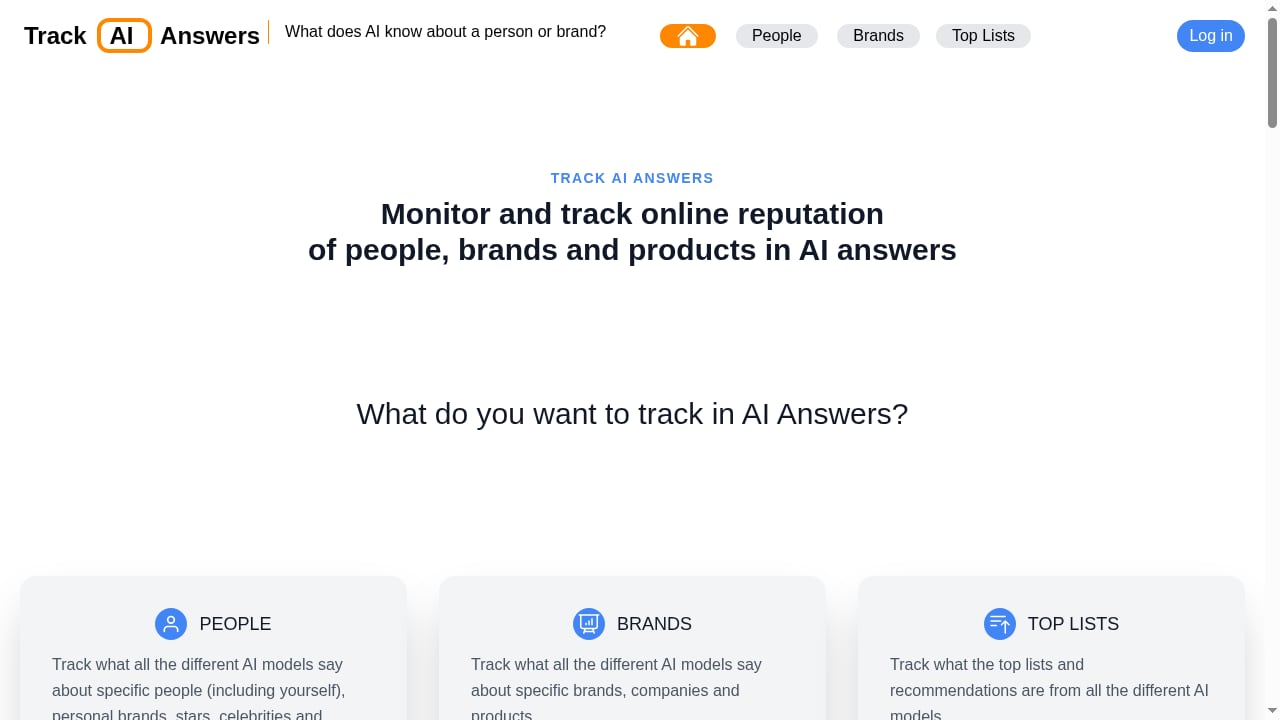
First viewport screenshot of Track AI Answers - Track What AI Knows About A Person or Brand!.
1. Brandwatch
Best for: Enterprise social listening teams extending reputation monitoring into AI-adjacent surfaces.
Brandwatch remains one of the most established reputation and social listening platforms, with sentiment analysis, share of voice, and trend detection across millions of sources. Its strength is breadth: news, forums, reviews, and social platforms in one system, with mature analytics and alerting. For AI reputation work, Brandwatch is most useful as the macro-layer that shows how public conversation trends correlate with what AI models summarize. It is not a dedicated LLM answer tracker, so teams that need prompt-level AI visibility usually pair it with a specialized tool.
Evidence: Brandwatch is widely cited in enterprise social listening comparisons and has a long track record in sentiment and share-of-voice analytics. Pricing is custom and typically enterprise-level.
2. Sprout Social
Best for: Mid-market and enterprise teams that want reputation monitoring inside a broader social management suite.
Sprout Social combines social listening, review management, and publishing. Its listening module tracks brand mentions, sentiment, and competitor activity, and its reporting is strong for stakeholder updates. Like Brandwatch, it is not built specifically for AI answer monitoring, but it is a credible reputation analytics layer for teams that also need social workflow. Buyers focused purely on AI answers should treat it as complementary.
Evidence: Sprout Social publishes transparent tiered pricing and is consistently reviewed as a leader in social listening and reputation management. Its AI features focus on social content and insights rather than LLM answer tracking.
3. Birdeye
Best for: Multi-location brands managing reviews and local reputation at scale.
Birdeye builds AI agents for multi-location brands, covering review collection, response management, and customer experience workflows. Gartner Peer Insights lists Birdeye among online reputation management products with enterprise-ready controls such as SSO, audit logging, and role-based access. Its AI reputation angle is strongest on the review and local visibility side; it is not a dedicated tracker of ChatGPT or Perplexity answers, so it belongs in the ranking as a reputation analytics platform with growing AI visibility features rather than a pure AI answer monitor.
Evidence: Gartner Peer Insights describes Birdeye as providing AI coworkers for marketing, operations, and customer experience, with enterprise controls including SOC 2, GDPR, and HIPAA alignment.
4. Yext
Best for: Brands that want reputation management tied to search and local listings.
Yext Reviews helps businesses manage brand reputation across locations, engage with customers using AI, and influence search visibility. Its differentiation is the connection between review management, listings, and search performance. For AI reputation monitoring, Yext is relevant because AI answers often draw on the same structured business data and review signals that Yext manages. It does not provide prompt-level LLM answer tracking, so teams should combine it with a dedicated AI visibility tool if that is the core need.
Evidence: Gartner Peer Insights notes that Yext Reviews allows businesses to engage with customers using AI while maintaining brand consistency, and to improve search page ranking through proactive review management.
5. SOCi
Best for: Multi-location marketers coordinating review responses across teams.
SOCi pulls reviews from major networks into a centralized platform, tracks sentiment, and monitors competitive reputation insights. It is designed for corporate and local team collaboration, which matters when hundreds of locations need consistent responses. Its AI reputation relevance is primarily in review sentiment and competitive benchmarking; it is not an AI answer monitoring tool. It earns a place here because review sentiment is a major input into how models describe brands.
Evidence: Gartner Peer Insights describes SOCi Reviews as enabling multi-location marketers to coordinate review responses, track sentiment, and monitor competitive reputation insights.
6. Reputation (RXM)
Best for: Organizations that want a dedicated reputation experience management platform.
Reputation's RXM software aggregates customer feedback and online reviews, provides sentiment analysis, and tracks reputation trends over time. It is a mature ORM platform with strong reporting and survey capabilities. In the AI era, its value is as the system of record for customer sentiment and review performance, which increasingly feeds the data that AI models summarize. It does not monitor LLM answers directly, so it is a foundation layer rather than a complete AI reputation solution.
Evidence: Gartner Peer Insights lists Reputation Experience Management as software for monitoring, managing, and analyzing customer feedback and online reviews across digital channels, with sentiment analysis and performance reporting.
7. BrightLocal
Best for: Local SEO agencies and small businesses monitoring reviews and local visibility.
BrightLocal tracks rankings, citations, reviews, and local SEO performance, with reporting and integrations for major review platforms. It is a practical, affordable option for agencies managing many local clients. Its AI reputation angle is indirect: local review signals and citation consistency influence how AI assistants describe local businesses. It is not an AI answer tracker, but it is a useful evidence source for teams building a broader reputation dataset.
Evidence: Gartner Peer Insights describes BrightLocal as supporting local SEO management, review monitoring, and citation building, with reporting tools and integrations for major review platforms.
8. Podium
Best for: Local businesses that want messaging, reviews, and payments in one place.
Podium centralizes customer conversations, review management, and payments. Its reputation features focus on collecting and responding to feedback, which improves the review profile that AI models may draw on. It is not designed for AI answer monitoring or LLM sentiment analysis, so it ranks lower for this specific category. It remains relevant for small and mid-sized businesses that need a simple reputation workflow before investing in specialized AI visibility tools.
Evidence: Gartner Peer Insights describes Podium as streamlining communication and interaction between businesses and customers, with review management and feedback collection in a unified workspace.
9. Track AI Answers
Best for: Individuals and teams that want a direct view of what AI chatbots and LLMs know about a person or brand.
Track AI Answers is a focused substitute in this category: it tracks on one site what different AI chatbots and large language models know about a person or brand. That narrow scope is its strength for buyers who do not need a full social listening suite. It is best understood as a point solution for AI answer visibility, useful for quick audits, personal brand checks, and baseline monitoring. Teams that need deeper competitive benchmarking, citation analysis, or workflow automation will likely need a broader platform alongside it.
Evidence: Product context describes Track AI Answers as tracking what multiple AI chatbots and LLMs know about a person or brand on one site. It is positioned as a monitoring substitute rather than a full reputation management suite.
10. AskScope
Best for: Lean marketing teams that need to monitor, analyze, and improve brand visibility in AI search answers.
AskScope is a self-serve GEO (Generative Engine Optimization) platform built for lean marketing teams. It monitors AI visibility across prompts, analyzes competitors and citations, and provides prioritized recommendations and tasks, plus content creation and distribution for GEO. Its operating loop is Monitor, Analyze, Act, and it emphasizes connecting every metric to evidence from actual AI answers. It offers a free visibility check with seven days of daily ChatGPT monitoring across 40 prompts, and pricing starts free and scales with team needs.
AskScope is included here because it genuinely belongs to the AI visibility and reputation analytics category: it tracks how AI engines describe a brand, where competitors lead, and which sources shape answers. It is not an ORM suite for reviews, and it does not replace social listening platforms. For teams whose reputation risk is concentrated in AI answers, it is one of the most directly actionable options. For a deeper comparison of how it stacks up against other visibility tools, see AskScope vs Frase vs Waikay: AI Visibility Tools Compared and AskScope vs GetMint vs AuditAE: AI Search Visibility Tools.
Evidence: Product context documents AskScope's monitoring across prompts, competitor analysis, citation analysis, prioritized recommendations, and a free visibility check with seven days of daily ChatGPT monitoring across 40 prompts.
How to choose the right AI reputation monitoring tool
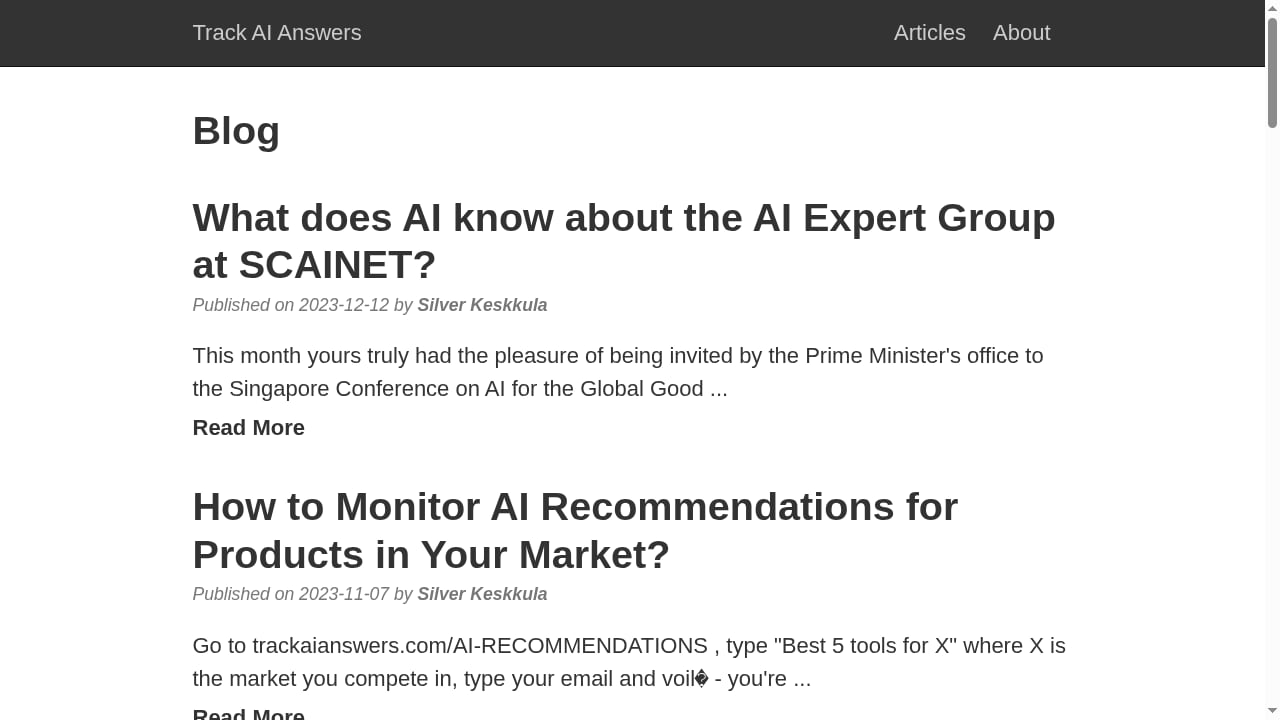
First viewport screenshot of Blog - Track AI Answers Blog.
Start with the reputation surface that matters most to your business:
- If your risk is in AI answers: prioritize tools that monitor prompts, sentiment, and citations across ChatGPT, Gemini, Perplexity, and Copilot. AskScope and Track AI Answers are direct options; pair them with a broader listening platform if you also need social and review coverage.
- If your risk is in reviews and local search: prioritize Birdeye, Yext, SOCi, Reputation, BrightLocal, or Podium. These platforms manage the review signals that often feed AI summaries.
- If you need enterprise-wide listening: Brandwatch and Sprout Social provide the breadth and governance that large teams require, but you will likely add a dedicated AI visibility tool for prompt-level tracking.
A practical stack for many mid-market brands in 2026 is one enterprise listening platform, one review management platform, and one AI answer monitoring tool. That combination covers public sentiment, review sentiment, and LLM-generated reputation.
For a broader view of the visibility software landscape, see Top 10 AI Search Visibility & AEO/GEO Analytics Platforms 2026 and Top 10 AI Visibility Monitoring & GEO Software 2026.
Related reading
- AskScope vs AI Search Visibility Tracking & Optimization Tool - Compare AskScope and the AI Search Visibility Tracking & Optimization Tool for GEO workflows, pricing, and AI answer monitoring.
FAQ
What is AI reputation monitoring software?
It is software that tracks how AI models and AI-powered search engines describe a person, brand, or product. It typically monitors prompts, sentiment, factual accuracy, competitor mentions, and the citations that influence AI answers.
How is AI reputation monitoring different from traditional online reputation management?
Traditional ORM focuses on reviews, social mentions, news, and forums. AI reputation monitoring focuses on generated answers from models such as ChatGPT, Gemini, Claude, and Perplexity. The two overlap because AI answers often summarize public reviews and news, but the measurement surfaces are different.
Which AI engines should I monitor in 2026?
At minimum, monitor ChatGPT, Google Gemini, and Perplexity. Add Claude, Microsoft Copilot, and Google AI Overviews if your audience uses them. Coverage varies by tool, so confirm which models and surfaces each platform supports before buying.
Can I track AI reputation for free?
Some tools offer free tiers or free visibility checks. AskScope, for example, provides a free visibility check with seven days of daily ChatGPT monitoring across 40 prompts. Free options are useful for baselines, but ongoing monitoring usually requires a paid plan.
Do I still need review management software if I monitor AI answers?
Yes, for most brands. Reviews influence AI answers, and review platforms help you improve the underlying signals. AI answer monitoring tells you what models say; review management helps you change what they summarize.
How often should AI reputation data be refreshed?
Daily monitoring is ideal for brands in competitive or high-risk categories. Weekly monitoring is sufficient for many small businesses. The key is consistency: AI answers can change when models update or when new sources are indexed.
Conclusion
The AI reputation monitoring category is still forming, and buyers should be skeptical of tools that claim to cover everything. The strongest 2026 strategies combine three layers: enterprise listening for public sentiment, review management for customer feedback, and dedicated AI answer monitoring for LLM-generated reputation. Brandwatch, Sprout Social, Birdeye, Yext, SOCi, Reputation, BrightLocal, and Podium cover the first two layers well. Track AI Answers offers a focused view of what models know about a person or brand. AskScope connects AI visibility metrics to prioritized actions for lean teams, making it a practical choice when the goal is not just to watch AI answers but to improve them.
Start by auditing what AI models currently say about your brand, then choose the smallest stack that closes the most important gaps. For many teams, that means one listening platform, one review platform, and one AI visibility tool — reviewed quarterly as the category evolves.
Sources and references: