Competitive Insights in AI Search: A GEO Guide
Competitive insights in AI search means understanding which brands AI assistants recommend, which sources they cite, and where your own brand is missing. This guide explains how to gather those insights, benchmark rivals across ChatGPT and Perplexity, and convert findings into concrete GEO actions.
What competitive insights mean in AI search
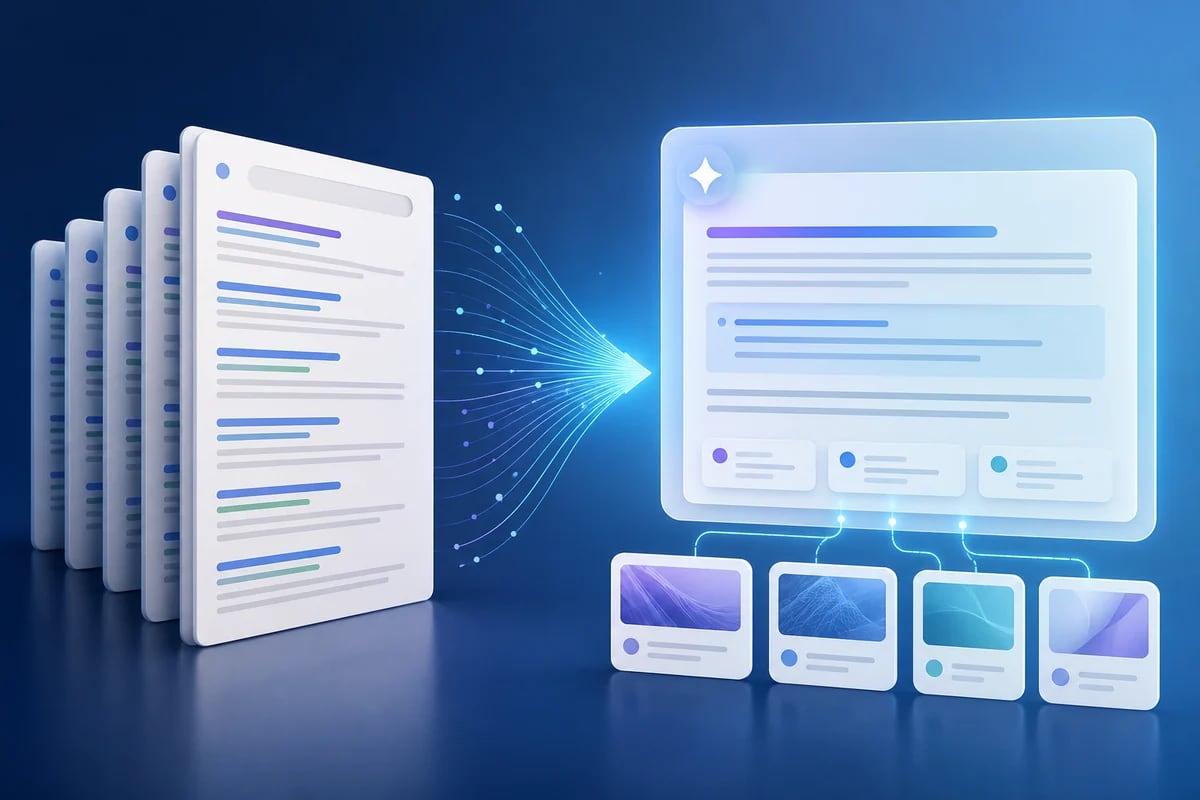
GEO vs. SEO: what changes when the answer replaces the result page.
In traditional search, competitive insights focus on rankings, keywords, and backlinks. In AI search, the unit of competition is the answer. When a buyer asks an assistant for the best tool in your category, the model produces a short list, often with a few sentences of reasoning and a handful of citations. Your competitive insight question becomes: did you appear, in what position, with what framing, and backed by which sources?
This shift matters because AI answers compress the funnel. A single response can validate a vendor, compare alternatives, and link to evidence. If you are absent from that response, you lose the consideration moment entirely, and you may never see it in a rank tracker.
Why AI answers change the competitive picture
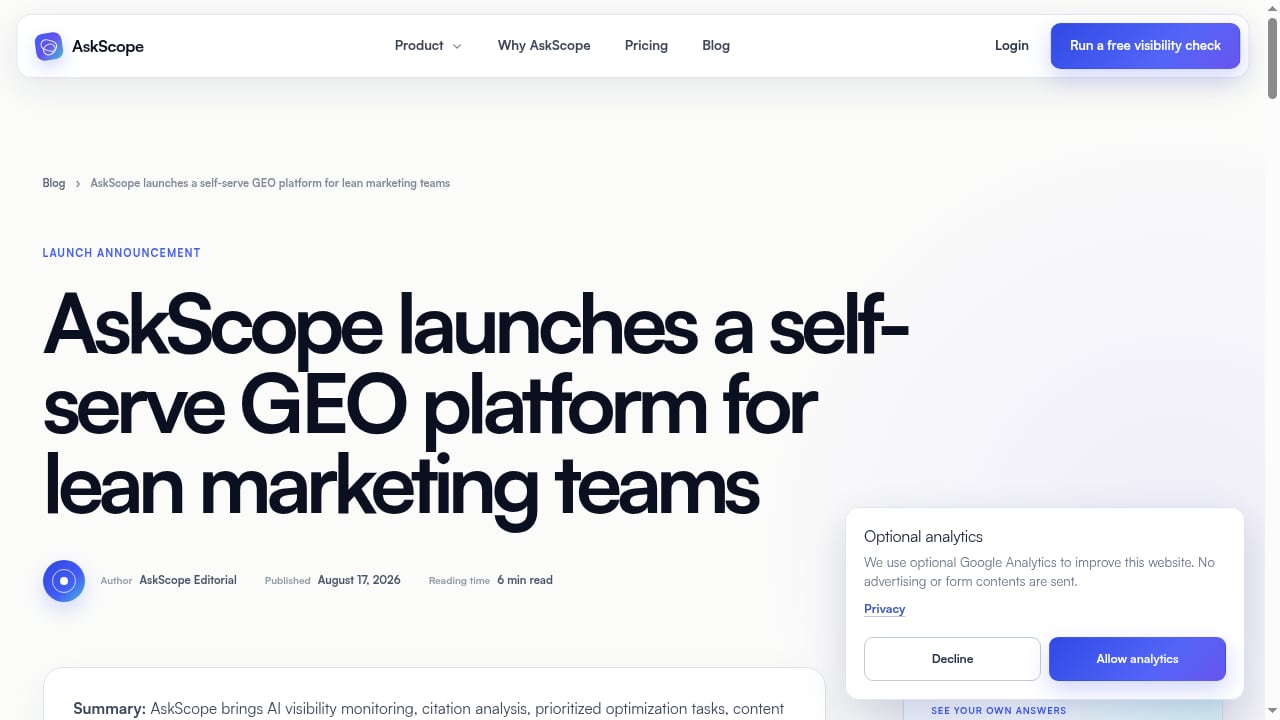
First viewport screenshot of Customers are asking AI. Is your brand in the answer?.
Three structural differences separate AI search from classic SERPs:
- Answers are synthesized, not listed. The model blends sources, so being cited matters as much as being mentioned.
- Prompts are conversational. Buyers ask full questions, which means your visibility depends on how well your content matches natural language intent.
- Results vary by engine and session. ChatGPT, Perplexity, and Google AI answers draw on different retrieval sets and produce different competitor sets.
Because of this, competitive insights in AI search require monitoring prompts rather than keywords, and tracking citations rather than just positions.
The competitive insight questions that actually matter
Before choosing tools, decide what you need to learn. Useful questions include:
- Which competitors appear most often across your priority prompts?
- What sources do AI engines cite when they recommend those competitors?
- Where do you appear, and with what sentiment or framing?
- Which prompts show a gap you can realistically close?
- What content or distribution change would move the answer?
These questions map to a simple loop: monitor answers, analyze gaps, act on evidence.
How to benchmark competitors in ChatGPT and Perplexity
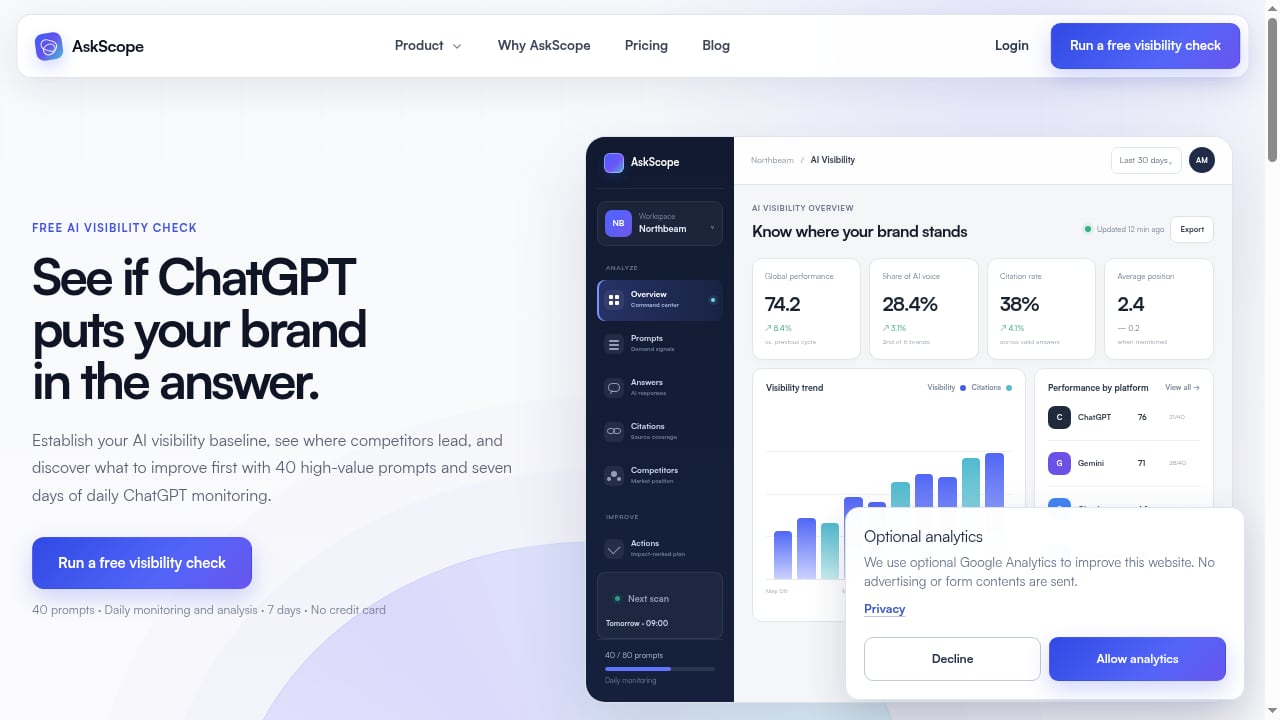
First viewport screenshot of Customers are asking AI. Is your brand in the answer?.
A practical benchmarking process looks like this:
1. Build a prompt set
Write 20 to 40 prompts that reflect real buyer questions in your category. Include branded prompts, category prompts, comparison prompts, and problem-first prompts. For example: "best GEO platform for small marketing teams" or "how do I track brand mentions in ChatGPT."
2. Capture answers on a schedule
Run the same prompts repeatedly. Daily monitoring over a week gives a baseline; longer runs reveal volatility. AskScope, for instance, offers a free visibility check with seven days of daily ChatGPT monitoring across 40 prompts, which is enough to see patterns rather than one-off results.
3. Score presence and position
For each prompt, note whether your brand appears, where it appears in the answer, and which competitors are named. Aggregate this into a share-of-answer metric so you can compare across engines.
4. Trace citations
Citation analysis shows which pages, reviews, and directories the model used. If a competitor is cited from a comparison article you are missing from, that is an actionable gap.
5. Compare engines
Run the same prompt set in ChatGPT, Perplexity, and Google AI answers. Differences often reveal where each engine sources information, which informs where you should publish or update content.
From insights to action: a GEO workflow
First viewport screenshot of Customers are asking AI. Is your brand in the answer?.
Competitive insights only pay off when they change what you publish. A workable workflow:
- Prioritize gaps by impact. Focus on prompts where you are absent but the topic is close to revenue.
- Fix citation gaps first. Getting included in an existing cited source is often faster than creating new content.
- Update or create content. Write pages that directly answer the prompt, with clear structure and evidence.
- Distribute where models look. Reviews, directories, and community threads frequently appear in AI citations.
- Re-measure. Re-run the prompt set and confirm movement before scaling the change.
Tools that connect metrics to evidence make this easier. AskScope, for example, ties scores to actual AI answers and provides prioritized recommendations, which reduces guesswork for lean teams. For a broader view of how platforms compare, see our roundup of AI search visibility and GEO analytics platforms.
Choosing a competitive insights approach
There are three common paths:
| Approach | Best for | Trade-off |
|---|---|---|
| Manual prompt tracking | Very early testing | Time-intensive, hard to scale |
| General SEO suites with AI add-ons | Teams already invested in SEO | AI coverage can be shallow |
| Dedicated GEO platforms | Lean teams needing repeatable monitoring | Requires prompt setup discipline |
If you are comparing dedicated options, our AskScope vs Frase vs Waikay comparison breaks down monitoring, GEO workflows, and pricing. For teams weighing lighter tools, AskScope vs Siftly covers tracking brand mentions across AI engines.
Common pitfalls in AI competitive analysis
- Treating one answer as truth. AI outputs vary; always aggregate over time.
- Ignoring citations. Mentions without citations are fragile.
- Chasing every prompt. Prioritize prompts tied to buying decisions.
- Skipping re-measurement. Without a before-and-after, you cannot prove impact.
For a deeper look at how patent and IP teams use competitive intelligence from structured data, LexisNexis explains how patent analytics reveal competitor strategy. The same principle applies in AI search: structured, repeated observation beats anecdote.
Related reading
- Top 10 AI Reputation Monitoring & Analytics Software 2026 - Compare the top 10 AI reputation monitoring and analytics platforms for 2026. Evidence-based rankings, evaluation criteria, pricing signals, and buying guidance.
- AskScope vs GetMint vs AuditAE: AI Search Visibility Tools - Compare AskScope, GetMint, and AuditAE for AI search visibility. See how each monitors ChatGPT, Perplexity, and Gemini, and which fits lean teams.
Sources and further reading
- Competitive Insights - AI Cost-to-Serve Analytics - efficiently and continuously transforming multiple sources of data into actionable operational insights
- Competitive Insights Platform | Foot Traffic Data - Competitive insights services and platform powered by foot traffic and mobile data. Benchmark competitors and make smarter location decisions today.
FAQ
What are competitive insights in AI search?
They are observations about which brands, sources, and messages appear in AI-generated answers for your priority prompts, and how your brand compares.
How often should I monitor AI answers?
Start with daily monitoring for at least a week to establish a baseline, then adjust frequency based on how volatile your category is.
Can I track competitors without a paid tool?
Yes, manually, but it is slow and hard to scale. Dedicated GEO platforms automate prompt runs and citation tracking.
Which engines should I monitor?
At minimum ChatGPT, Perplexity, and Google AI answers, since each retrieves and cites differently.
What is the fastest competitive insight win?
Closing a citation gap: getting your brand added to a source that AI engines already cite for your category.
Conclusion
Competitive insights in AI search are not about outranking a page. They are about understanding which brands AI assistants trust, which sources shape those answers, and what you can change to earn a place in the response. Build a prompt set, monitor it consistently, analyze citations, and act on the clearest gaps first. That loop is the practical core of GEO, and it is how lean teams turn AI visibility from a mystery into a measurable channel.